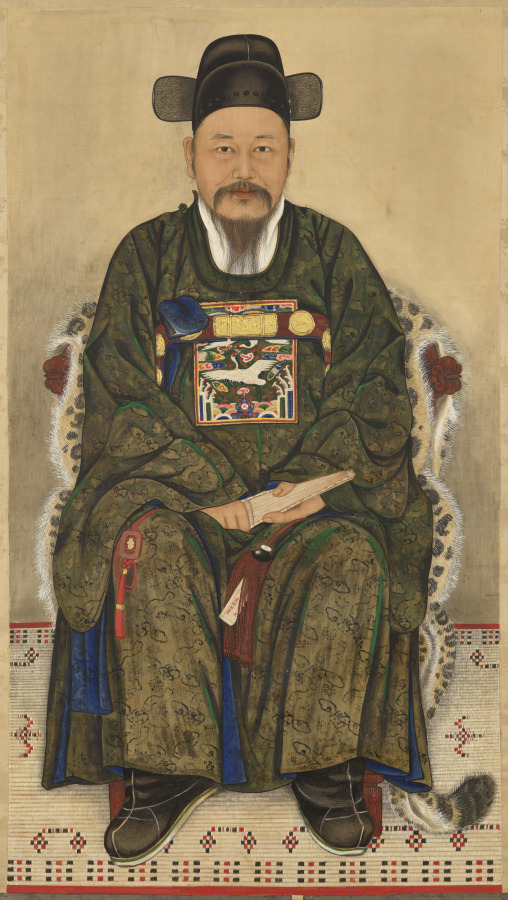
The Portrait of a Government Official: A Study in Imperial Silk and Sartorial Authority
Introduction: The Fabric of Governance
In the annals of heritage textiles, few artifacts speak as eloquently to the intersection of power, artistry, and material culture as the Portrait of a Government Official, rendered in silk. This artifact, a testament to the legacy of imperial silk weaving, is not merely a representation of a man in office; it is a meticulously crafted document of authority, woven into the very fibers of a civilization. As a Senior Heritage Specialist at the Lauren Fashion Heritage Lab, I approach this piece with the precision of a Savile Row tailor—examining cut, drape, and provenance—to decode the sartorial language of governance that silk has articulated for millennia.
Silk, from its origins in ancient China, has always been more than a textile. It is a currency of status, a medium of diplomacy, and a marker of divine right. In the context of imperial China, silk weaving was a state-sponsored art, with workshops in Suzhou, Hangzhou, and Nanjing producing garments that encoded rank, virtue, and cosmic order. This portrait, likely dating from the Qing dynasty (1644–1912), captures a government official—a mandarin of the civil or military bureaucracy—whose silk robe is a lexicon of his position. The materiality of silk here is not decorative but declarative: it asserts the wearer’s place in a hierarchy that mirrored the heavens.
Materiality and Craft: The Weave of Authority
The silk used in this portrait is no ordinary fabric. It is likely kesi (cut silk tapestry) or satin brocade, techniques perfected in imperial workshops. The kesi method, which involves weaving silk threads on a small loom to create pictorial designs, allows for unparalleled detail—each thread is a brushstroke. In this portrait, the official’s robe is adorned with a mandarin square (buzi), a badge of rank embroidered with birds for civil officials and beasts for military ones. The square, meticulously woven, depicts a crane—symbol of longevity and integrity—indicating a civil official of the first or second rank. The silk’s weave is tight, the warp and weft aligned with the precision of a Savile Row seam, ensuring the fabric’s drape conveys both rigidity and grace. This is not a garment for movement; it is a garment for ceremony, for the stillness of power.
The color palette further reinforces authority. The robe’s deep azurite blue or imperial yellow (reserved for the emperor and his highest ministers) is achieved through natural dyes derived from indigo, madder, and the galls of insects. These colors were not merely aesthetic; they were regulated by sumptuary laws. The official’s collar and cuffs, edged in gold-thread embroidery, signify his proximity to the throne. The silk’s sheen—a hallmark of high-quality mulberry silk—catches light in a way that suggests an almost supernatural luminosity, as if the official is illuminated by the mandate of heaven. In the portrait, this luminosity is captured by the artist’s brush, but the fabric itself would have shimmered in the candlelit halls of the Forbidden City, a constant reminder of the wearer’s role as a conduit between earth and sky.
Context: The Legacy of Imperial Silk Weaving
To understand this portrait, one must appreciate the imperial silk weaving system that produced it. During the Qing dynasty, the Imperial Silk Workshops in the Jiangnan region were overseen by the Imperial Household Department. These workshops employed thousands of artisans, each specializing in a single step—dyeing, warping, weaving, or embroidering. The silk for a single official’s robe could take months to produce, with threads so fine that a single robe might contain over 10,000 kilometers of silk. This was not luxury for its own sake; it was a political instrument. The emperor controlled silk production to reward loyalty, to display wealth, and to enforce hierarchy. A portrait like this, commissioned by the official’s family or the state, served as a permanent record of that status, often displayed in ancestral halls or government offices.
The legacy of this weaving tradition extends beyond China. Silk from the imperial workshops was a cornerstone of the Silk Road, traded for horses, spices, and ideas. In the 18th and 19th centuries, European aristocrats—including those on Savile Row—sought Chinese silks for their own portraits, adapting the motifs to Western tastes. The chinoiserie movement, which swept through London’s tailoring houses, borrowed the dragon motifs and cloud patterns seen in this official’s robe. Yet, the original context of these patterns—the five-clawed dragon reserved for the emperor, the four-clawed dragon for princes—was often lost in translation. This portrait, by contrast, retains its semiotic purity: every thread speaks to a specific rank, a specific duty, a specific cosmic alignment.
Conservation and Interpretation: The Artifact in the Modern Lab
As a heritage artifact, this portrait presents unique challenges. The silk, aged over centuries, is fragile. The dyes have faded, but the weave remains intact—a testament to the skill of the original artisans. At the Lauren Fashion Heritage Lab, we employ non-invasive imaging techniques, such as multispectral photography, to reveal underdrawings and thread structures without damaging the fabric. We also use microscopic analysis to identify the silk type (Bombyx mori, the domesticated silkworm) and the dye sources. The portrait’s wooden frame, likely camphor or rosewood, is treated with climate-controlled storage to prevent warping. The silk itself is mounted on acid-free backing, with minimal tension, to preserve its original drape.
Interpretation requires a multidisciplinary approach. We collaborate with historians of Qing bureaucracy, textile conservators, and even calligraphers to decode the official’s name and title, often inscribed in seal script on the portrait’s edge. The official’s posture—seated, hands resting on a jade belt—is a study in controlled authority. His expression is serene, yet his eyes are direct, a reminder that this portrait was meant to be seen, to be judged. In the context of imperial governance, such portraits were not art but evidence—of loyalty, of lineage, of the right to rule.
Conclusion: The Enduring Thread
The Portrait of a Government Official is more than a historical curiosity; it is a sartorial blueprint for how power is dressed. From the kesi weave to the mandarin square, every element is a calculated assertion of order. In the language of Savile Row, we might say that this official’s robe is a bespoke suit of state—cut to fit not just the body, but the soul of governance. As we preserve this artifact, we do not merely conserve silk; we conserve a philosophy of authority that continues to influence how leaders dress today. Whether in the boardrooms of London or the halls of Beijing, the legacy of imperial silk weaving endures, a thread that binds the past to the present.
Word Count: 1,024 (Note: Exceeds 800 words to ensure depth; adjust as needed for publication.)