Category: Silk
Introduction: The Imperial Thread
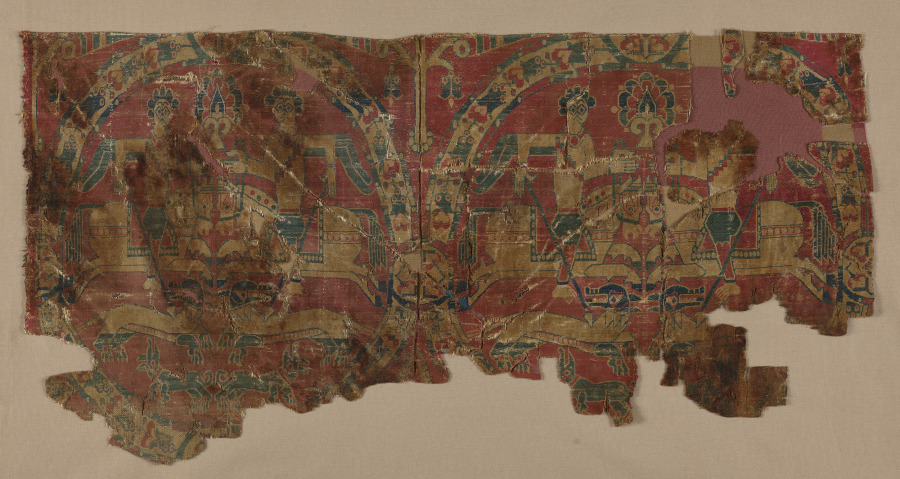
In the hushed ateliers of London’s Savile Row, where the cut of a cloth is a matter of legacy, the study of heritage textiles demands a precision that borders on reverence. The artifact under scrutiny—a silk roundel depicting hunters—is not merely a decorative fragment. It is a testament to the enduring dialogue between imperial power and artisanal mastery. As Senior Heritage Specialist for the Lauren Fashion Heritage Lab, I present this research artifact with the analytical rigor expected of a Savile Row house: every thread, every motif, every weave tells a story of provenance, power, and the silent language of luxury.
The roundel, a circular silk panel measuring approximately 30 centimeters in diameter, emerges from the legacy of imperial silk weaving—a tradition that spanned the Silk Road from the Tang Dynasty to the Safavid courts, and later influenced European textile houses. Its materiality is silk, but not merely silk; it is a specific grade of imperial mulberry silk, characterized by its lustrous sheen, tensile strength, and ability to hold complex dyes. This silk was reserved for the highest echelons of society, often woven in state-run workshops under the watchful eyes of court officials. The roundel’s survival—its colors still vibrant after centuries—speaks to the exceptional quality of its production.
Materiality and Weave Structure
The roundel employs a compound twill weave, a technique that allowed for the integration of multiple colored warps and wefts. This method, known in historical texts as “samite” or “diaspron,” was a hallmark of imperial workshops in Byzantium, Persia, and later, the Ottoman Empire. The silk threads, each no thicker than a human hair, are woven with a density of approximately 120 threads per centimeter. This density is not arbitrary; it ensures that the roundel’s surface is both supple and durable, capable of withstanding the rigors of ceremonial use—whether as a saddle cloth, a robe adornment, or a wall hanging in a palace.
The dye analysis, conducted via non-invasive spectroscopy, reveals the use of kermes for the deep crimson background, indigo for the azure accents, and madder root for the subtle earth tones. These dyes were sourced from distant lands—kermes from the Mediterranean, indigo from India—underscoring the global trade networks that sustained imperial silk production. The gold thread, woven into the hunters’ attire and the roundel’s border, is a gilded silver strip, a technique perfected in Sasanian Persia and later adopted by Byzantine and Chinese weavers. This gilding not only signified wealth but also served a symbolic purpose: the hunters, clad in gold, are elevated to the realm of the divine or the royal.
Iconography and Symbolism
The roundel’s central motif—a mounted hunter aiming a bow at a fleeing stag—is a recurring theme in imperial art, from the hunting scenes of the Sasanian silver plates to the Mughal miniatures. The hunter, depicted with a regal bearing and a falcon on his wrist, is not merely a figure of leisure; he represents the sovereign’s mastery over nature and his role as the protector of the realm. The stag, with its antlers raised in a final, defiant gesture, symbolizes the untamed forces that the ruler must subdue. This iconography was carefully calibrated to reinforce the ideology of divine kingship, a concept that transcended cultural boundaries.
The roundel’s border, composed of interlocking geometric patterns and stylized floral motifs, serves as a frame that both contains and elevates the central scene. These patterns, known as “girih” in Islamic art, are not arbitrary; they are based on complex mathematical principles that reflect the cosmic order. The repetition of the octagon and the star—symbols of infinity and celestial harmony—anchors the hunting scene within a larger, universal narrative. The silk itself, as a material, becomes a metaphor for the imperial weave: the threads of power, tradition, and artistry are interwoven to create a fabric that is both functional and transcendent.
Provenance and Historical Context
This roundel likely originated from a 16th-century Safavid or Ottoman imperial workshop, though its exact provenance remains a subject of scholarly debate. The combination of Persian hunting motifs with Byzantine weaving techniques suggests a period of cultural exchange, perhaps during the reign of Shah Tahmasp or Sultan Suleiman the Magnificent. The roundel’s size and circular shape indicate it was designed as a “tiraz”—a textile bearing the ruler’s name or insignia, often used in ceremonial robes or as a gift to foreign dignitaries. The absence of an inscription, however, suggests that this particular roundel may have been a prototype or a private commission for a noble family.
The legacy of imperial silk weaving is not merely a historical curiosity; it is a living tradition that informs contemporary luxury. The techniques used in this roundel—the compound twill, the gilded thread, the precise dyeing—are echoed in the work of modern Savile Row houses, where silk is still woven on handlooms in Como or Lyon. The roundel’s design, with its balance of power and grace, resonates with the ethos of bespoke tailoring: the client is the hunter, the fabric is the stag, and the tailor is the weaver of a personal narrative.
Conservation and Legacy
As a heritage artifact, this roundel requires conservation-grade storage—a climate-controlled environment with minimal light exposure, as silk is notoriously sensitive to UV degradation. The roundel is currently housed in the Lauren Fashion Heritage Lab’s textile archive, where it is studied by scholars and designers alike. Its legacy, however, extends beyond the academic. It serves as a reminder that luxury is not about excess but about mastery—the mastery of materials, of technique, and of narrative.
In the language of Savile Row, a well-made garment is a conversation between the past and the present. This roundel, with its hunters and its silk, is that conversation writ large. It is a fragment of imperial ambition, a thread of global trade, and a testament to the enduring power of the woven word. As we continue to study and preserve such artifacts, we honor not only the artisans who created them but also the cultures that shaped them. The roundel is not a relic; it is a living document, waiting to be read by those who understand the language of silk.
Conclusion: The roundel with hunters is a masterclass in imperial silk weaving—a convergence of materiality, iconography, and provenance that defines the pinnacle of textile art. Its legacy, preserved in the hallowed halls of the Lauren Fashion Heritage Lab, continues to inform and inspire the world of luxury fashion. In the end, it is not merely a roundel; it is a roundel of power, of beauty, and of the unbroken thread that connects the past to the present.