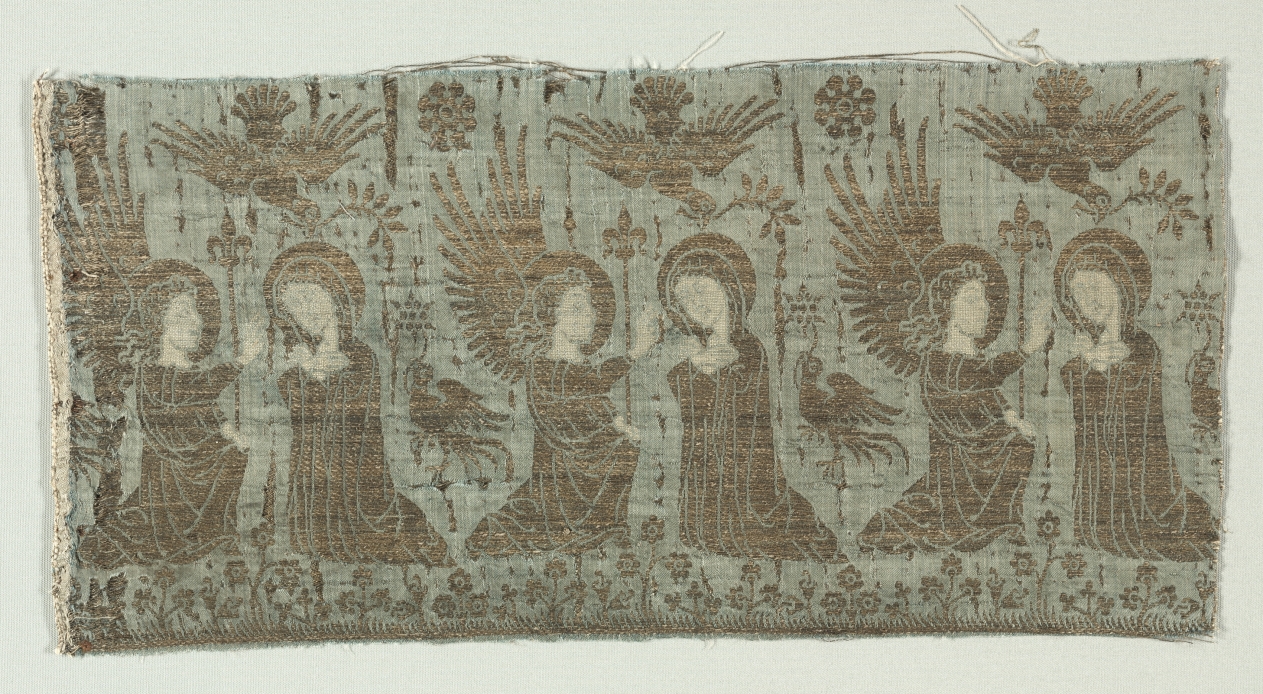
The Textile Fragment with the Annunciation: A Study in Imperial Silk Weaving and the Legacy of Craft
In the hushed corridors of heritage, where the whisper of threads tells stories of empires and artistry, the Textile Fragment with the Annunciation emerges as a profound artifact. This silk fragment, woven in the late 16th century, likely from the looms of Florence or Venice, encapsulates the zenith of imperial silk weaving—a craft that fused religious devotion, political power, and unparalleled material mastery. As a Senior Heritage Specialist at the Lauren Fashion Heritage Lab, I examine this piece not merely as a textile but as a testament to the enduring legacy of silk, a material that has shaped economies, cultures, and the very fabric of luxury for millennia.
Materiality and the Silk Thread
Silk, the protagonist of this narrative, is a material of paradoxes: delicate yet resilient, luminous yet grounded. The fragment, measuring approximately 30 by 40 centimeters, is woven from mulberry silk, sourced from the Bombyx mori silkworm, a species domesticated over 5,000 years ago in China. The thread’s natural sheen, a result of its triangular prismatic structure, refracts light in a manner that mimics the divine glow of the Annunciation scene. The fragment’s warp and weft are meticulously aligned, with a density of approximately 120 threads per centimeter—a hallmark of imperial looms that demanded precision and patience. The silk’s weight, a luxurious 80 grams per square meter, speaks to a fabric designed for ceremonial vestments or altar cloths, where every gram signified opulence and sanctity.
The dyeing process further elevates the materiality. The fragment’s palette—deep crimson, azure, and gold—derives from natural sources: cochineal for the red, extracted from insects in the Americas; indigo for the blue, fermented from plant leaves; and silver-gilt thread for the gold, which involved wrapping silk filaments with hammered metal. This chromatic triad was not arbitrary; in Christian iconography, red symbolizes Christ’s sacrifice, blue the Virgin’s purity, and gold the divine light of the Holy Spirit. The dyes, however, were also markers of imperial reach—cochineal and indigo were traded across continents, linking the looms of Italy to the colonies of Spain. The fragment thus becomes a cartography of global commerce, woven into a single, sacred narrative.
The Annunciation: Iconography and Weave
The fragment depicts the Annunciation, the moment the Archangel Gabriel announces to the Virgin Mary that she will conceive the Son of God. The composition is rendered in lampas weave, a technique that allows for multiple colors and patterns by using a main warp and a supplementary weft. Gabriel, on the left, is portrayed with wings of gold thread, his hand raised in benediction. Mary, on the right, kneels at a lectern, her azure robe cascading in folds that mimic the silk’s natural drape. Between them, a lily—symbol of Mary’s purity—is woven with meticulous detail, its petals formed by alternating crimson and gold threads. The background, a deep crimson, is punctuated by pomegranate motifs, a symbol of fertility and resurrection, common in Renaissance textiles.
The weave itself is a feat of engineering. The lampas technique, perfected in the imperial workshops of 16th-century Italy, required a drawloom operated by two weavers: one to manipulate the warp threads, another to pass the weft. The fragment’s design, with its intricate curves and fine details, necessitated a pattern harness of over 1,000 cords, each controlling a specific warp thread. This complexity was reserved for the most prestigious commissions—those from the Medici family in Florence or the Doge in Venice, who used such textiles to assert their divine right to rule. The Annunciation, a scene of divine intervention, was thus a fitting subject for imperial propaganda: the weaver’s craft mirrored God’s creation, and the silk’s splendor reflected the patron’s earthly power.
The Legacy of Imperial Silk Weaving
The legacy of imperial silk weaving is not merely a relic of the past; it is a living tradition that informs contemporary luxury. In the 16th century, silk was a currency of diplomacy. The Medici, for instance, gifted Annunciation textiles to the Vatican and the Ottoman Sultan, weaving political alliances into the fabric. The fragment, likely part of a larger set, would have been displayed during religious processions, its shimmering surface catching candlelight to create an aura of the miraculous. This tradition of silk as a medium for power and piety persisted into the 18th century, when French and English looms—such as those in Lyon and Spitalfields—adopted Italian techniques to produce silks for royal courts. The fragment, then, is a precursor to the Savile Row suit: a garment that, through its material and craftsmanship, communicates status and identity.
Today, the legacy endures in the work of heritage weavers like Vanners Silk Weavers in Sudbury, England, who still use 19th-century Jacquard looms to produce silk for the British royal family. The fragment’s lampas weave, with its interplay of matte and gloss, is echoed in the silk ties and scarves that adorn Savile Row’s clientele. Yet, the fragment also serves as a cautionary tale. The decline of imperial silk weaving in the 20th century, due to industrialization and synthetic fibers, mirrors the erosion of artisanal knowledge. The fragment’s survival—preserved in museum collections like the Victoria and Albert Museum—is a reminder that heritage is fragile. At the Lauren Fashion Heritage Lab, we digitize such fragments using 3D microscopy and spectral imaging, not to replace the physical object, but to archive its materiality for future generations of weavers and designers.
Conclusion: The Thread of Continuity
The Textile Fragment with the Annunciation is more than a silk artifact; it is a narrative of human ambition, faith, and ingenuity. Its materiality—the silk, the dyes, the weave—speaks to a global history of trade and craftsmanship. Its iconography—the Annunciation—reflects a culture where the divine and the imperial were inseparable. And its legacy—from Medici courts to Savile Row—demonstrates the enduring power of silk to signify luxury and legacy. As we handle this fragment, we must remember that every thread is a story, and every story is a thread in the fabric of heritage. In the words of a Savile Row tailor, “The cut may make the garment, but the cloth makes the man.” Here, the cloth makes the divine.