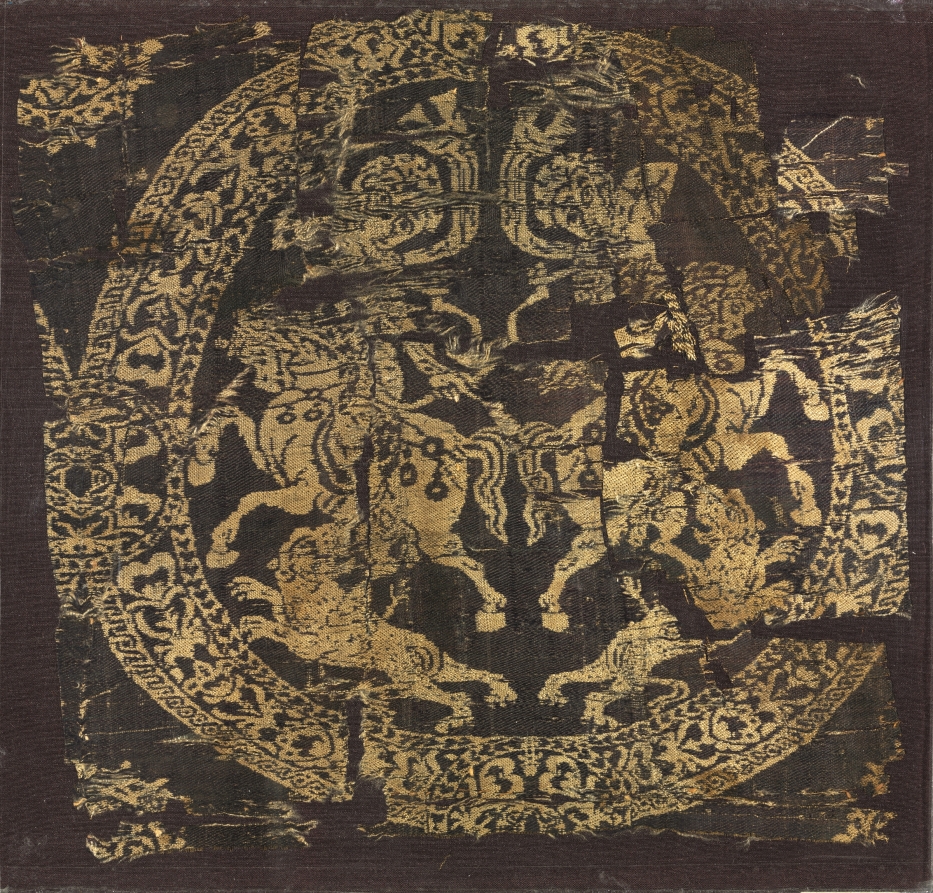
The Roundel with Amazons: A Study in Imperial Silk Weaving and the Legacy of Power
In the hushed, paneled rooms of London’s Savile Row, where the weight of a cloth is measured not merely in ounces but in centuries of craft, the Roundel with Amazons from a Late Antique tunic stands as a profound artifact. This silk fragment, woven in the Eastern Roman Empire—likely in Constantinople or Alexandria—between the 5th and 7th centuries, is more than a decorative patch. It is a testament to the imperial silk weaving legacy, a material narrative of power, mythology, and the unbroken thread of luxury that connects the Roman purple to the bespoke tailoring of today. The roundel, a circular medallion originally sewn onto a tunic’s shoulder or hem, depicts Amazon warriors in dynamic combat, their forms rendered in vibrant, undyed silk and deep, madder-dyed reds. Its materiality—silk—is the first and most critical clue to its significance.
The Materiality of Silk: Imperial Monopoly and Global Trade
Silk in the Late Antique world was not merely a textile; it was a currency of empire. The Roundel with Amazons was woven from raw silk filaments imported along the Silk Road from China, a journey of thousands of miles through Sogdian, Persian, and Byzantine intermediaries. By the 6th century, the Byzantine Emperor Justinian I had established state-controlled silk workshops (gynaikia) in Constantinople, effectively monopolizing the production of high-grade silk textiles. This roundel, therefore, was not a casual purchase. It was a product of imperial infrastructure, likely commissioned for a high-ranking military or court official. The silk’s warp-faced compound weave—a technique called samit—allowed for intricate, polychrome designs, with the Amazon figures rendered in a tapestry-like precision that required master weavers. The material’s sheen, its ability to absorb and reflect light, and its tactile softness were markers of status. In a world where wool and linen were common, silk was the exclusive domain of the elite, a fabric that whispered of distant lands, state power, and the divine right of emperors.
The roundel’s survival is itself a miracle of material resilience. Silk, unlike wool, is a protein fiber that can degrade under humidity and light. Yet this fragment endured, likely preserved in a dry, temperate tomb or a monastic treasury in Egypt, where the dry climate acted as a natural archive. The silk’s structural integrity speaks to the quality of imperial weaving: the threads are evenly spun, the dyes—madder for red, woad or indigo for blue, and undyed cream for flesh tones—are fast, resisting fading for over a millennium. This is not a textile of expediency; it is a textile of permanence, designed to outlast its wearer.
The Iconography of Amazons: Power, Gender, and Imperial Ideology
The choice of Amazons—mythological warrior women from Scythian lore—is no accident. In Late Antique art, Amazons were not merely exotic figures; they were symbols of conquered chaos. The Romans, and later the Byzantines, frequently used Amazonomachies (battles with Amazons) to allegorize the triumph of civilization over barbarism, order over anarchy. On a tunic worn by a Roman or Byzantine official, the roundel with Amazons would have functioned as a visual declaration of imperial might. The Amazons, often depicted in dynamic, twisting poses, their limbs splayed in combat, represent the wild, untamed forces that the empire had subdued. The roundel’s circular format—a clipeus or shield-like medallion—reinforces this martial theme, evoking the round shields of Roman legionaries. The silk, soft yet strong, becomes a metaphorical armor.
Yet the iconography also carries a nuanced, almost subversive layer. Amazons, as female warriors, challenge traditional gender roles. In a patriarchal society, their depiction on a man’s tunic could be read as a fetishization of female power, a visual containment of the feminine threat. The roundel’s placement on the shoulder—the site of strength and authority—suggests a talismanic quality. The wearer, by donning this silk, absorbs the Amazon’s ferocity while simultaneously asserting his dominance over it. This duality is a hallmark of imperial silk weaving: the fabric is both a trophy and a tool of identity.
The Legacy of Imperial Silk Weaving: From Constantinople to Savile Row
The Roundel with Amazons is not a relic of a dead art; it is a living document of a craft that has evolved but never vanished. The imperial silk weaving legacy—with its emphasis on state-controlled production, high-quality materials, and narrative design—directly informs the ethos of London’s Savile Row. Consider the parallels: a Savile Row tailor, like a Byzantine weaver, works with a client to create a garment that is both functional and symbolic. The silk used in a bespoke suit today—often sourced from mills in Como, Italy, or Lyons, France—is the direct descendant of the silk that flowed through Constantinople. The same attention to thread count, weave density, and dye fastness that defined the roundel is present in a Huntsman or Anderson & Sheppard jacket. The roundel’s iconography, too, finds an echo in the heraldic linings, monograms, and pocket squares that define modern bespoke tailoring. A client chooses a silk lining with a subtle pattern—a houndstooth, a paisley, a crest—to project an identity, just as a Byzantine official chose an Amazon roundel to project power.
Moreover, the roundel’s survival underscores a key principle of heritage: materiality as memory. Silk, when properly cared for, can endure for centuries. A Savile Row suit, if stored correctly, can be passed down through generations. The roundel, now housed in institutions like the Victoria and Albert Museum or the Dumbarton Oaks Collection, is a reminder that luxury is not ephemeral. It is a long-term investment in craft, in narrative, in the self. The imperial silk weaving legacy, from the looms of Constantinople to the cutting tables of Savile Row, is a continuum of excellence. The roundel’s Amazons, frozen in their eternal combat, are not just warriors; they are guardians of a tradition that values precision, power, and the enduring allure of silk.
Conclusion: The Thread of Empire
The Roundel with Amazons is a microcosm of the imperial silk weaving legacy. Its materiality—silk—speaks to global trade, state monopoly, and the pursuit of luxury. Its iconography—Amazons in combat—reflects imperial ideology, gender dynamics, and the visual language of power. Its survival—a fragment of a tunic, preserved for over a millennium—testifies to the durability of craft. For the modern connoisseur, whether a historian or a client of Savile Row, this roundel offers a lesson: that the finest textiles are not merely worn; they are inhabited. They carry the weight of empire, the stories of myth, and the promise of permanence. In the quiet, bespoke world of London tailoring, where every stitch is a decision, the Roundel with Amazons remains a silent, silk-bound testament to the art of weaving power into cloth.