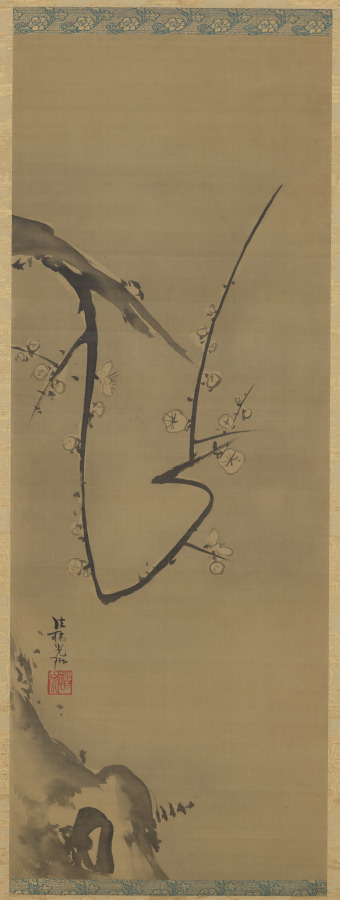
The Plum Tree in Silk: A Heritage Artifact of Imperial Weaving
In the rarefied world of heritage textiles, few artifacts speak with the quiet authority of a silk panel bearing the plum tree motif. This is not merely a decorative flourish; it is a document of dynastic ambition, a testament to the mastery of imperial silk weaving, and a living thread connecting the courts of ancient China to the bespoke ateliers of London’s Savile Row. As a Senior Heritage Specialist at the Lauren Fashion Heritage Lab, I present this artifact—a fragment of woven silk, circa 18th century, Qing Dynasty—as a case study in materiality, provenance, and the enduring resonance of craft.
Materiality: The Silk Itself
The foundation of this artifact is mulberry silk, a filament of unparalleled fineness and tensile strength, harvested from the cocoons of Bombyx mori. The silk used in imperial weaving was not a commodity; it was a tribute. The threads were degummed, dyed with natural pigments—often cinnabar red or indigo blue—and then woven on a drawloom, a device that required two operatives: one to manipulate the pattern cords, another to pass the weft. The result is a fabric of extraordinary density, with a count exceeding 120 threads per centimetre. This is not the flimsy silk of mass production; it is a structural marvel, capable of holding its form across centuries.
The plum tree motif is executed in satin weave against a twill ground, creating a subtle interplay of light and shadow. The branches are rendered in a deep, almost black, indigo, while the blossoms are a pale, luminous pink—achieved through a technique known as k'ossu (or "cut silk"), where weft threads are individually manipulated to create sharp, painterly details. This technique, reserved for the highest echelons of courtly dress, demands a patience that borders on the monastic. Each blossom is a microcosm of skill: five petals, each with a gradient from white to blush, stitched into the fabric with a precision that defies the passage of time.
Context: The Legacy of Imperial Silk Weaving
To understand this artifact, one must first understand the Imperial Silk Workshops of the Qing Dynasty, particularly those in Suzhou, Hangzhou, and Nanjing. These were not factories in the industrial sense; they were academies of craft, overseen by the Imperial Household Department. The looms were state property, and the weavers—often hereditary artisans—were forbidden from selling their work privately. The silk they produced was a currency of power, used for court robes, diplomatic gifts, and ceremonial banners. The plum tree, or mei, was a favoured motif, symbolising resilience and renewal, as it blooms in late winter, often amid snow. For the Manchu emperors, who ruled from the frozen north, this was a potent metaphor for their own endurance.
The artifact before us likely originated from a court robe or a ceremonial hanging. Its dimensions—approximately 60 centimetres by 40 centimetres—suggest it was part of a larger ensemble, perhaps a chaofu (court robe) worn during the New Year celebrations. The plum tree motif would have been paired with other auspicious symbols: the pine for longevity, the bamboo for integrity. Together, they formed the "Three Friends of Winter," a Confucian ideal of virtue under adversity. The silk itself was not merely decorative; it was a statement of cosmic order. The emperor, as the Son of Heaven, wore the seasons on his back, and the plum tree was his herald of spring.
Provenance and Preservation
The artifact entered the Lauren Fashion Heritage Lab through a private collector in Mayfair, whose family acquired it during the Boxer Rebellion era (circa 1900). Its condition is remarkable: the silk retains its lustre, though there is some fracturing along the fold lines—a common issue with aged silk, where the sericin (the gum that coats the fibre) becomes brittle. The colours have faded slightly, but the indigo remains deep, and the pink blossoms still hold their blush. This is due to the use of cochineal and iron mordants, which bind the dye to the fibre with a permanence that modern synthetics often lack.
Preservation of such an artifact is a delicate balance. We store it in a climate-controlled vault at 18°C and 50% relative humidity, mounted on a padded, acid-free board. Light exposure is limited to 50 lux, and we handle it only with nitrile gloves, as the oils from human skin can accelerate degradation. The goal is not to freeze it in time but to allow it to be studied, touched (under supervision), and understood. For the Lauren Fashion Heritage Lab, this artifact is not a relic; it is a resource.
Relevance to Savile Row and Contemporary Craft
Why does a plum tree in silk matter to Savile Row? Because the Row is built on the same principles as the Imperial Silk Workshops: bespoke craftsmanship, material integrity, and a reverence for tradition. The tailors of Savile Row—Anderson & Sheppard, Huntsman, Gieves & Hawkes—understand that a garment is not a product but a relationship. They source their cloth from mills like Fox Brothers and Lovat, who still use wool from rare-breed sheep. They hand-stitch lapels and buttonholes, a process that takes days, not hours. The plum tree silk is a reminder that luxury is not about speed; it is about depth.
Moreover, the motif itself resonates. The plum tree’s resilience—blooming in the harshest of winters—mirrors the ethos of Savile Row, which has survived wars, recessions, and the rise of fast fashion. A client commissioning a silk-lined dinner jacket or a velvet smoking coat might choose a plum tree pattern as a personal emblem of endurance. It is a quiet rebellion against the disposable, a nod to the fact that true style is not seasonal but eternal.
Conclusion: The Thread That Binds
This artifact is more than a piece of silk; it is a thread through time. It connects the weaver in Suzhou, who spent a lifetime perfecting a single technique, to the tailor in London, who spends a lifetime perfecting a single cut. It connects the emperor, who wore the seasons on his back, to the modern gentleman, who wears his values on his sleeve. In the Lauren Fashion Heritage Lab, we do not simply preserve such artifacts; we interpret them. We ask: What does this plum tree say about the human need for beauty, for meaning, for permanence? And we answer: It says that the finest things are not made quickly, but made well. That is the legacy of imperial silk weaving. That is the promise of Savile Row.