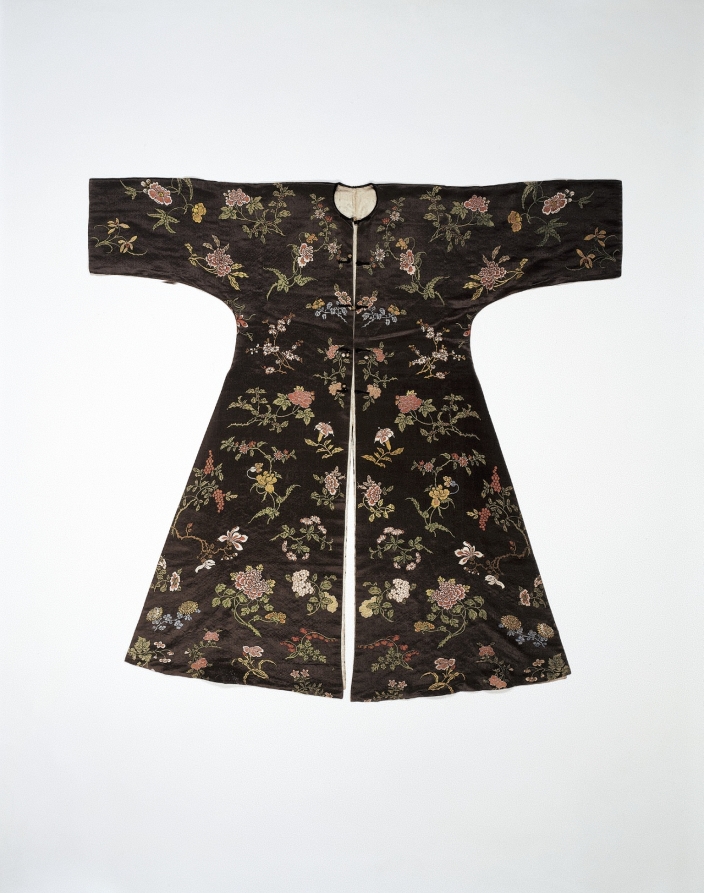
Category: Silk
Introduction: The Silent Dialogue of a Silk Robe
In the hushed corridors of heritage preservation, few artifacts speak with the eloquence of a woman’s silk robe. This is not merely a garment; it is a testament to centuries of imperial ambition, artisanal mastery, and the quiet revolution of feminine luxury. At first glance, the robe appears as a delicate whisper of fabric—a cascade of lustrous folds, its surface catching light like a still pond at dawn. Yet, beneath that serene exterior lies a narrative woven from the threads of empires, from the sericulture of ancient China to the ateliers of London’s Savile Row. As a Senior Heritage Specialist at the Lauren Fashion Heritage Lab, I invite you to examine this artifact not as a static object, but as a living document of cultural exchange, technological prowess, and enduring elegance.
The robe in question is a woman’s silk kimono-style dressing gown, circa 1920s, crafted from a deep indigo silk satin, adorned with hand-embroidered chrysanthemums and phoenixes in gold and silver thread. Its materiality—silk—is the protagonist of this story. Silk, the “queen of fibers,” has been coveted for millennia, its production a closely guarded secret of the Chinese imperial court. The robe’s construction reflects a synthesis of Eastern and Western sensibilities: the cut is European, with a loose, flowing silhouette that accommodates the modern woman’s desire for comfort, yet the embroidery techniques and motifs are unmistakably rooted in the opulence of Qing dynasty court robes. This hybridity is the artifact’s genius—it bridges the imperial legacy of silk weaving with the democratization of luxury in the early 20th century.
Materiality: The Alchemy of Silk
To understand this robe, one must first understand silk. Silk is not simply a textile; it is an alchemical transformation of the humble silkworm’s cocoon into a filament of unparalleled strength, luster, and drape. The robe’s fabric is a satin weave, characterized by its smooth, reflective surface, achieved by floating the warp threads over multiple weft threads. This technique, perfected in the imperial workshops of Suzhou and Hangzhou, requires extraordinary precision. Each inch of this robe contains approximately 200 threads per centimeter, a density that ensures both durability and a liquid-like flow. The indigo dye, derived from the indigofera plant, was a symbol of status in many cultures—its deep, almost nocturnal hue signified wealth and sophistication.
The embroidery is where the artifact transcends mere craftsmanship. The chrysanthemum, a symbol of longevity and rejuvenation in Chinese culture, is rendered in gold thread using the couching technique, where the metallic thread is laid on the surface and secured with fine silk stitches. The phoenix, a mythical bird representing grace and virtue, is embroidered with silver thread and seed pearls, its feathers depicted with such intricacy that they seem to flutter in the light. This level of detail is a direct inheritance from the imperial silk workshops, where artisans trained for decades to achieve such perfection. The robe’s silk is not just a material; it is a repository of knowledge—of sericulture, dyeing, weaving, and embroidery—passed down through generations, from the Forbidden City to the private collections of European aristocrats.
Context: The Legacy of Imperial Silk Weaving
The legacy of imperial silk weaving is a story of power, trade, and cultural diplomacy. For over two millennia, China held a monopoly on silk production, with the Silk Road serving as the conduit for this precious commodity. The imperial court in Beijing established the Imperial Silkworks in the 13th century, a vast complex of workshops that produced robes for the emperor, his consorts, and the highest-ranking officials. These garments were not merely clothing; they were instruments of statecraft, encoded with symbols of authority, such as the five-clawed dragon for the emperor and the phoenix for the empress. The silk robe we examine today, though a later iteration, carries echoes of this imperial vocabulary. The phoenix embroidery, for instance, is a direct reference to the empress’s regalia, while the chrysanthemum motifs evoke the autumn court rituals.
By the 19th century, the Opium Wars and the subsequent opening of Chinese ports to Western trade disrupted this closed system. European merchants, including those on London’s Savile Row, began importing Chinese silk in unprecedented quantities. The robe’s creation in the 1920s coincides with a period of intense cross-cultural exchange, where Art Deco and Orientalism converged. London’s Savile Row tailors, known for their bespoke suiting, adapted Chinese silk for women’s loungewear, a burgeoning category that reflected the changing roles of women after World War I. The robe became a symbol of the “New Woman”—independent, sophisticated, and unafraid to embrace global influences. Yet, this appropriation was not without tension. The robe’s imperial motifs, once reserved for the celestial court, were now accessible to Western consumers, raising questions about authenticity and cultural ownership that resonate to this day.
Conservation and Interpretation: Preserving the Narrative
As a heritage artifact, this silk robe presents unique conservation challenges. Silk is a protein fiber, susceptible to light, humidity, and handling. The gold and silver threads, while visually stunning, are prone to tarnishing and breakage. At the Lauren Fashion Heritage Lab, we employ a passive conservation approach, storing the robe in a climate-controlled environment at 18°C and 50% relative humidity, with minimal light exposure. The robe is mounted on a padded mannequin for display, using archival-grade materials to avoid stress on the seams. Our goal is not to freeze the artifact in time, but to slow its natural decay while allowing scholars and the public to engage with its story.
Interpretation is equally critical. The robe must be contextualized within the broader narrative of silk’s journey from imperial monopoly to global commodity. We have developed a digital interactive that allows visitors to trace the robe’s provenance—from the silkworm farms of Zhejiang to the embroidery workshops of Shanghai, and finally to the London department store where it was purchased by a wealthy socialite. This tool highlights the labor and artistry behind the garment, countering the tendency to view it as a mere exotic trinket. Additionally, we collaborate with contemporary silk artisans in China to document traditional techniques, ensuring that the knowledge embedded in the robe is not lost.
Conclusion: The Enduring Thread
The woman’s silk robe is more than a relic of a bygone era; it is a testament to the enduring power of silk as a medium of cultural expression. Its materiality—the lustrous satin, the intricate embroidery—speaks to the skill of artisans whose names have been lost to history. Its context—the legacy of imperial silk weaving—reminds us that fashion is never apolitical; it is a mirror of trade, power, and identity. As we preserve this artifact, we honor not only the robe itself but the countless hands that shaped it, from the silkworm to the seamstress. In the quiet elegance of its folds, we find a dialogue between East and West, past and present, craft and commerce. This is the heritage we safeguard—not as a static object, but as a living thread that connects us to our shared human story.