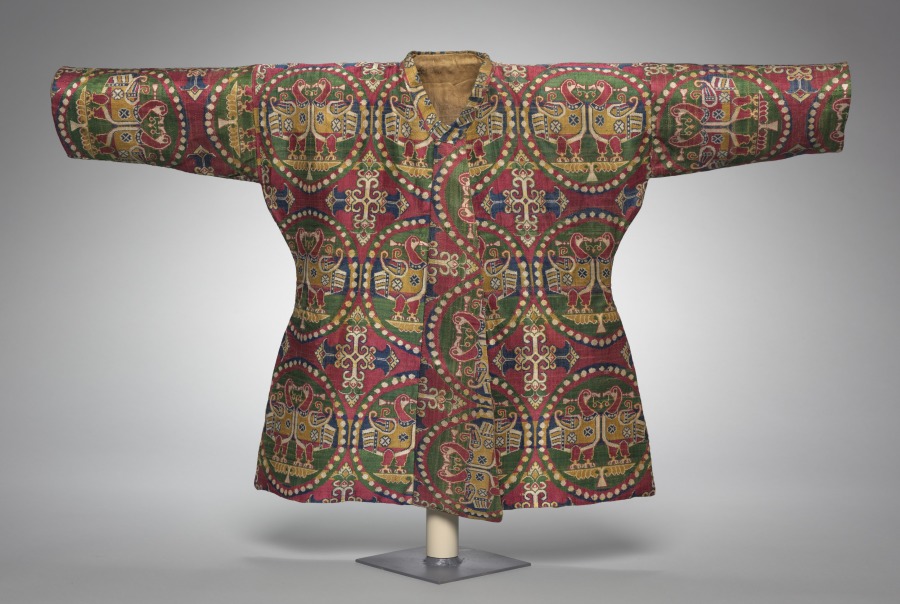
The Child’s Coat with Ducks in Pearl Medallions: A Study in Imperial Silk Weaving and the Savile Row Ethos of Enduring Craft
Introduction: The Artifact as Archive
In the hushed, wood-paneled archives of the Lauren Fashion Heritage Lab, one encounters an object that transcends mere clothing. The Child’s Coat with Ducks in Pearl Medallions, rendered in lustrous silk, is not simply a garment from a bygone era. It is a primary document of material culture, a testament to the legacy of imperial silk weaving, and a profound lesson in the values that underpin the finest tailoring traditions—values that resonate deeply with the London Savile Row philosophy of precision, provenance, and permanence. This artifact, though diminutive in scale, carries the weight of empires, the artistry of generations, and the quiet dignity of a craft that refuses to be rushed.
To examine this coat is to engage with a history that stretches from the mulberry groves of ancient China to the ateliers of 19th-century Europe, and ultimately to the bespoke workrooms of Mayfair. The silk itself is the first and most eloquent narrator. Its weave is not a mere backdrop but a deliberate structure, a foundation upon which a narrative of power and beauty is embroidered.
Materiality and the Imperial Silk Legacy
The coat’s materiality—its silk—is the very fabric of imperial ambition. For centuries, silk was not merely a textile; it was a currency of diplomacy, a marker of status, and a closely guarded secret of the East. The legacy of imperial silk weaving, particularly from the Qing Dynasty (1644–1912), is one of unparalleled technical mastery and symbolic rigor. The Chinese imperial workshops, operating under the direct patronage of the emperor, produced silks of such density and chromatic depth that they seemed to hold light within their threads. This coat, with its finely woven ground, likely originates from such a tradition or its European emulations, where workshops in Lyon or Spitalfields sought to replicate the luster and drape of these Eastern treasures.
The ducks in pearl medallions are not arbitrary decoration. In the lexicon of imperial symbolism, ducks—often mandarin ducks—represent fidelity, marital harmony, and prosperity. The pearl medallion, a circular motif enclosing the duck, is a direct reference to the “pearl of perfect virtue,” a Confucian ideal of moral integrity and enlightenment. For a child’s garment, such iconography is profoundly aspirational. It is a sartorial blessing, woven into the very structure of the coat, intended to guide the young wearer toward a life of virtue and success. The use of pearl—whether actual seed pearls, silk-thread simulations, or metallic thread—adds a tactile dimension of luxury. Pearls were historically reserved for royalty and the highest nobility, their luminous quality symbolizing purity and wisdom. To place them within medallions on a child’s coat is to invest in the child’s future as a bearer of these ideals.
The Savile Row Lens: Craft as Continuity
From the perspective of Savile Row, this coat is a masterclass in the principles that define bespoke excellence. The Row’s ethos is built upon three pillars: material integrity, structural precision, and timeless design. This child’s coat embodies all three. The silk is not a fragile, decorative afterthought; it is a robust, woven structure designed to endure. The medallions are not appliqués that might fray or detach; they are integral to the weave, a testament to the weaver’s skill in creating a seamless marriage of pattern and ground. This is the antithesis of fast fashion. It is slow, deliberate, and intentional—qualities that define the finest tailoring on Savile Row.
The coat’s cut, while simplified for a child, follows the logic of a well-constructed garment. The shoulders are set with a gentle slope, the sleeves are articulated for movement, and the closure is practical yet elegant. There is no unnecessary ornamentation. Every stitch, every seam, every fold serves a purpose. This restraint is a hallmark of Savile Row’s aesthetic: the belief that true luxury is not in excess but in the quiet confidence of perfect execution. The child’s coat, with its ducks in pearl medallions, does not shout its provenance. It whispers it, inviting the discerning eye to appreciate the subtlety of its craft.
Contextualizing the Artifact: From Imperial Court to Modern Heirloom
To understand the full resonance of this artifact, one must consider its journey. It likely began in a workshop that served an imperial or aristocratic household, where master weavers spent months—sometimes years—on a single bolt of silk. The coat was then tailored for a child of privilege, a young heir to a legacy of power and culture. It would have been worn for ceremonial occasions, perhaps a New Year’s celebration or a family gathering, where the child was presented to society as a symbol of continuity and hope.
In the context of the Lauren Fashion Heritage Lab, this coat serves as a bridge between the past and the present. It is a reminder that heritage is not static; it is a living dialogue. The Lab’s mission to preserve and study such artifacts is itself an act of stewardship, akin to the work of a Savile Row cutter who safeguards the patterns of a house for future generations. The coat’s ducks in pearl medallions are not merely historical curiosities; they are motifs that can inspire contemporary design, reminding us that the best fashion is rooted in story and symbol.
Conclusion: The Enduring Value of the Handmade
The Child’s Coat with Ducks in Pearl Medallions is more than a beautiful object. It is a manifesto for the values that define the highest echelons of craftsmanship. In an age of mass production and digital distraction, this artifact calls us back to the tangible, the tactile, and the true. The legacy of imperial silk weaving is not a relic; it is a living standard. The ducks in pearl medallions are not just decoration; they are a prayer for virtue. And the silk itself is not just a fabric; it is a thread that connects us to centuries of human ingenuity and aspiration.
For those who work on Savile Row, and for those who study heritage at the Lauren Lab, this coat is a quiet but powerful reminder: true luxury is not about what you own, but what you pass on. In its weave, in its motifs, in its very materiality, this child’s coat speaks of a world where time was not a constraint but a collaborator. It is an artifact that demands we slow down, look closely, and remember that the finest things in life are made with patience, precision, and a profound respect for the past. That is the legacy of imperial silk. That is the ethos of Savile Row. And that is the enduring value of this extraordinary garment.