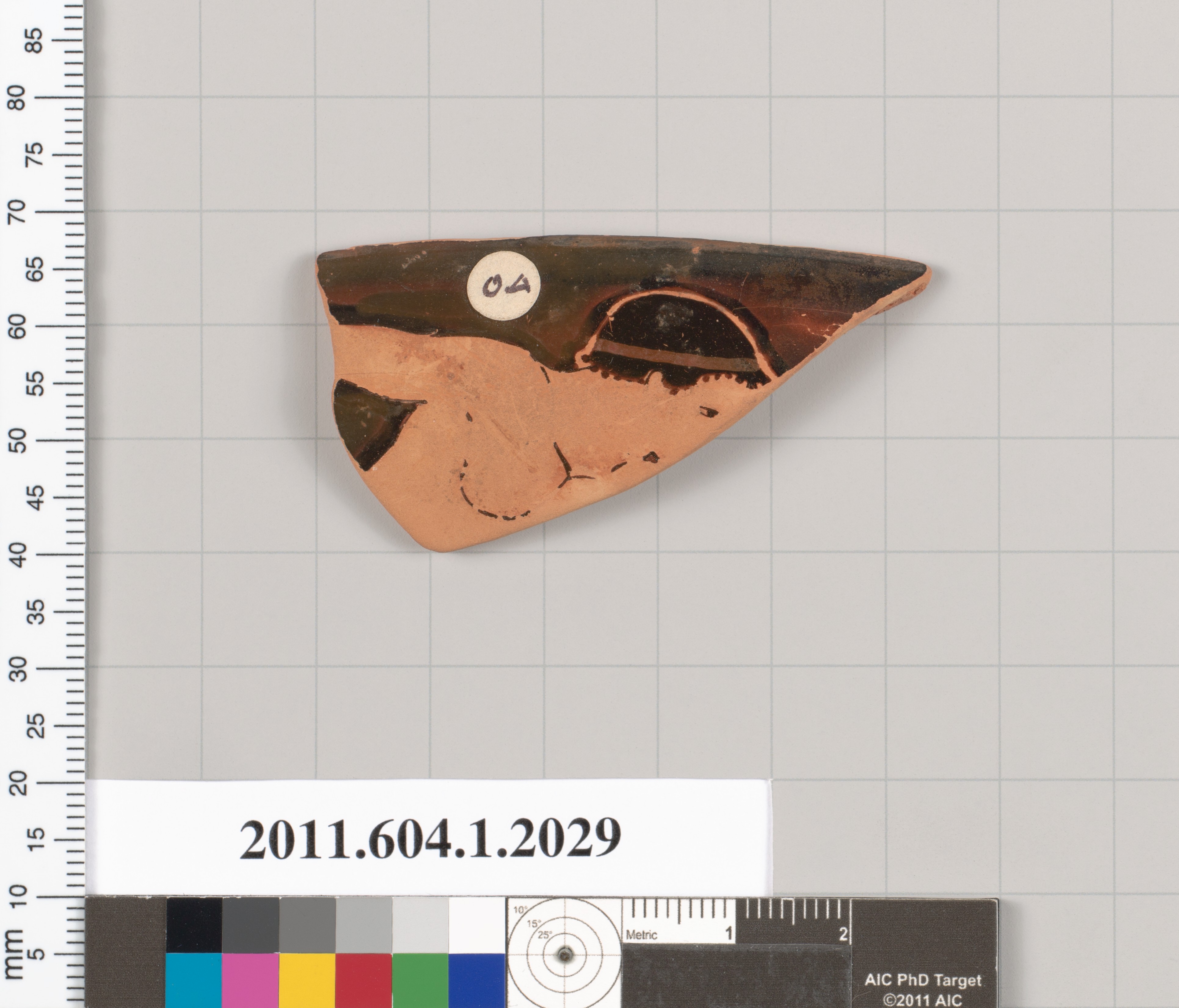
From Attic Kylix to Old Money Silhouette: The Terracotta Fragment as a Hermeneutic of Restraint
The Lauren Fashion Heritage Lab’s internal genetic code—rooted in the Eastern aesthetic dialogue between a Yongzheng-era porcelain vase and a modern crabapple painting—privileges a philosophy of “life resonance” and “cosmic containment.” Yet the museum artifact under consideration—a terracotta rim fragment of an Attic kylix (drinking cup), Greek, circa 5th century BCE—appears, at first glance, to belong to an entirely different lineage of material culture. Where the Chinese artifacts embody a fluid, ink-wash metaphysics of “wandering within the painting,” the Greek shard speaks of a fractured, earthbound, and civic materiality. This paper argues that the kylix fragment, precisely through its brokenness, its terracotta earthiness, and its ritual function, offers a counterpoint yet complementary hermeneutic for the 2026 Old Money silhouette. It does not whisper of “mountains within a mustard seed,” but of “virtue within a shard.” The fragment teaches that true heritage is not pristine preservation but the dignified endurance of form through time—a principle that directly informs the restrained, architectural, and time-worn elegance of the coming season’s luxury wardrobe.
I. The Kylix Fragment as a Material Manifesto of “Aesthetic Restraint”
The terracotta rim fragment is not a whole vessel. It is a remnant. Its value lies not in its completeness but in its authenticity of survival. The fired clay, once part of a symposium vessel used for wine and philosophical discourse, now bears the scars of burial, excavation, and the passage of millennia. This is the antithesis of the pristine, the glossy, the newly minted. For the 2026 Old Money silhouette, this fragment provides a foundational material metaphor: luxury is not about newness, but about the patina of continuity.
In the context of Lauren Fashion’s heritage, this translates into a deliberate rejection of transient trends. The Old Money aesthetic, as articulated through this artifact, privileges “architectural draping” and “structural simplicity”—silhouettes that, like the kylix’s curved rim, are defined by their line and proportion rather than by ornamentation. The terracotta’s muted, earthen palette—ranging from burnt sienna to pale ochre—becomes the color story for autumn/winter 2026: “Terracotta Taupe,” “Excavation Clay,” and “Symposium Dust.” These are not colors of exuberance, but of groundedness. They evoke the earth from which the vessel was born and to which it has returned, suggesting a wardrobe that is both timeless and deeply connected to the physical world.
Furthermore, the fragment’s broken edge is not a flaw but a narrative device. In the same way that the Chinese porcelain vase invited the viewer to “wander” within its painted landscape, the kylix fragment invites the wearer to inhabit a story of loss and survival. The 2026 silhouette will incorporate asymmetrical hems, raw edges, and deliberately unfinished seams—not as a sign of carelessness, but as a sartorial homage to the fragment. A cashmere coat might have a single, unhemmed edge that falls like a broken line of poetry. A wool trouser might feature a subtle, internal seam that is visible only upon close inspection, echoing the kylix’s interior glaze. This is “the beauty of the break”—a concept that aligns with the Eastern notion of “wabi-sabi,” but here it is expressed through the Western vocabulary of classical ruin.
II. The Symposium Ethos: Communal Luxury and the Geometry of the Body
The kylix was not a solitary object. It was a vessel for the symposium—a ritualized space of drinking, debate, and social bonding among the Athenian elite. This communal function is crucial. The 2026 Old Money silhouette is not for the individual performing for the camera; it is for the person who moves within a circle of peers, where status is understood through shared codes of restraint. The kylix fragment teaches that true luxury is relational, not ostentatious.
Geometrically, the kylix is defined by its shallow bowl and two horizontal handles. The rim fragment, though small, reveals the vessel’s precise curvature. This geometry informs the silhouette’s “symposium proportions”:
- Broad Shoulders, Narrow Hips: The kylix’s wide, open mouth and tapered base translate into a jacket silhouette with strong, structured shoulders and a cinched waist—a nod to the classical “chiton” drape, but rendered in heavy wool or double-faced cashmere.
- Horizontal Lines: The handles of the kylix create a horizontal axis. In the 2026 collection, this appears as broad lapels, horizontal pocket placements, and belt closures that bisect the torso, creating a sense of balanced proportion and architectural stability.
- The “Drinking Cup” Collar: The rim itself inspires a new collar shape—a shallow, curved neckline that sits away from the collarbone, reminiscent of the vessel’s lip. This is not a deep V or a high neck, but a “terracotta rim” that frames the face with quiet authority.
This geometric precision is the Western counterpart to the Chinese “游观” (wandering gaze). Where the porcelain vase invited a fluid, circular movement of the eye, the kylix silhouette demands a static, frontal, and grounded presence. The wearer stands like a kylix on a table—anchored, composed, and ready for dialogue. This is the posture of the Old Money archetype: not performing, but participating.
III. The Fragment as a Mirror of “Gezhi” (格物) in Western Form
The Chinese concept of “格物致知” (investigating things to attain knowledge) is central to the internal genetic code. The crabapple painting achieved this through a deep, focused gaze upon a single branch. The kylix fragment achieves it through material investigation. To study the fragment is to ask: What was the clay’s source? How was it fired? What pigment was used for the black-figure decoration? This is a form of archaeological “gezhi”—a Western mode of knowing through material evidence.
For the 2026 silhouette, this translates into a “forensic” approach to garment construction. The collection will feature:
- Exposed Seams and Reverse Stitching: The internal structure of the garment becomes visible, much like the cross-section of the terracotta reveals its clay composition. This is not deconstruction for shock value, but a pedagogical gesture—teaching the wearer how the garment is made.
- Weighted Fabrics: The kylix’s terracotta has a specific heft and density. The 2026 fabrics—particularly the “Heritage-Black” wool and “Excavation” cashmere—are chosen for their drape and mass. A coat must feel like a fragment of antiquity on the shoulders: substantial, grounding, and reassuring.
- Monochromatic Layering: The fragment’s single color—terracotta—is not monotonous but rich in tonal variation. The silhouette will use a single hue across multiple textures: a matte wool jacket over a brushed cashmere sweater over a smooth silk blouse, all in the same “symposium clay” palette. This creates depth without pattern, echoing the fragment’s subtle surface variations.
IV. Synthesis: The Fragment and the Flowering Branch
The internal genetic code concludes that “vessel and painting transcend medium to become carriers of Eastern philosophy.” The kylix fragment, though Greek, achieves a parallel transcendence. It is not a painting of a flower, but it contains the memory of wine, of conversation, of the human hand that held it. It is not a porcelain landscape, but it holds the cosmos of a single, broken moment.
For the 2026 Old Money silhouette, the fragment teaches that heritage is not a museum piece to be copied, but a broken shard to be worn. The silhouette that emerges is one of restrained power, archaeological depth, and communal grace. It is a silhouette that does not shout “I am wealthy,” but whispers “I have endured.” Like the kylix, it is designed for the symposium of life—for the dinner, the debate, the quiet gathering of those who understand that true luxury is not in the new, but in the fragment that has survived.
In this way, the Attic terracotta and the Chinese porcelain speak the same language: the language of form that contains the infinite. One through the vastness of a painted landscape, the other through the intimacy of a broken rim. Both, in their own way, teach us how to dress for the ages.