An Examination of Avian Hierarchy and Seasonal Abundance: A Consideration of Material and Motif
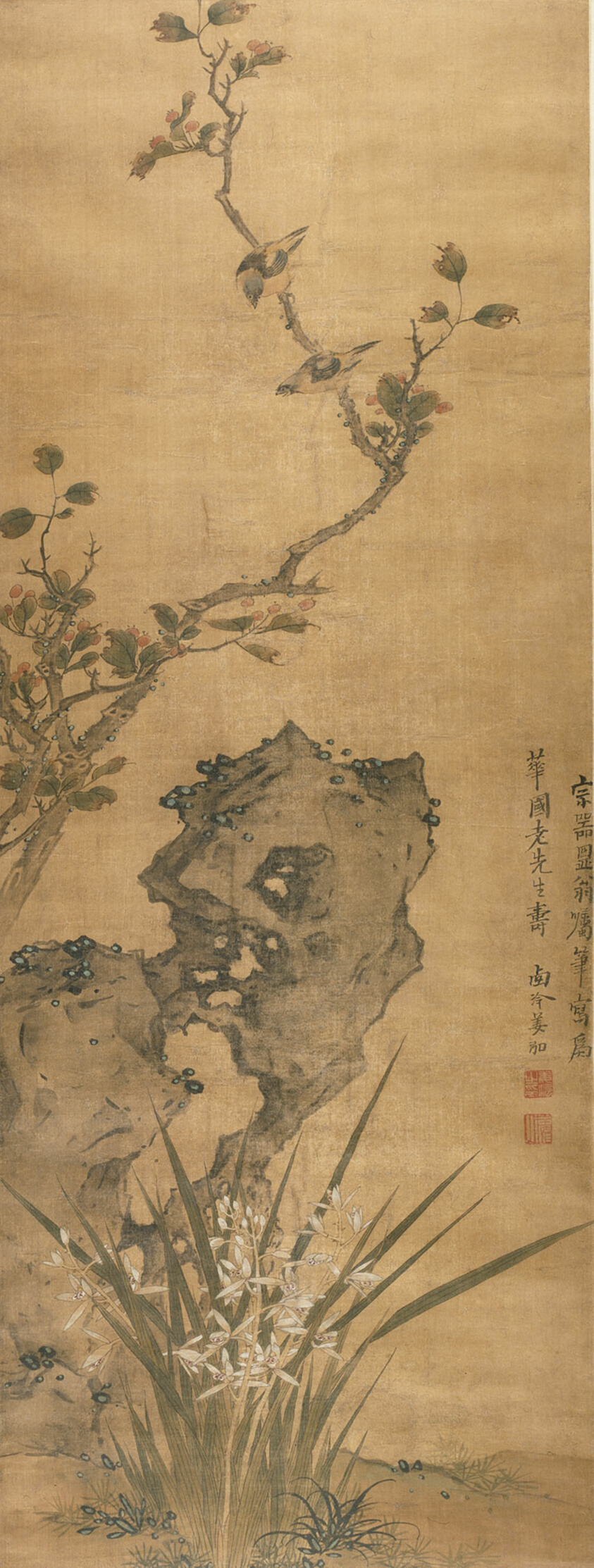
The artifact under consideration—a hanging scroll of ink and colours upon silk, depicting birds amidst fruited boughs and autumn foliage—presents not merely a decorative scene, but a profound statement on natural order, cultivated prosperity, and the quiet authority of the bespoke. To engage with this piece is to enter into a dialogue with a legacy of craftsmanship where material and motif are inseparably fused, each elevating the other to a realm of silent eloquence. The foundation, of course, is the silk. This is not a mere substrate; it is the essential canvas upon which the narrative of elegance is built. Its fine, luminous grain accepts the mineral pigments and ink with a deference that paper cannot muster, allowing for a depth of colour that seems inherent rather than applied. The silk’s inherent sheen provides a subdued, internal radiance, mimicking the soft glow of an autumn sky, against which the drama of the scene is set. It is the sartorial equivalent of a superlative woolen cloth—the unseen foundation that promises durability, drapes with grace, and confers an immediate sense of consequence.
The Grammar of the Bough: Structure and Spontaneity
The composition speaks a language of deliberate arrangement, much like the cut of a garment. The central tree, its branches arcing with a sense of both structural integrity and natural whimsy, establishes the piece’s silhouette. The brushwork here is paramount. The delineation of the bark and limbs employs a lexicon of ink strokes—from the robust, confident “axe-cut” texture suggesting age and resilience, to the finer, more fluid lines of the extending twigs. This balance between the structured and the spontaneous is the very essence of fluid elegance. It conveys an authority that is never rigid, a mastery that appears effortless. The autumn foliage, rendered in washes of ochre, vermilion, and carmine, is not applied with uniform flatness, but with a tonal variation that suggests the play of light and the individual life of each leaf. This technique demonstrates a profound understanding of visual depth and texture, akin to the subtle patterning of a jacquard or the deliberate sheen of a silk shantung.
The Avian Assembly: A Study in Propriety and Placement
The birds are the focal points, the “accessories” that complete the ensemble and articulate its theme. Their placement is never accidental; it follows a rhythm and a hierarchy. A magpie, perhaps, occupies a central, higher branch, its form rendered with precise ink strokes that define its plumage as clearly as a master tailor defines a lapel. Its posture is alert, composed, the embodiment of watchful prosperity. Lower, a pair of finches might engage in quieter discourse, their colours—touches of azurite or malachite—providing points of contrast without vulgarity. Each species is depicted with an ornithological accuracy that transcends mere imitation, aiming instead for the capture of essence, of *character*. This reflects a principle we hold dear: that decoration must be in service of identity. The birds are not simply *on* the tree; they are *of* it, integral components of an ecosystem, just as a well-placed buttonhole or a pocket’s pitch is integral to the garment’s whole.
The Fruit of Labour: Symbolism as Subtext
The fruit, pendulous and richly coloured, is the unequivocal symbol of abundance and reward. Whether pomegranate, bursting with seeds to signify fertility and lineage, or persimmon, a deep orange emblem of success and transformation, its inclusion is a narrative choice. It speaks of the harvest, the culmination of seasonal cycles and careful cultivation. In the context of heritage, this fruit represents the tangible yield of skill, patience, and tradition—the enduring results of the artisan’s labour. The rendering of the fruit, with careful attention to the play of light on its rind and the subtle gradations of its hue, demonstrates a commitment to realism that avoids the trompe l'oeil. It is suggestive, not imitative, leaving space for the intellect of the viewer to complete the picture, much as a superior garment suggests rather than shouts the status of its wearer.
Autumn as Ambience: The Patina of Time
The choice of autumn as the seasonal setting is particularly astute. This is not the blatant vibrancy of spring nor the overt fullness of summer, but a season of mature, complex beauty. It is a time of culmination, of richness achieved, and of graceful transition. The palette—burnished golds, deep reds, muted greens—carries within it an implicit narrative of time’s passage and the dignity it confers. This aligns perfectly with the heritage value of the silk itself and the classic techniques employed. The scene possesses a patina, not of age, but of timelessness. It evokes the same feeling as a well-maintained, decades-old bespoke suit: its value is deepened, not diminished, by its acknowledgment of cycle and continuity.
In final analysis, this hanging scroll is a masterful articulation of heritage principles. The silk provides the impeccable ground, the “cloth” of supreme quality. The painting upon it demonstrates the cut and drape—the structural composition married to fluid execution. The motifs—birds, fruit, autumn leaves—are the discreet yet meaningful details: the functional buttonholes, the specific weave of the lining, the personal monogram. Together, they form a complete and coherent statement. It is an artifact that does not seek to dominate its environment, but to enrich it quietly, asserting its place through understated authority, profound skill, and a deep, resonant dialogue between nature and cultivation. It is, in essence, the sartorial philosophy of Savile Row, translated onto silk and expressed through the natural world.