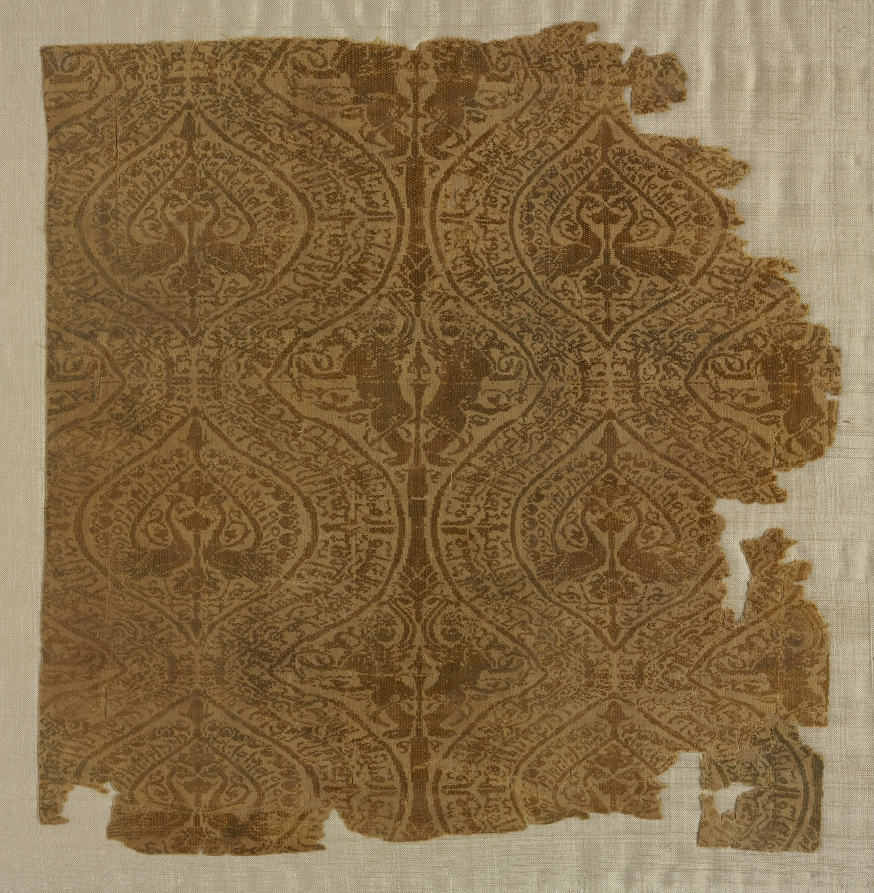
Fragment with Peacocks in Ogival Pattern: A Study in Imperial Silk Weaving
Introduction: The Artifact as a Testament to Craft
The Fragment with Peacocks in Ogival Pattern, rendered in silk, is not merely a textile remnant; it is a tangible relic of imperial ambition and artisanal mastery. This artifact, likely originating from the Safavid or Ottoman courts of the 16th or 17th century, embodies the zenith of silk weaving—a craft that defined the economic and cultural hegemony of empires from Persia to the Sublime Porte. As a heritage specialist for Lauren Fashion Heritage Lab, I approach this fragment with the precision of a Savile Row tailor: examining its materiality, pattern, and provenance to decode its legacy. The silk itself—a lustrous, warp-faced weave—speaks to the technical prowess required to produce such a fabric, while the ogival pattern and peacock motifs reveal a language of power, spirituality, and trade that resonates through centuries of fashion history.
Materiality: The Silk as a Medium of Imperial Status
Silk, as a material, has long been synonymous with luxury and authority. In the context of imperial silk weaving, the Fragment with Peacocks in Ogival Pattern exemplifies the compound weave technique, where multiple warp and weft threads create intricate, multi-colored designs. The silk’s high twist and tight weave would have produced a fabric with a distinctive sheen and drape—qualities prized in courtly garments, ceremonial hangings, and diplomatic gifts. The fragment’s preservation, though partial, allows us to analyze the dyeing methods: the deep indigo blues, madder reds, and gold accents derived from natural sources like lapis lazuli and saffron. These pigments were not merely aesthetic choices; they signified wealth, as the procurement of such dyes required extensive trade networks—a hallmark of imperial power.
From a Savile Row perspective, the silk’s weight and handle suggest it was intended for a structured garment, perhaps a kaftan or a robe of honor (khil’at). The fabric’s resilience, despite its age, underscores the durability of imperial weaving standards. This materiality is not incidental; it reflects a system of production where master weavers, often working in state-sponsored workshops (like the karkhanas of the Mughal or Safavid empires), were tasked with creating textiles that embodied the ruler’s authority. The fragment, therefore, is a microcosm of this system—a piece of cloth that once draped an emperor or adorned a throne room, now preserved as a testament to the intersection of art, commerce, and power.
The Ogival Pattern: Geometry as a Symbol of Order
The ogival pattern—a repeating, pointed arch motif—is a defining feature of this fragment. In Islamic art, the ogive (or lancet arch) is a structural and decorative element that evokes the architecture of mosques and palaces. When translated into textile design, the ogival lattice creates a rhythmic, almost hypnotic repetition that frames the central peacock motifs. This pattern is not arbitrary; it reflects the imperial desire for order and symmetry, mirroring the cosmic and political hierarchies of the court. The ogive’s pointed shape also suggests a fusion of Eastern and Western influences, as the motif appears in Byzantine, Persian, and later European silks, indicating the cross-cultural exchanges facilitated by the Silk Road.
In the context of Savile Row tailoring, the ogival pattern would be considered a formal repeat, requiring precise alignment during cutting and sewing. A tailor today might approach such a fabric with reverence, understanding that the pattern’s continuity is essential to its visual impact. For the imperial weaver, achieving this pattern demanded a mastery of the drawloom, a complex device that allowed for the manipulation of individual warp threads. The ogival design, therefore, is not merely decorative; it is a technical achievement that underscores the sophistication of imperial silk weaving. The fragment’s survival allows us to study these techniques, offering insights into the looms, threads, and labor that produced such textiles.
Peacocks: Symbolism and Sovereignty
The peacock is a recurring motif in imperial silk weaving, and its presence in this fragment is laden with meaning. In Persian and Mughal iconography, the peacock symbolizes immortality, beauty, and the divine—often associated with the Simurgh or the Tree of Life. For the Ottoman court, the peacock represented the sultan’s authority, as its iridescent plumage mirrored the jewels and splendor of the palace. The fragment’s peacocks are depicted in profile, their tails fanning into a circular form that echoes the ogival arches. This stylization is typical of Safavid and Ottoman design, where natural forms are abstracted into geometric patterns to align with Islamic aniconic traditions.
The choice of the peacock also reflects the textile’s function as a status marker. In imperial courts, fabrics with peacock motifs were reserved for the highest echelons of society—the shah, the sultan, or their viziers. The fragment, therefore, likely belonged to a garment or furnishing that signified its owner’s proximity to power. From a heritage perspective, this symbolism offers a window into the social hierarchies of the time. A Savile Row tailor might interpret the peacock as a statement motif, requiring careful placement to ensure the bird’s prominence. In the imperial context, the motif was a declaration of sovereignty, woven into the very fabric of the state.
Context: The Legacy of Imperial Silk Weaving
The Fragment with Peacocks in Ogival Pattern is a product of the imperial silk weaving tradition, a legacy that spans from the Byzantine Empire to the Mughal, Safavid, and Ottoman courts. These empires established state-run workshops that controlled every aspect of silk production—from sericulture to dyeing to weaving. The result was a standardized yet highly artistic output that served as a tool of diplomacy and a marker of cultural identity. The fragment’s ogival pattern and peacock motifs are characteristic of the 16th-century Safavid style, particularly the silks produced in Isfahan and Kashan. However, the pattern’s diffusion across the Islamic world—and later into Europe—demonstrates the global reach of imperial silk weaving.
The legacy of this tradition is evident in modern fashion, particularly in the work of houses like Hermès and Gucci, which draw on historical motifs for their silk scarves and ties. For Lauren Fashion Heritage Lab, this fragment serves as a benchmark for understanding the intersection of craft, commerce, and culture. It challenges us to consider how contemporary designers can honor these traditions without appropriating them. The fragment’s preservation is also a reminder of the fragility of such artifacts; many imperial silks have been lost to time, warfare, or neglect. As a heritage specialist, I advocate for the continued study and conservation of these textiles, ensuring that their stories—of emperors, weavers, and trade routes—are not forgotten.
Conclusion: A Fragment of History, a Blueprint for the Future
The Fragment with Peacocks in Ogival Pattern is more than a piece of silk; it is a narrative of imperial ambition, technical innovation, and symbolic power. Its materiality—the silk’s luster and durability—speaks to the mastery of ancient weavers. Its pattern—the ogival lattice and peacock motifs—reveals a world where geometry and iconography merged to convey authority and spirituality. And its context—the legacy of imperial silk weaving—underscores the enduring influence of these textiles on global fashion. For the scholar, the tailor, and the heritage enthusiast, this fragment offers a rare glimpse into a bygone era, while also inspiring a deeper appreciation for the craft that continues to shape our sartorial world. In the spirit of Savile Row, we must approach such artifacts with the same precision and reverence as a bespoke suit: honoring the past while tailoring it for the future.