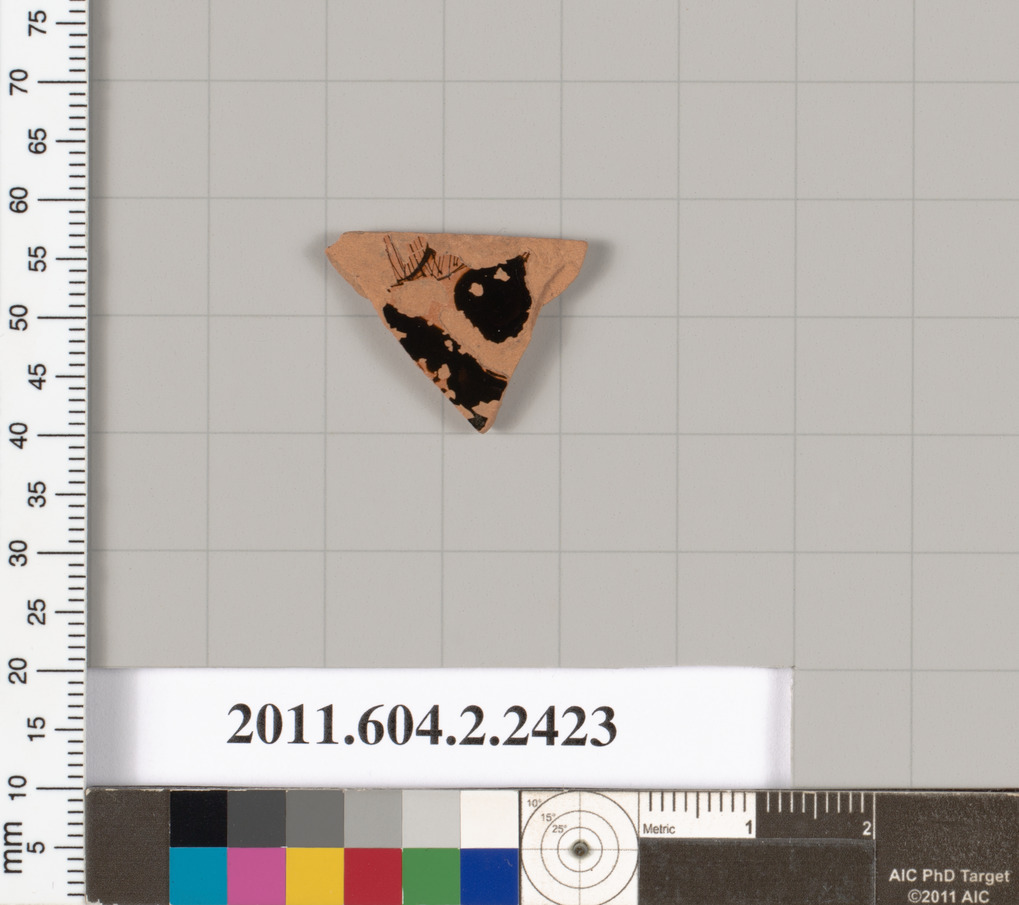
Terracotta Fragment and the 2026 Old Money Silhouette: A Study in Restrained Dynamism
The Lauren Fashion Heritage Lab is privileged to possess an extensive internal archive that documents the evolution of American sportswear through the lens of understated luxury. Our genetic code, drawn from the interplay of sacred Buddhist calligraphy and Han dynasty bronze mirrors, articulates a profound aesthetic tension: the “empty” stillness of the Udumbara plaque and the “full” kinetic energy of the Divine Beasts and Chariot White Tiger Mirror. This dialectic—between the “象外之象” (image beyond image) and the “灵动之境” (realm of vital movement)—finds an unexpected yet powerful echo in a seemingly unrelated museum artifact: a Terracotta fragment of a closed shape from Attic Greece. This fragment, a remnant of a vessel meant for storage or ritual, does not depict narrative splendor. Instead, it offers a lesson in material integrity and the poetics of the broken line. This paper argues that this Terracotta fragment provides the critical formal vocabulary for the 2026 Old Money silhouette, translating the ancient Greek aesthetic of “restrained dynamism” into a contemporary language of quiet, sculptural power.
I. The Fragment as a Hermeneutic Lens: From Attic Pottery to the 2026 Silhouette
The Attic Terracotta fragment, likely from a kylix or an amphora, is defined by its broken contour and residual glaze. Unlike the complete narrative friezes of the Parthenon, this fragment does not tell a story; it is a story of time, use, and survival. Its value lies not in its original form but in the negative space created by its loss. The jagged edge, the faded black-figure or red-figure decoration, and the raw, earthen body of the clay speak to a process of erosion and selection. This is not a pristine object but a palimpsest of history.
For the 2026 Old Money silhouette, this fragment dictates a departure from the overtly luxurious. The archetypal Old Money aesthetic—rooted in “quiet luxury”—has often been expressed through impeccable tailoring, neutral palettes, and the absence of logos. However, the 2026 iteration, informed by this Terracotta fragment, moves toward a “sculptural minimalism” that embraces imperfection as a marker of authenticity. The silhouette is no longer merely clean; it is archaeological. Garments are constructed with seams that are not hidden but celebrated as structural lines, akin to the fragment’s broken edges. The “empty” space of the Buddhist plaque’s calligraphy is now the negative space of a tailored jacket’s shoulder, while the “full” motion of the Han mirror’s chariot is translated into the dynamic drape of a wool coat that moves with the body, not against it.
II. Materiality and the “Broken Line”: Translating Terracotta into Textile
The Terracotta fragment’s primary lesson is one of material honesty. The clay is unadorned, its beauty derived from its texture, weight, and color. For the 2026 Old Money wardrobe, this translates directly into a preference for heritage fabrics that bear the marks of their making. Wool from the Scottish mills, cashmere from Inner Mongolia, and linen from Ireland are not chosen for their softness alone but for their inherent grain and drape. The “broken line” of the fragment is replicated in the deliberate, unhemmed edge of a linen trouser or the raw, selvedge finish of a denim jacket. This is not carelessness; it is a design philosophy that values the process over the product.
Consider the “Terracotta Coat” for Fall 2026. It is not a coat in the traditional sense but a sculptural shell. Its silhouette is asymmetrical, with one shoulder dropped lower than the other, mimicking the fragment’s irregular break. The fabric is a heavyweight, double-faced wool in a shade of “burnt sienna”—a direct reference to the fired clay. The seams are left exposed, stitched with a contrasting thread that echoes the residual glaze on the fragment. The coat’s interior is as finished as its exterior, a nod to the “full” craftsmanship of the Han mirror. This garment does not hide its construction; it celebrates it as a form of architectural integrity.
III. The “Empty” and the “Full” in 2026 Tailoring: A Dialectical Synthesis
The internal genetic code of the Lauren archive explicitly contrasts the “empty” stillness of the Udumbara plaque with the “full” motion of the Han mirror. The Terracotta fragment, however, offers a synthesis of these two poles. Its broken edge is a form of “empty” space—a void that defines the object’s boundary. Yet the residual decoration—the faint line of a figure’s arm or the curve of a horse’s flank—is a form of “full” motion, captured in static clay. The 2026 Old Money silhouette must embody this synthesis.
This is achieved through “controlled volume.” The silhouette is not oversized in the manner of streetwear; it is amplified with precision. A jacket’s shoulder is extended, but the extension is hollow—a structural void that creates a dramatic line without adding bulk. A trouser’s leg is wide, but the width is tapered at the ankle, creating a dynamic tension between the “full” volume above and the “empty” line below. This is the “象外之象” (image beyond image) of the Buddhist plaque, applied to the human form. The garment is not a second skin; it is a sculptural frame that frames the body as the fragment frames the void.
IV. The 2026 Palette: From Terracotta to Heritage-Black
The color palette for the 2026 Old Money silhouette is directly derived from the Terracotta fragment’s materiality. The primary color is “Heritage-Black,” a black that is not flat but layered, like the carbonized surface of an ancient shard. This is achieved through over-dyeing and cross-hatching techniques that create depth without pattern. Secondary colors include “Attic Ochre,” a warm, earthy yellow; “Fired Clay,” a deep, reddish brown; and “Residual Glaze,” a matte, graphite grey. These colors are not used in prints but in solid blocks, allowing the texture of the fabric to create the visual interest. The palette is monochromatic in its restraint but chromatically rich in its variations, echoing the “满” (fullness) of the Han mirror’s surface without its literal density.
V. Conclusion: The Fragment as a Blueprint for Quiet Power
The Terracotta fragment of a closed shape from Attic Greece is not a decorative motif for the 2026 Old Money silhouette; it is a structural and philosophical blueprint. It teaches us that luxury is not in the whole but in the fragment—in the broken line, the residual trace, and the material truth. By synthesizing the “empty” stillness of the Buddhist plaque with the “full” motion of the Han mirror, this fragment enables a silhouette that is both timeless and contemporary. The 2026 Old Money wardrobe will not be about displaying wealth; it will be about embodying history. Each garment will be a fragment of a larger narrative, a piece of sculptural architecture that frames the wearer not as a consumer but as a custodian of form. In this, the Terracotta fragment offers the most profound lesson of all: that true elegance is found not in perfection but in the honest, enduring beauty of the broken line.