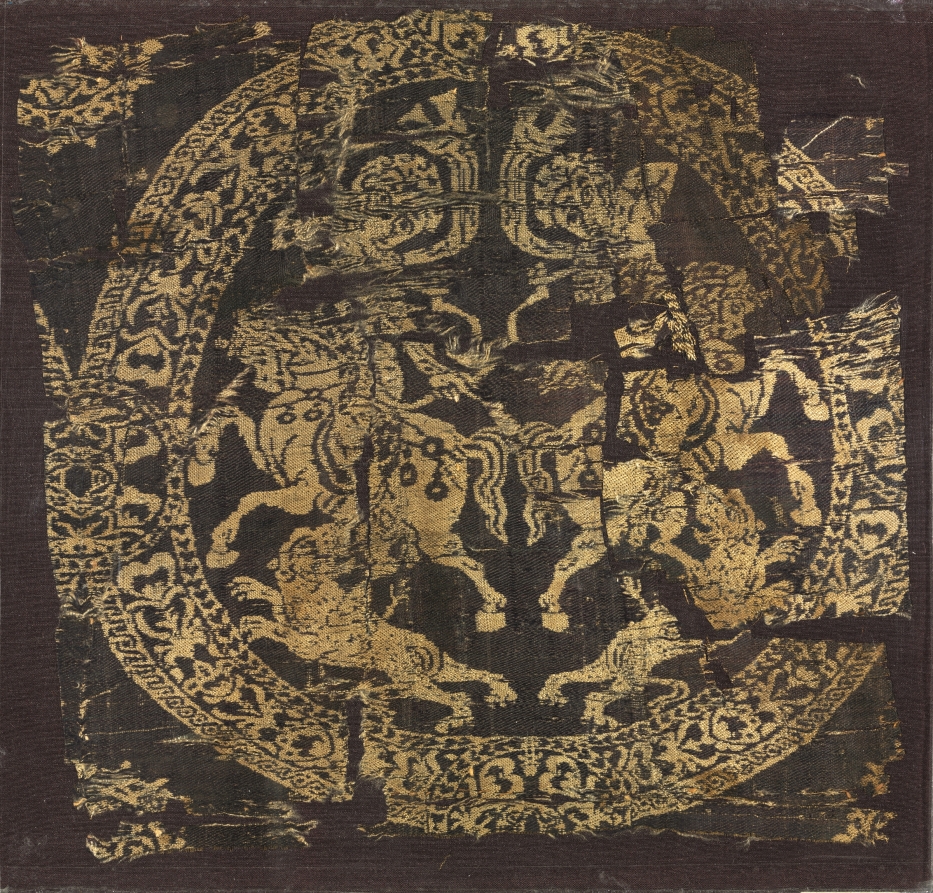
The Roundel with Amazons: A Testament to Imperial Silk Weaving and the Enduring Legacy of Craft
In the hallowed corridors of Lauren Fashion Heritage Lab, where the threads of history are meticulously examined and reimagined for contemporary relevance, we turn our attention to a singular artifact: the Roundel with Amazons, from a tunic. This piece, rendered in silk, is not merely a fragment of ancient textile; it is a profound narrative of imperial ambition, technical mastery, and the timeless dialogue between power and adornment. As we dissect its materiality and context, we must approach it with the precision of a Savile Row tailor—each stitch, each fiber, a testament to a legacy that continues to shape the very fabric of luxury fashion.
Materiality: The Silk of Empires
The roundel’s foundation is silk, a material that, in the context of imperial weaving, was far more than a commodity. It was a currency of influence, a marker of sovereignty, and a canvas for ideological expression. The silk used in this tunic likely originated from the Byzantine or Sasanian empires, where sericulture was a closely guarded state secret, and the production of luxury textiles was a monopoly of the court. The weave itself—likely a compound twill or samite—demonstrates a level of technical sophistication that rivals the finest bespoke tailoring of today. The warp and weft are not merely functional; they are architectural, creating a surface that catches light with a luster that only high-quality, degummed silk can achieve. This is not a fabric for the masses; it is a material for the elite, a tactile assertion of status.
The roundel’s design, featuring Amazons—mythical warrior women from Greek lore—is executed with a precision that speaks to the weaver’s mastery of pattern and color. The silk threads, dyed with natural pigments such as madder for reds, woad for blues, and saffron for yellows, retain a vibrancy that defies centuries of aging. The iconography of the Amazons, often depicted in combat or hunting scenes, is rendered with a dynamic tension that mirrors the physicality of the textile itself. The roundel’s circular form, a common motif in late antique and early medieval textiles, serves as a microcosm of the cosmos, with the Amazons symbolizing the untamed, the martial, and the feminine—a complex interplay that would have resonated deeply with an imperial audience.
Context: The Legacy of Imperial Silk Weaving
To understand the Roundel with Amazons, one must situate it within the broader legacy of imperial silk weaving. This was not a craft born in isolation; it was a product of global trade routes, political alliances, and cultural exchange. The Silk Road, that ancient network of commerce, carried not only raw silk but also the techniques and motifs that would define the aesthetic of empires from Constantinople to Chang’an. The Byzantine Empire, in particular, elevated silk weaving to an art form, with state-run workshops—the gynaikeia—producing textiles for the court, the church, and the military. These workshops were the precursors to modern ateliers, where master weavers trained apprentices in a lineage of skill that would endure for centuries.
The roundel’s Amazonian theme is a fascinating choice. In Byzantine and Sasanian art, Amazons were often used as allegories for the empire’s own martial prowess and its ability to conquer and civilize. Yet, the choice of a female warrior motif also reflects the nuanced role of women in imperial courts, where empresses and noblewomen wielded significant influence, often through the patronage of textiles. The tunic from which this roundel originates would have been worn by a figure of considerable rank—perhaps a military commander or a court official—as part of a ceremonial or diplomatic ensemble. The silk itself, imported or produced under imperial auspices, was a statement of allegiance to the state and its values.
Savile Row Parallels: Craft, Legacy, and Modern Relevance
Drawing a parallel to London’s Savile Row, the legacy of imperial silk weaving resonates with the principles of bespoke tailoring that define that hallowed street. Just as a Savile Row suit is the product of hundreds of hours of hand-stitching, pattern-cutting, and fitting, the Roundel with Amazons represents a similar dedication to craft. The weaver’s hand, like the tailor’s, is invisible in the final product, yet its presence is felt in every thread. The roundel’s durability—its ability to survive for over a millennium—is a testament to the quality of its construction, a quality that Savile Row houses like Anderson & Sheppard or Henry Poole would recognize as the hallmark of true craftsmanship.
Moreover, the roundel’s role as a symbol of status and identity mirrors the function of bespoke clothing today. In an era of mass production, the bespoke garment remains a marker of individuality and discernment. The Roundel with Amazons, with its intricate design and imperial provenance, was a bespoke artifact in its own right, commissioned for a specific individual and imbued with personal and political meaning. This is the essence of heritage: not merely the preservation of objects, but the continuation of a philosophy that values quality, narrative, and the human hand.
Preservation and Interpretation at Lauren Fashion Heritage Lab
At the Lauren Fashion Heritage Lab, our mission is to bridge the gap between past and present, to extract the lessons of history and apply them to the future of fashion. The Roundel with Amazons is a key artifact in this endeavor. Through advanced imaging techniques, such as multispectral analysis and digital microscopy, we can study the weave structure, dye composition, and wear patterns of the silk, gaining insights into the production methods and use-life of the tunic. This data informs our understanding of ancient textile technologies, which in turn inspires contemporary designers to explore sustainable practices, natural dyes, and artisanal techniques.
The roundel also serves as a reminder of the cyclical nature of fashion. The Amazon motif, with its themes of strength and femininity, has resurfaced in collections from houses like Gucci and Alexander McQueen, who draw on classical iconography to make modern statements. By studying this artifact, we can trace the lineage of these ideas, understanding how they have been reinterpreted across cultures and centuries. This is not mere academic exercise; it is a practical tool for innovation, allowing designers to build on a foundation of historical knowledge while pushing the boundaries of creativity.
Conclusion: The Thread That Binds
The Roundel with Amazons is more than a silk fragment; it is a thread that binds us to the imperial weavers, the courtiers, and the warriors of a bygone era. Its materiality speaks of the luxury and power of silk, while its context reveals the complex interplay of trade, politics, and art that defined the ancient world. In the hands of the Lauren Fashion Heritage Lab, this artifact becomes a living document, a source of inspiration for a new generation of craftsmen and designers. As we continue to explore the legacy of imperial silk weaving, we are reminded that the finest textiles, like the finest tailoring, are not merely worn—they are lived, they are remembered, and they endure.