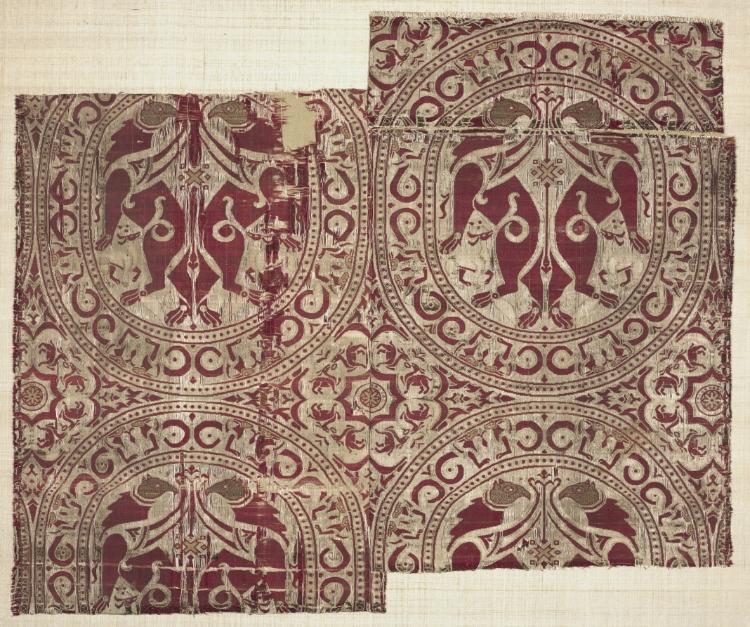
The Lampas with Griffins in Roundels: A Study in Imperial Silk Weaving and Material Legacy
In the hushed, stone-vaulted silence of Siguenza Cathedral, a fragment of textile history endures, woven not merely with threads of silk but with the political and spiritual ambitions of an empire. The lampas with griffins in roundels, preserved within the Reliquary of Saint Librada, is not a mere decorative cloth. It is a material testament to the sophisticated, imperial silk weaving traditions that once connected the courts of Byzantium, the Islamic caliphates, and the nascent kingdoms of medieval Europe. For the discerning scholar of heritage, this artifact demands a rigorous examination of its materiality, its iconographic language, and its role as a carrier of power across centuries.
Materiality and the Language of Silk
The foundation of this artifact’s significance lies in its materiality: silk. In the pre-industrial world, silk was not a commodity; it was a currency of power. Its production, a closely guarded imperial monopoly in Byzantium and later in the Islamic world, required vast resources, specialized labor, and a complex infrastructure of sericulture and weaving. The very presence of a silk lampas in a Spanish cathedral speaks to the long arm of trade and diplomacy. The weave structure itself—a lampas—is a compound weave where a pattern, often in a contrasting color and weave, is floated over a ground weave. This technique, perfected in the great imperial workshops of Constantinople and later in the Islamic centers of Al-Andalus, allowed for the creation of intricate, repeating patterns with a clarity and depth unattainable in simpler weaves. The griffins, rendered in a contrasting color against the roundel’s field, would have been woven with a precision that demanded master weavers and the finest, degummed silk threads. The tactile quality of the fabric—its weight, its drape, its subtle sheen—would have been a sensory experience of imperial authority, a textile that felt as powerful as it looked.
The Iconography of Power: The Griffin in the Roundel
The central motif—the griffin in a roundel—is a masterclass in the semiotics of imperial silk. The griffin, a hybrid creature with the body of a lion and the head and wings of an eagle, is an ancient symbol of divine power, guardianship, and the union of earthly and celestial realms. In the context of Byzantine and Islamic art, it was a potent emblem of royal authority, often associated with the emperor or caliph as the protector of the realm and the intermediary between heaven and earth. The roundel, a perfect geometric circle, is equally significant. It is a symbol of eternity, the cosmos, and the unbroken cycle of imperial rule. When the griffin is placed within the roundel, it is not merely a decorative element; it is a heraldic statement. The repeating pattern of griffins in roundels creates a visual rhythm of power, a textile that, when draped over a reliquary or worn as a vestment, literally wrapped the sacred or the sovereign in a narrative of divine protection and imperial legitimacy. This iconographic language was not unique to one culture; it was a shared visual vocabulary of the medieval Mediterranean, a lingua franca of power that transcended religious and political boundaries.
The Legacy of Imperial Silk Weaving: From Byzantium to Al-Andalus
The lampas from Siguenza Cathedral must be understood within the broader legacy of imperial silk weaving. The Byzantine Empire, with its state-run silk workshops in Constantinople, established the technical and aesthetic standards for luxury textile production in the Mediterranean. After the Islamic conquests, these traditions were absorbed and refined in the great weaving centers of the Umayyad and Abbasid caliphates, particularly in Persia, Syria, and later in Al-Andalus (Islamic Spain). The silk lampas with griffins in roundels is a direct descendant of this lineage. Its technical sophistication—the precise registration of the pattern, the evenness of the weave, the richness of the dye—points to a workshop that was heir to centuries of accumulated knowledge. The presence of such a textile in a Christian cathedral in Spain is not an anomaly. It is a testament to the fluidity of cultural and commercial exchange in the medieval world. These silks were traded, gifted, and looted, moving across political and religious frontiers. They were repurposed as vestments, altar cloths, and reliquary wrappings, their original imperial symbolism often re-interpreted within a Christian context. The griffin, once a symbol of the Byzantine emperor, could now be seen as a guardian of the saint’s relics, a protector of the sacred space.
Preservation and the Art of the Fragment
For the heritage specialist, the condition of this lampas is as telling as its design. The fact that it survives at all is a miracle of preservation. Silk is a protein fiber, susceptible to light, humidity, and physical stress. The fragment’s survival within the reliquary, shielded from the elements, speaks to the reverence with which it was treated. The fading of the dyes, the fraying of the edges, the subtle distortions of the weave—these are not signs of decay but of history. They are the material evidence of centuries of handling, of liturgical use, of the passage of time. The study of such a fragment requires a forensic approach. We must ask: Was this a piece of a larger garment? A section of a hanging? How was it cut and reused? The answers lie in the weave structure, the selvage edges, and the pattern repeat. The fragment is not a complete object; it is a clue, a piece of a larger puzzle that speaks to the life of the textile after it left the loom. The legacy of imperial silk weaving is not just about the moment of creation but about the object’s journey through history, its transformation from a symbol of imperial power to a relic of sacred veneration.
Conclusion: A Textile of Enduring Authority
The lampas with griffins in roundels from the Reliquary of Saint Librada is more than a beautiful artifact. It is a document of power, a technical achievement, and a bridge between cultures. Its materiality—silk—and its iconography—the griffin in the roundel—are the hallmarks of an imperial tradition that shaped the visual and political landscape of the medieval world. For the scholar, it is a reminder that textiles are not passive objects. They are active agents in the construction of authority, the negotiation of identity, and the preservation of memory. In the quiet of Siguenza Cathedral, this fragment of silk continues to speak, its threads carrying the weight of an empire’s ambition and a saint’s protection. It is, in the truest sense, a heritage of enduring authority.