The Luminous Thread: Silk and the Diamond in Imperial Weaving
In the hushed, wood-paneled ateliers of London’s Savile Row, where the whisper of shears and the scent of fine wool are sacrosanct, the conversation rarely turns to the raw, unadorned mineral. Yet, for the Senior Heritage Specialist at the Lauren Fashion Heritage Lab, the intersection of silk and the diamond represents a pinnacle of material culture—a dialogue between the organic and the inorganic, the fluid and the unyielding. This artifact, a fragment of a larger imperial narrative, is not merely a textile; it is a document of power, a testament to the alchemy of craftsmanship, and a silent chronicle of a world order built on the back of the Silk Road and the mines of Golconda.
To understand this legacy, one must first appreciate the materiality of silk. Unlike wool, which is a fibre of the field, or cotton, a fibre of the sun, silk is a fibre of the worm—a continuous, lustrous filament extruded by the Bombyx mori in a singular act of biological precision. For the imperial courts of China, Persia, and later the Ottoman and Mughal empires, this filament was not just a textile; it was a currency of diplomacy, a marker of divine right, and a canvas for the most sophisticated iconography. The diamond, by contrast, is a carbon lattice forged under the earth’s mantle, a symbol of invincibility and eternal light. When these two materials converged in the hands of master weavers, the result was a fabric that transcended fashion to become a statement of absolute sovereignty.
The Imperial Loom: Weaving as Statecraft
The legacy of imperial silk weaving is inextricably linked to the concept of the state manufactory. From the Ming dynasty’s Nanjing workshops to the Safavid karkhanas of Isfahan, the production of silk was a state monopoly, controlled with the same rigor as the minting of coinage. The weaver was not an artist in the modern sense; he was a courtier, a technician of luxury, bound by protocols that dictated every thread. The introduction of diamond motifs into this lexicon was a deliberate act of semiotics. The diamond shape—a lozenge, a rhombus, a faceted point—was not merely decorative. In Persian and Mughal art, it represented the “Chahar Bagh” or the four-fold garden of paradise, a geometric echo of the cosmos. In Chinese symbolism, the diamond pattern evoked the “shou” character for longevity, or the “ruyi” scepter, a talisman of power.
Consider the Mughal pashmina shawls of the 17th century, woven in Kashmir. These were not mere wraps; they were diplomatic gifts exchanged between emperors and European ambassadors. A single shawl could require the labour of a dozen weavers for over a year, its surface a dense field of buta motifs—teardrop forms that, when arranged in a diamond lattice, created a shimmering, kaleidoscopic effect. The silk itself was often “kinkhab” (brocade), where gold and silver threads were interwoven, and the diamond pattern was highlighted with “zari” work—a technique that mimicked the sparkle of the gemstone. The effect was hypnotic: the fabric appeared to move, to breathe, to emit its own light.
The Diamond in the Weave: Technical Mastery
The technical challenge of weaving a diamond pattern into silk is profound. Unlike a printed textile, where a design is applied to the surface, a woven pattern is structural—it is the fabric itself. The diamond twill, a derivative of the basic twill weave, creates a diagonal ribbing that, when combined with a satin weave for the ground, produces a fabric that is both supple and rigid in its geometry. The weaver must calculate the “repeat” of the pattern with mathematical precision, ensuring that the diamond points align perfectly across the width of the loom. A single mis-thread can distort the entire design, turning a symbol of order into a chaos of broken lines.
In the imperial workshops of the Ottoman Empire, particularly in Bursa, the “seraser” (golden silk) fabrics were woven with diamond-shaped medallions containing calligraphic inscriptions from the Quran. These were not just textiles; they were portable shrines, worn by the sultan as a declaration of his role as “Shadow of God on Earth.” The diamond, in this context, was a geometric representation of the “Nur” (divine light), a concept that resonated with the Sufi mysticism of the court. The weaver, therefore, was not merely a craftsman; he was a theologian, encoding spiritual truths into the warp and weft.
The Legacy on Savile Row
How does this imperial legacy translate to the bespoke tailoring of Savile Row? The answer lies in the “house style” of the great tailoring houses, which have long understood that the fabric is the foundation of the garment. A Savile Row suit is not made; it is “built”—a process of cutting, padding, and pressing that respects the material’s inherent properties. For a client who commissions a silk jacket or a waistcoat with a diamond pattern, the heritage specialist must source a fabric that carries the weight of this history. This is not a matter of nostalgia; it is a matter of “hand”—the tactile quality of the silk, the way it drapes, the way it holds a crease.
Consider the “Mughal Diamond” pattern, a design that has been reproduced by mills such as Holland & Sherry and Scabal, using modern jacquard looms that can replicate the complexity of the imperial weaves. The silk is often a “silk-wool” blend, combining the lustre of the filament with the resilience of the wool, making it suitable for a tailored jacket. The diamond motif is scaled down, refined, and placed within a “windowpane” check—a classic Savile Row pattern that adds structure without overwhelming the silhouette. The result is a fabric that whispers of the past but speaks to the present: a garment that is both a tribute to the imperial weaver and a tool for the modern gentleman.
Preservation and the Future
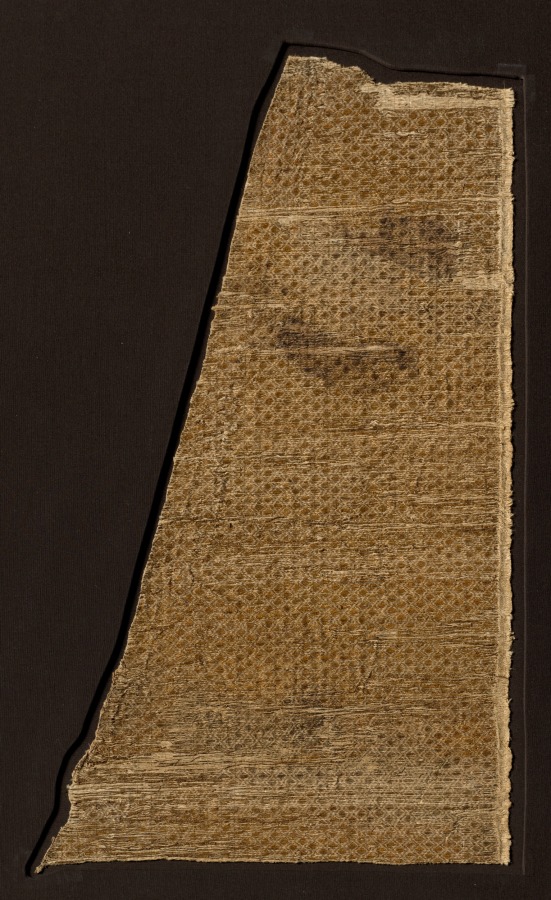
At the Lauren Fashion Heritage Lab, we are tasked with preserving these artifacts—not as static museum pieces, but as living documents. The “Textile with Diamonds” is a research artifact that challenges us to think about the intersection of material science, art history, and cultural diplomacy. We use non-invasive imaging to analyse the weave structure, spectroscopy to identify the dyes (indigo, madder, cochineal), and carbon dating to place the fabric in its historical context. But the true value of this artifact lies in its ability to inspire. When a young designer on Savile Row sees the diamond pattern on a 17th-century Mughal shawl, they are not just looking at a pattern; they are looking at a solution to a design problem—a way to create movement, light, and meaning in a static material.
In conclusion, the Textile with Diamonds is more than a fabric; it is a “thread of empire,” a material manifestation of the human desire to capture the eternal in the ephemeral. From the imperial looms of Asia to the bespoke tailoring of London, the diamond pattern endures because it speaks to a universal truth: that the most powerful statements are often made in the quietest of materials. For the Senior Heritage Specialist, this is not just a research artifact; it is a reminder that the past is not a foreign country—it is a fabric we are still weaving.