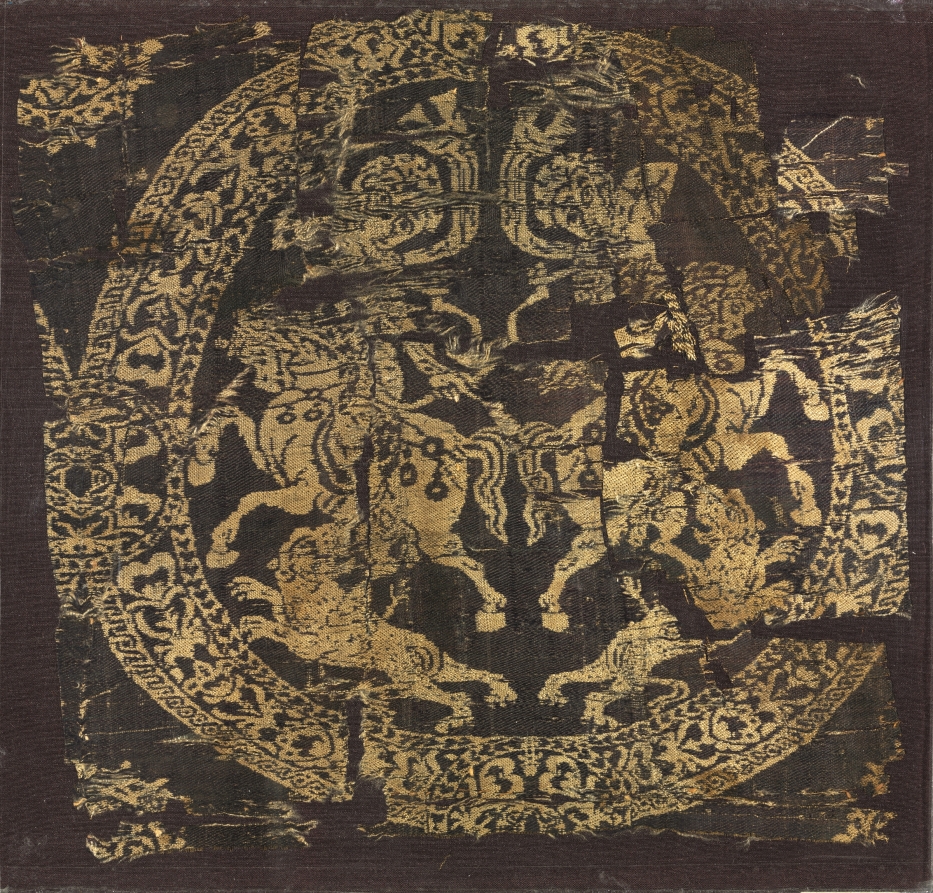
The Roundel with Amazons: A Testament to Imperial Silk Weaving
In the hallowed corridors of heritage fashion, few artifacts resonate with the gravitas of the Roundel with Amazons, a silk fragment from a tunic that embodies the zenith of imperial silk weaving. This piece, originating from the Byzantine or Sasanian spheres of influence circa 6th–7th century AD, is not merely a textile; it is a narrative of power, artistry, and cross-cultural exchange. For the connoisseur of luxury—whether on Savile Row or in the ateliers of modern haute couture—this roundel offers a profound lesson in the enduring legacy of silk as a medium of status and storytelling.
Materiality and Craftsmanship
The roundel’s materiality is its first and most commanding attribute. Woven from silk, a fiber that in antiquity was as precious as gold, this artifact exemplifies the technical mastery of imperial weavers. The silk threads, likely sourced from the sericulture of China and traded along the Silk Road, were dyed with natural pigments—crimson from kermes, indigo from woad, and ochre from iron oxides—to achieve a palette that has endured centuries. The weave itself is a compound twill, a structure that allowed for intricate patterning through the use of supplementary wefts. This technique, known as samite, produced a fabric of unparalleled density and sheen, ideal for the depiction of complex figural scenes.
The roundel’s diameter, approximately 20 centimeters, suggests it was designed as an ornamental patch, or segmentum, sewn onto a tunic’s shoulder or hem. Such placement was deliberate: it positioned the imagery at eye level, inviting contemplation. The silk’s tactile quality—smooth yet substantial—would have brushed against the wearer’s skin with a whisper of luxury, a sensation that modern Savile Row tailors still seek to replicate in their finest cloths.
Iconography: The Amazons as Symbols of Imperial Might
At the heart of the roundel lies a scene of dynamic tension: a group of Amazons, the mythical warrior women of Greek lore, engaged in combat or hunt. The figures are rendered with a stylized naturalism typical of late antique art—their musculature defined by sinuous lines, their garments flowing with rhythmic folds. One Amazon, mounted on a horse, draws a bow; another brandishes a spear; a third appears to restrain a fallen adversary. The composition is circular, a format that forces the eye to follow the action in a perpetual cycle, evoking the eternal nature of imperial dominion.
Why Amazons? In the context of imperial silk weaving, these figures were not mere decoration. They served as allegories for the empress or the empire itself. The Amazons, often associated with the Scythian and Persian worlds, were recast in Byzantine and Sasanian art as symbols of martial prowess and exotic conquest. For a wearer—likely a high-ranking official or military commander—the roundel communicated a message of strength, vigilance, and the subjugation of chaos. This iconographic strategy mirrors the heraldic devices on Savile Row’s bespoke suits, where a crest or monogram signifies lineage and authority.
The Legacy of Imperial Silk Weaving
The roundel’s creation was possible only within the ecosystem of imperial silk weaving, a state-controlled industry that flourished in Constantinople, Antioch, and the Sasanian capital of Ctesiphon. These workshops, known as gynaecia in the Roman East and karkhanas in Persia, were staffed by skilled artisans who operated under strict regulations. Silk was a monopoly of the crown, and its production was guarded as a strategic asset. The roundel’s design, with its precise symmetry and sophisticated color gradations, reflects the output of a workshop where weavers were trained in mathematical geometry and dye chemistry—a precursor to the technical rigor of modern textile mills.
This legacy endures in the DNA of luxury fashion. The double-cloth technique used in the roundel, where two layers of silk are woven simultaneously to create reversible patterns, anticipates the jacquard looms of Lyon and the intricate weaves of Scotland’s cashmere mills. The roundel’s circular format, a constraint that challenged the weaver’s creativity, is echoed in the medallion motifs of 19th-century paisley shawls and the roundels on contemporary silk scarves by Hermès. For the Savile Row tailor, the roundel is a reminder that true luxury is not just about material but about the story woven into every thread.
Preservation and Contemporary Relevance
Today, the Roundel with Amazons resides in collections such as the Victoria and Albert Museum or the Dumbarton Oaks, where it is studied as a benchmark of textile art. Its preservation—the silk’s fibers stabilized under controlled humidity, the dyes protected from light—is a testament to the reverence we afford these artifacts. Yet, its relevance extends beyond the museum case. In an era where fast fashion dominates, the roundel challenges us to reconsider the value of craftsmanship and heritage. It asks: What does it mean to create a garment that lasts centuries? How can we imbue modern textiles with the same narrative depth?
For the heritage specialist, the roundel is a call to action. It advocates for the preservation of traditional weaving techniques, the ethical sourcing of materials, and the celebration of cultural exchange. On Savile Row, this translates into partnerships with mills that still use hand-operated looms, commissions for bespoke silks that reference historical patterns, and a commitment to sustainability that honors the past while shaping the future.
Conclusion: A Thread Through Time
The Roundel with Amazons is more than a fragment of silk; it is a portal to a world where fashion was a language of power and artistry. Its materiality—the silk’s luster, the dye’s depth—speaks to the ingenuity of imperial weavers. Its iconography—the Amazons’ eternal struggle—reflects the values of an empire. And its legacy—the continuity of silk weaving—reminds us that heritage is not static but a living tradition. As we handle this artifact, we are not just preserving history; we are weaving it into the fabric of our own time. For the connoisseur of fine tailoring, this roundel is the ultimate bespoke piece—a garment that tells a story, demands attention, and endures.