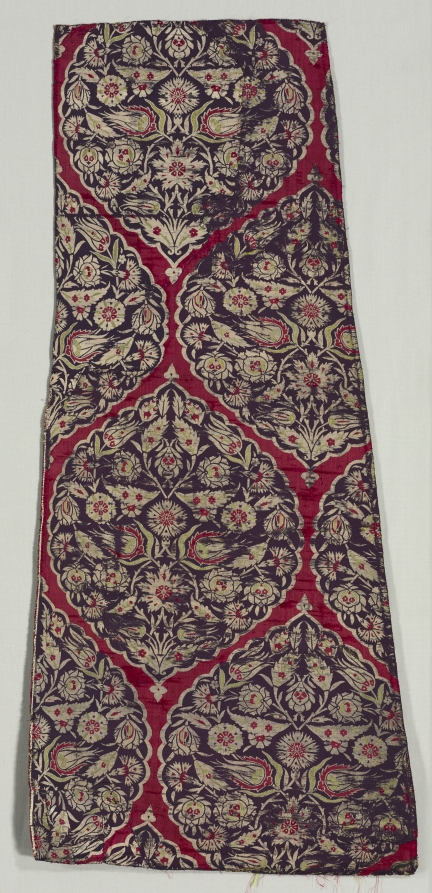
On the Substance of Sovereignty: A Disquisition on Brocaded Silk
To comprehend the object—a fragment of brocaded silk, its warp and weft once constituting the very fabric of a kaftan—is to engage in a dialogue with power itself. This is not mere textile; it is a testament to a specific, rarefied order of material intelligence. The subject before us, a foliate medallion pattern wrought in silk of the highest possible grade, speaks not of fashion in the transient sense, but of authority, of geopolitical theatre, and of a supply chain so exquisitely controlled it became an instrument of state. The legacy of imperial silk weaving is, in essence, the legacy of managed excellence, a principle as relevant to the ateliers of centuries past as it is to the contemporary maison.
The Imperial Framework: Supply as Strategy
Consider, first, the provenance of the fibre. Imperial silk was never a commodity; it was a monopolised asset. From the Byzantine *gynaecea* and the Seraglio workshops of the Ottomans to the state-sanctioned looms of Ming China, control began with the silkworm itself. The cultivation of *Bombyx mori*, the stewardship of mulberry groves, the reeling of the filament—each step was a guarded secret, a protected process. This vertical integration ensured that the foundational material possessed an unassailable integrity: a filament length, a tensile strength, a luminosity that became the baseline for all that followed. It established a qualitative gulf between the imperial product and all imitations, a gulf that was both tangible and symbolic. The sheen of the silk was the sheen of power.
The Language of the Loom: Brocade as Heraldry
The foliate medallion pattern, repeated across the field of our fragment, is where strategy becomes syntax. This is not decoration applied post-factum; it is architecture woven in situ. The technique of brocading—introducing supplementary weft threads, often of precious metal or contrasting colour, to create a raised pattern—demanded looms of immense complexity and weavers of consummate skill. The medallion, a self-contained orb of intricate botanical motifs, is a hallmark of Sassanian, Byzantine, and later Islamic court aesthetics. It functions as a non-verbal cipher.
Within the context of a kaftan, a garment of bestowal and ritual, these medallions were not randomly scattered. They were deployed. Their arrangement spoke of cosmic order; their density and size often correlated with the rank of the wearer. The repeat pattern, so precise as to be hypnotic, communicated the infinite, eternal reach of the imperial house. To don such a garment was to be cloaked in a portable manifesto of dominion, one that articulated legitimacy through a language of flora and geometry understood by elites across continents.
Materiality and Metaphor: The Hand and the Eye
The material hand-feel of this brocade is paramount. It is substantial, weighty with intent. The raised pattern provides a topography under the fingers, a tactile record of countless hours at the loom. This is a fabric designed to drape with a certain gravitas, to move with a rustle that commands silence, to catch light in a manner that illuminates not just the wearer, but the very fact of their ascendancy. The contrast between the lush, reflective silk ground and the intricate, dense brocade creates a visual depth—a luxurious dimensionality—that no printed or embroidered substitute could achieve. The investment in raw material and labour was so profound as to make the object virtually priceless, transforming it from attire into treasure, suitable for diplomatic gift-giving or as a reward for sublime service.
The Enduring Legacy: A Grammar of Excellence
The legacy of this imperial silk weaving is not confined to museums. It established a grammar of excellence that informs the highest echelons of material culture today. The Savile Row suit, for instance, relies upon a similar doctrine: the sourcing of peerless cloth (the modern equivalent of state-controlled silk), the deployment of complex, time-honoured construction techniques (the analogue to the brocading loom), and the creation of a garment that communicates status through subtle, coded language rather than overt display. The foliate medallion finds its echo in a bespoke lapel roll, a hand-picked stitch, a perfectly balanced pattern match—details invisible to the layman but eloquent to the cognoscenti.
This fragment of silk, therefore, is more than an archaeological relic. It is a case study in aspirational materiality. It reminds us that true luxury is never accidental; it is the product of a ruthless dedication to quality at the source, a mastery of complex craft, and the strategic application of the resulting object to convey power, identity, and belonging. The imperial workshops understood that to control the narrative, one must first control the thread. In that singular principle, spanning from the silent looms of history to the quiet workrooms of today, lies the uninterrupted thread of legacy itself.