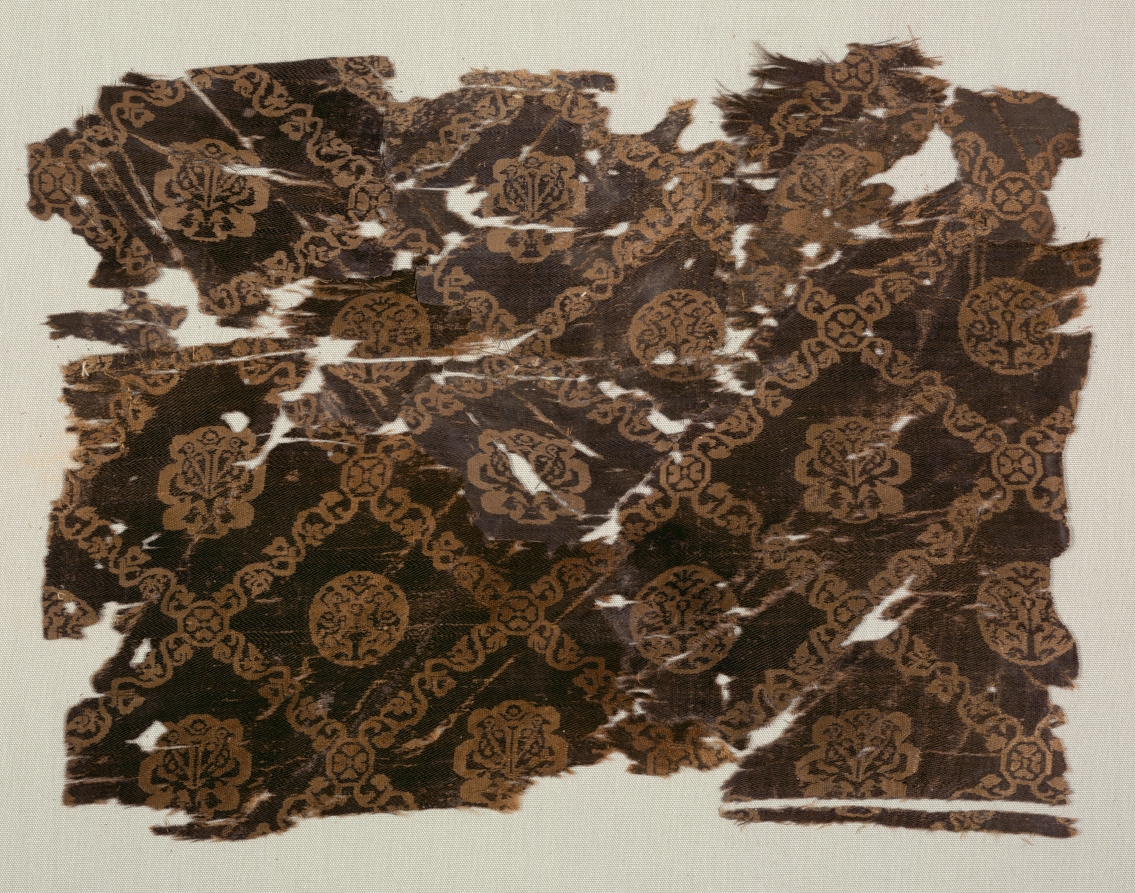
The Lattice of Beasts: A Study in Imperial Silk and the Geometry of Power
In the hushed ateliers of London’s Savile Row, where the cut of a lapel is a matter of national pride and the drape of a fabric is a silent testament to centuries of craft, we encounter a textile of profound historical and material significance: the silk with a lattice of animals in medallions. This is not merely a decorative cloth; it is a cartography of imperial ambition, a woven document of dynastic authority, and a technical marvel that speaks to the very soul of luxury. For the discerning curator or collector, understanding this artifact requires a forensic examination of its materiality, its structural logic, and its place within the legacy of imperial silk weaving.
Materiality: The Silk as a Living Archive
The foundation of this artifact is, of course, the silk itself. In the context of imperial weaving, silk was never a neutral substrate. It was a medium of statecraft. The materiality of this piece—its weight, its lustre, its tactile resistance—reveals the specific provenance and the technical mastery of its creation. The warp and weft are not merely threads; they are the sinews of a system. The silk used in these lattice medallion textiles was often the product of the Imperial Silkworks, such as those in Suzhou or Hangzhou, where the cultivation of Bombyx mori silkworms was a guarded state secret. The yarns were reeled with a precision that ensured a uniform diameter, allowing for the tight, even weave that characterises high-grade imperial silk. The density of the weave—often exceeding 100 threads per centimetre—creates a surface that is both supple and resilient, a paradox that defines the finest silks.
The dyeing process further elevates the material. The colours—deep indigos, cinnabar reds, and golds derived from orpiment or saffron—were not merely aesthetic choices. They were symbolic registers. The use of gold thread, often wrapped around a silk core, was a prerogative of the imperial court. This thread, known as “zari” in some traditions, was not simply applied; it was woven into the very structure of the lattice, creating a metallic shimmer that caught the light and signalled the wearer’s proximity to the throne. The hand of the fabric—its “handfeel” in Savile Row parlance—is cool, smooth, and with a subtle rustle, a quality known as “scroop,” which is the hallmark of degummed, high-twist silk. This is a textile that demands reverence; it does not yield to the casual touch but invites a deliberate, respectful handling.
The Lattice: Geometry as Imperial Order
The lattice structure is the organizing principle of this design. It is not a random scatter of motifs but a deliberate, repeating grid that imposes a sense of cosmic order. This geometric framework—often a diamond or lozenge lattice—serves multiple functions. Structurally, it provides a stable, repeatable pattern that allows for efficient weaving on a drawloom, a complex apparatus that required two operators: one to manipulate the pattern harness and another to throw the shuttle. The lattice is a testament to the weaver’s ability to control thousands of individual warp threads, each one a potential variable in the design.
Symbolically, the lattice represents the celestial and terrestrial order. In Chinese imperial cosmology, the emperor was the “Son of Heaven,” and his garments were microcosms of the universe. The lattice, with its intersecting lines, evokes the grid of heaven and earth, the cardinal directions, and the harmony of yin and yang. The medallions—the circular or oval enclosures within the lattice—are not decorative afterthoughts. They are focal points, each one a bounded universe containing a specific animal. The lattice thus creates a controlled environment, a curated menagerie, where each creature is held in its proper place, mirroring the emperor’s role as the arbiter of all beings within his realm.
The Animals: A Bestiary of Power
The animals within these medallions are not mere fauna; they are heraldic symbols, each with a precise meaning. The most common motifs include the dragon (long), the phoenix (fenghuang), the qilin (a mythical hooved chimerical creature), and the lion (shi). The dragon, often five-clawed in imperial contexts, represents the emperor himself, the supreme authority over water, weather, and the forces of nature. The phoenix, a symbol of the empress, embodies virtue, grace, and the yin principle. The qilin, a benevolent omen, signifies justice, prosperity, and the arrival of a sage ruler. The lion, often depicted with a ball or cub, denotes strength, protection, and the guardianship of the law.
The arrangement of these animals within the lattice is not arbitrary. A typical composition might feature a central medallion with a dragon, flanked by phoenixes in the adjacent cells, with qilins and lions in the corners. This hierarchy mirrors the courtly order: the emperor at the centre, the empress and consorts beside him, and the ministers and generals at the periphery. The repetition of these motifs across the fabric creates a rhythmic incantation of power, a visual mantra that reinforces the legitimacy of the ruling house. For the wearer—whether a high-ranking official or the emperor himself—this garment was a statement of allegiance and a reminder of his place within the imperial machine.
Legacy of Imperial Silk Weaving: From Court to Couture
The legacy of this silk extends far beyond the confines of the Forbidden City. The techniques developed for these lattice medallion textiles—the precise control of the drawloom, the use of multiple wefts to create complex patterns, the integration of gold thread—became the foundation for later luxury textile production. When the Silk Road brought these fabrics to the West, they were coveted by European courts and eventually influenced the development of jacquard weaving in 19th-century Lyons. The lattice structure, in particular, found its way into the designs of William Morris and the Arts and Crafts movement, who admired its integration of structure and ornament.
In the context of Savile Row, this heritage is not a museum piece but a living reference. The finest bespoke tailors understand that a garment’s authority lies not in its novelty but in its adherence to principles of balance, proportion, and material integrity. The lattice of animals in medallions teaches us that luxury is not about excess but about the disciplined arrangement of elements within a defined space. It is a lesson in restraint, in the power of repetition, and in the quiet confidence that comes from knowing one’s place in a lineage of craft. For the modern connoisseur, this silk is a reminder that the most enduring designs are those that speak to the universal human desire for order, beauty, and meaning—woven, thread by thread, into the very fabric of our culture.