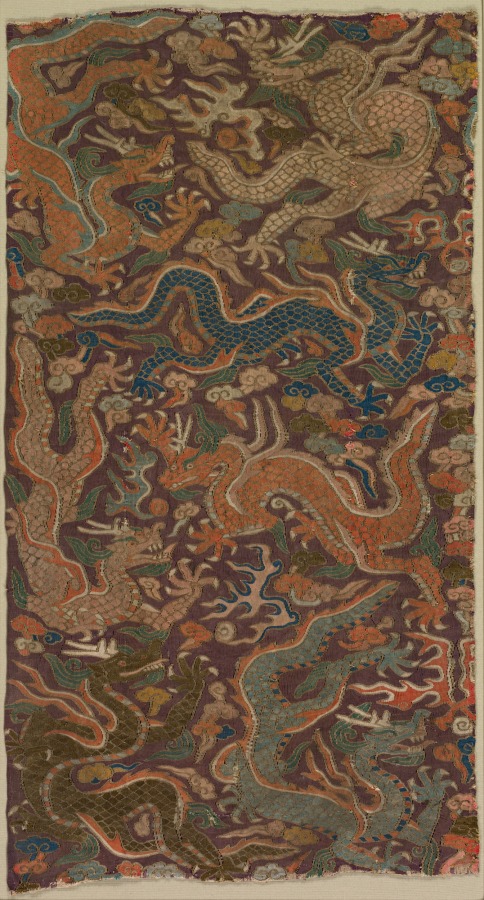
Heritage Research Artifact: The Dragon’s Pursuit of the Flaming Pearl in Imperial Silk Weaving
Introduction: A Motif of Power and Transcendence
The motif of dragons chasing flaming pearls, rendered in the lustrous, tactile medium of silk, stands as one of the most potent and enduring symbols in the lexicon of imperial Chinese textile art. This is not merely a decorative flourish; it is a codified language of authority, cosmic harmony, and spiritual aspiration. For the connoisseur of heritage—whether a Savile Row tailor, a museum curator, or a discerning collector—understanding this artifact requires a deep appreciation for the interplay between materiality, technique, and the socio-political context of its creation. The silk itself is not a passive substrate; it is an active participant in the narrative, its sheen, weight, and drape amplifying the drama of the celestial chase. This paper examines the materiality of silk as the foundational element of this heritage artifact, tracing its legacy through the imperial weaving workshops of China, and elucidating how the dragon-and-pearl motif embodies a sophisticated system of belief and power.
Materiality of Silk: The Imperial Thread
Silk is the singular, non-negotiable material for this motif. Its production, from the cultivation of mulberry trees to the delicate unwinding of the silkworm’s cocoon, was a state-controlled enterprise in imperial China, guarded as a strategic secret for millennia. The materiality of silk—its tensile strength, its capacity to absorb and reflect light, its ability to be dyed in saturated, fugitive colors—dictates the very aesthetic of the dragon-and-pearl design. Unlike wool or cotton, silk’s natural luster creates a dynamic surface that shifts with movement, allowing the embroidered or woven dragons to appear to writhe and the pearls to glow with an inner fire. The warp and weft of the silk ground, often a deep azure, vermilion, or imperial yellow, provide a dramatic backdrop against which the gold and silver threads, used for the dragon’s scales and the pearl’s radiance, achieve maximum visual impact. The weight of the silk—from the gossamer sha gauze used for summer robes to the heavy, stiff duan satin for formal court attire—determines the garment’s silhouette and the motif’s three-dimensionality. In the context of imperial weaving, the material was not chosen for comfort alone; it was a statement of dominion over nature, a harnessing of the silkworm’s life cycle to serve the emperor’s image.
The Legacy of Imperial Silk Weaving: Technique as Tradition
The creation of a dragon-chasing-pearl silk artifact was a feat of technical mastery, executed within the Jiangning, Suzhou, and Hangzhou imperial weaving workshops. These ateliers, operating under the direct patronage of the Ming and Qing dynasties, employed artisans who spent lifetimes perfecting kesi (silk tapestry) and jin (brocade) techniques. In kesi, the weaver uses a discontinuous weft technique, allowing for precise, painterly rendering of the dragon’s claws, the pearl’s flames, and the surrounding clouds. This method, painstakingly slow, produces a fabric that is identical on both sides—a hallmark of the highest quality. The jin brocade technique, conversely, incorporates supplementary wefts of gold or silver thread, creating a raised, textured surface that catches light differently from the ground silk. The legacy of these workshops is not merely in the surviving artifacts but in the codified rules of design. The number of claws on the dragon—five for the emperor, four for princes—was strictly regulated. The pearl, often depicted as a flaming orb, was not a random ornament but a symbol of the sun, the moon, or the Buddhist cintamani wish-fulfilling jewel. The choreography of the chase—the dragon’s sinuous body, the pearl’s position relative to its open jaws—was dictated by cosmological principles, ensuring that the garment conferred not just status but cosmic alignment upon its wearer.
Symbolism and Context: The Dragon, the Pearl, and the Emperor
To the uninitiated, the image of a dragon chasing a pearl may appear as a simple, if dramatic, decorative motif. However, within the context of imperial silk weaving, it is a sophisticated allegory. The dragon (long) is the embodiment of the emperor’s power—a benevolent, rain-bringing force that also commands absolute authority. The flaming pearl represents the qi, or life force, as well as spiritual enlightenment and the attainment of immortality. The chase itself is not one of predation but of aspiration; the dragon seeks to possess the pearl, symbolizing the emperor’s pursuit of wisdom, harmony, and eternal rule. This motif was deployed on the most significant garments: the chaopao (court robe) worn during the winter solstice, the jifu (dragon robe) for official audiences, and the longpao for ceremonial occasions. The placement of the motif was equally deliberate. On a robe, the dragon might be positioned on the chest and back, with the pearl at the center, or the design might wrap around the shoulders and hem, creating a continuous narrative of pursuit. The silk’s materiality—its ability to be folded, draped, and layered—allowed the motif to move with the emperor, making him a living, breathing embodiment of the cosmic drama. The legacy of this weaving tradition extends beyond China’s borders; it influenced textile production in Japan, Korea, and, through the Silk Road, as far as the courts of Europe, where it was collected and copied, albeit often without the nuanced understanding of its symbolic weight.
Conclusion: A Legacy Woven in Light and Thread
The heritage artifact of dragons chasing flaming pearls on silk is a testament to the confluence of material mastery, technical virtuosity, and profound symbolic meaning. The silk, with its unique material properties, is not merely a canvas but an integral component of the narrative, its luster and texture elevating the design from decoration to doctrine. The legacy of imperial silk weaving, with its rigorous workshops and codified aesthetics, ensured that each artifact was a precise instrument of statecraft and spirituality. For the modern inheritor of this tradition—whether a Savile Row tailor seeking inspiration for a bespoke suit lining or a conservator preserving a Ming dynasty robe—the lesson is clear: true heritage lies not in the motif alone, but in the disciplined marriage of material and meaning. The dragon’s eternal pursuit of the pearl, rendered in silk, remains a powerful reminder that the finest artifacts are those that weave together the threads of history, technique, and belief into a fabric that endures across centuries.