← BACK TO ARCHIVES
Silk
Heritage Synthesis: Silk with Dogs and Arabic Script in Swaying Bands
Curated on Aug 01, 2026 // Node: LDN-01
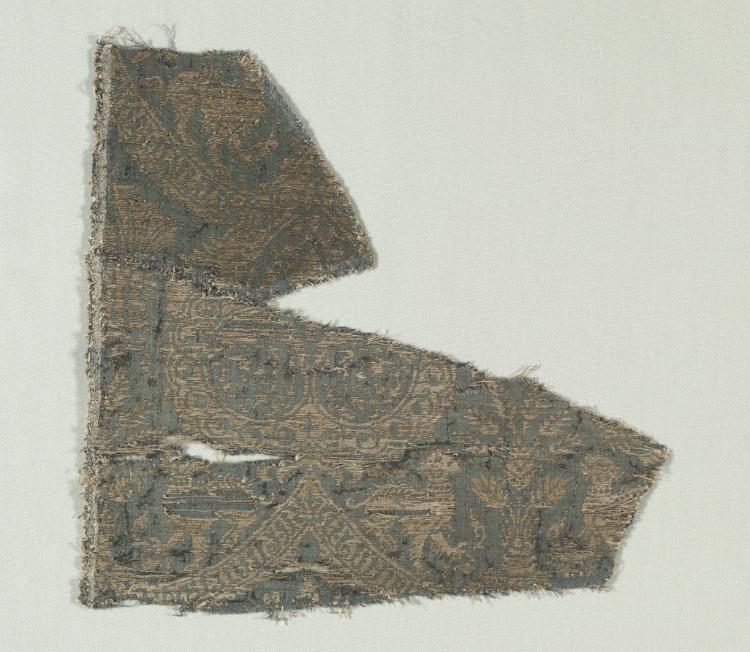
The Swaying Band: An Heirloom of Imperial Synthesis
In the hushed ateliers of Mayfair, where the cut of a sleeve is a matter of national honour, we speak of cloth not merely as textile, but as testament. The artifact before us—a length of silk bearing the entwined motifs of hounds, Arabic script, and undulating bands—is no mere remnant. It is a ledger of empire, a silent negotiation between the loom of the East and the ledger of the West. To handle this silk is to read a dispatch from a century when commerce and conquest were stitched from the same thread.
Materiality and the Imperial Loom
The ground of this piece is a *souplesse de soie*, a warp-faced silk of exceptional density, its surface cool to the touch, yet alive with a latent shimmer. This is not the flimsy gauze of a Parisian fancy; it is a cloth built for permanence, its weft packed with a discipline that speaks of Lyon’s finest *ateliers de passementerie* or, more intriguingly, of a Mughal *karkhana* operating under British patronage. The materiality itself is a political statement. Imperial silk weaving, at its zenith, was not a craft but an industry of soft power. The British East India Company, having wrested control of Bengal’s raw silk, fed these filaments into the looms of Spitalfields and Manchester, only to re-export the finished yardage back to the subcontinent. This silk, therefore, is a hybrid—its raw fibre likely subcontinental, its finishing and dyeing possibly European, its design a deliberate fusion. The weight in the hand is the weight of logistics, of monsoon shipping schedules, of colonial ledgers balanced in rupees and sterling.
Decoding the Motif: The Dog, The Script, and The Band
The iconography is where the cloth’s true diplomacy resides. The dog—rendered with a sleek, greyhound-like elongation, its musculature taut beneath a fine coat—is not the mongrel of the street. This is a *tazi*, the Persian hunting hound, a creature of aristocratic lineage. In the Mughal court, the *tazi* was a symbol of royal sport, of *shikar*, and of the sovereign’s mastery over nature. Yet, in the European imagination, the greyhound was equally noble, a fixture in heraldic crests and a companion to the English gentry. The weaver has thus created a visual pun: a single animal that reads as both Eastern and Western nobility, a shared vocabulary of elite leisure.
The Arabic script, woven in a *thuluth* or *naskh* style, is not merely decorative. It is a cartouche of legitimacy. While a Western observer might see only elegant calligraphy, the initiated eye discerns a *tughra* or a fragment of a royal *firman*—a decree. The script likely invokes blessings upon a sovereign, perhaps a Mughal emperor or, more subversively, a British monarch styled in the Oriental manner. This was a common tactic of imperial textile diplomacy: to borrow the enemy’s visual language to assert one’s own dominance. The script is not a translation; it is an appropriation. It says, “We, too, can command in your tongue.”
The swaying bands—the *mihrab*-like curves that undulate across the field—are the cloth’s rhythmic heartbeat. These are not static stripes; they are *buta* or *paisley* motifs elongated into a continuous, flowing wave. This is the visual equivalent of a courtly procession, a slow, ceremonial movement. The bands create a sense of perpetual motion, a silk that appears to sway even when pinned flat. In the Savile Row context, this is crucial. A tailored garment from this cloth would not hang stiffly; it would move with the wearer, the bands catching the light like a slow tide. The design is engineered for the body in motion, a fact that would have been appreciated by the officers and civil servants who commissioned such lengths for ceremonial dress.
Context: The Legacy of Imperial Silk Weaving
This artifact must be understood within the broader ecosystem of imperial silk. By the mid-19th century, the British had systematically dismantled the indigenous silk-weaving industries of Bengal and Kashmir, replacing them with a system of raw material extraction and re-importation. The looms of Lyons, however, remained the gold standard for luxury. They were commissioned to produce “presentation cloths”—gifts for Indian princes, tokens of alliance, and bribes for loyalty. This silk, with its fusion of motifs, was likely such a piece: a gift from a British Governor-General to a local raja, or perhaps a commission from a wealthy Parsi merchant who straddled both worlds.
The legacy is one of creative destruction. The British did not simply copy Indian designs; they re-engineered them for European looms, often with a loss of technical finesse but a gain in commercial consistency. The result is a cloth that is neither authentically Indian nor purely European. It is a third thing—a colonial hybrid, born of exploitation but yielding a strange, undeniable beauty. The swaying bands, in this light, become a metaphor for the era itself: a period of shifting allegiances, of power that swayed between courts and companies, of identities that were woven, unravelled, and re-woven.
Conclusion: A Cloth for the Connoisseur
For the modern inheritor of this heritage—the tailor, the collector, the historian—this silk offers a lesson in restraint and audacity. It is audacious in its cultural synthesis, yet restrained in its palette and rhythm. To cut a jacket from this cloth today would be to wear a document. It would demand a silhouette of quiet authority: a single-breasted, three-button coat with a soft shoulder, allowing the fabric to drape rather than be forced. The swaying bands should be aligned to flow from the left lapel to the right hip, a subtle nod to the cloth’s own kinetic energy.
In the end, this silk is not a relic of a lost empire but a living argument. It argues that luxury is never innocent, that beauty is often born of imbalance, and that the finest cloth carries within its threads the weight of history. As we handle it, we do not merely preserve it; we continue its conversation. And in the quiet of the fitting room, with the chalk and the shears, we add our own stitch to that swaying band.
Heritage Lab Insight
Lab Insight: CMA Silk Archive Node integration.