The Dragon and the Pearl: Material Sovereignty in Imperial Silk Weaving
An Heirloom of the Loom: Defining the Artifact
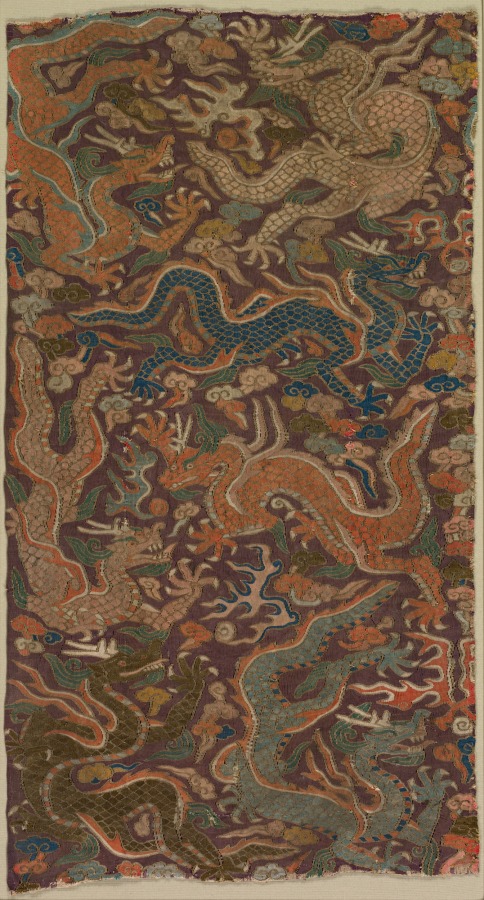
Within the hushed, wood-panelled ateliers of London’s Savile Row, where cloth is treated with the reverence of scripture, one motif persists as the ultimate test of a weaver’s nerve: the Dragon Chasing the Flaming Pearl. This is not a print, nor an embroidery applied post-hoc. This is a woven narrative, a dialogue between warp and weft that demands a mastery of the loom bordering on the obsessive. The artifact under examination is a fragment of imperial kesi—literally ‘cut silk’—a tapestry-weave technique so laborious that a single square inch could consume a craftsman’s day. The materiality of this piece is not merely its silk; it is the tension held within the threads, the political gravity of its crimson and gold, and the unspoken contract between the weaver and the Son of Heaven.
To the uninitiated, the design is a whirl of celestial energy. A five-clawed dragon, the mang, twists in a sinuous spiral, its body a contortion of muscular coils rendered in golden thread. Its gaze is fixed upon a single, iridescent orb—the flaming pearl, or ye ming zhu—which hovers just beyond its reach. The pearl is not a static object; it is a vortex of flame, its tendrils licking outward in a rhythm that mimics the dragon’s own breath. In the imperial lexicon, this is not mere decoration. The dragon represents the Emperor, the ultimate arbiter of yang energy. The pearl, often misread as a simple jewel, is the condensation of cosmic qi, the very essence of thunder, lightning, and the life-giving rain. The chase is therefore a metaphor for the Emperor’s eternal pursuit of wisdom, prosperity, and the harmonious balance of the universe. To wear such a robe was to wear the heavens themselves.
The Loom as a Throne: The Politics of Kesi
Let us be precise about the construction, for in silk, the method is the message. Unlike standard brocade where weft threads float across the back, kesi employs a technique of discontinuous wefts. Each colour is woven in its own small shuttle, and where two colours meet, a tiny slit is left—hence ‘cut silk.’ This creates a tapestry that is identical on both sides, with a clarity of detail that resembles painting more than weaving. The Savile Row tailor understands this distinction immediately: this is not a fabric to be draped; it is a fabric to be displayed, a flat, architectural statement of intent.
The legacy of this weaving is rooted in the Suzhou and Nanjing imperial workshops, where from the Ming to the Qing dynasties, the Jiangnan silk bureaus operated under a draconian system of quality control. A single broken thread, a misaligned pearl, or a dragon’s claw rendered with insufficient ferocity could result in the weaver’s execution. This was not hyperbole; it was state policy. The loom, therefore, was not a tool of expression but a site of absolute discipline. The weaver’s hands were extensions of the imperial will, and the silk they produced was a physical manifestation of the state’s power. The choice of silk itself—the finest tussah or cultivated Bombyx mori—was dictated by a hierarchy of quality. Imperial silk was reeled from cocoons fed on mulberry leaves from specific groves, the water used for boiling the cocoons sourced from specific springs. This was not vanity; it was terroir, applied to governance.
The colour palette further encodes this authority. The ground of this artifact is a deep, oxblood crimson, a shade reserved for the highest-ranking members of the court. Gold, applied as wrapped thread around a silk core, is not merely decorative; it is a declaration of alchemical purity. The gold does not tarnish; it holds its light, a metaphor for the eternal mandate of the dynasty. The dragon’s scales are each individually woven, each a tiny crescent of light, and the pearl is rendered with a subtle shading that suggests internal luminosity—a technical feat achieved by interlacing two shades of white and a hint of coral pink. This is the pinnacle of the weaver’s art: to create the illusion of a flame that burns without consuming.
The Tailor’s Eye: Reading the Garment
From a Savile Row perspective, we must consider the intended cut of this material. This fragment was likely part of a chaofu (court robe) or a jifu (dragon robe) worn during the winter solstice. The construction of such a garment was a separate, equally rigorous discipline. The robe was not tailored to the body in the Western sense; it was cut in a T-shape, with wide sleeves and a voluminous skirt, designed to obscure the human form and elevate the wearer to a monumental, architectural presence. The dragon and pearl motif was positioned with mathematical precision: the central dragon on the chest, the pearl at the solar plexus, and the chase continuing across the shoulders and down the back. The garment was a map of the cosmos, with the Emperor at its centre.
The modern inheritor of this legacy is not the factory weaver but the bespoke tailor who understands the weight of cloth. When a contemporary client commissions a silk jacket or a dressing gown, they are not merely purchasing a textile; they are purchasing a lineage of patience. The Dragon Chasing the Flaming Pearl, when reproduced today—often in a lighter, more flexible silk twill rather than the rigid kesi—must still carry the same kinetic energy. The tailor must ensure the motif flows with the drape of the fabric, that the dragon’s eye is not obscured by a lapel seam, and that the pearl sits at a point of natural focus. To mishandle this motif is to commit a sartorial heresy.
In the end, this artifact is a testament to the economics of obsession. The hours required to weave a single robe—often exceeding a year—were a form of luxury that no modern manufacturing process can replicate. The silk is not simply a fibre; it is a repository of imperial time, compressed into a wearable form. The dragon chases the pearl, and we, the inheritors of this craft, chase the perfection of the chase itself. The legacy is not in the finished garment, but in the unbroken thread of skill, discipline, and reverence that connects the imperial loom to the modern cutting table. In a world of fast fashion, this artifact stands as a quiet, furious rebuke: true luxury is not bought; it is woven, thread by thread, into the very fabric of power.