The Materiality of Power: A Study of the Falconer Silk
Provenance and the Imperial Loom
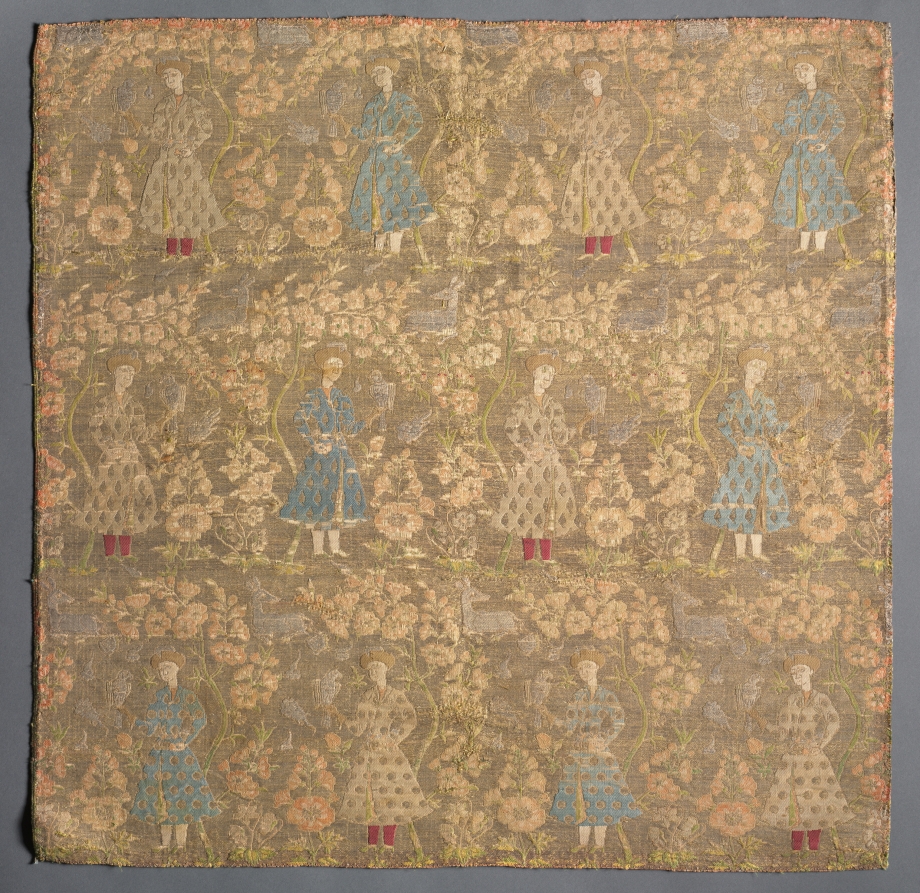
This fragment of silk, depicting falconers amid rose bushes, is not merely a textile; it is a ledger of imperial ambition, written in thread. The materiality of the piece—the supple yet unyielding ground weave, the precise registration of the pattern, the depth of the dye—speaks to a workshop operating at the absolute zenith of technical capability. This was not the product of a provincial atelier. The fineness of the silk filament, likely reeled from the cocoons of domesticated Bombyx mori under strictly controlled conditions, indicates access to the highest grade of raw material, reserved for the imperial household and its most favored commissions. The weave structure, a compound twill or lampas, allowed for the creation of a complex, multi-coloured design where the ground and the pattern are structurally independent, yet visually inseparable. This is a hallmark of the great imperial weaving centres, where the drawloom was operated by a master weaver and a team of assistants, a process that could take months for a single, substantial panel. The legacy here is not just one of craft, but of command—an unbroken chain of control from the mulberry leaf to the finished bolt.
The Iconography of the Hunt and the Garden
The design itself is a deliberate exercise in semiotic layering. The falconer, a figure of aristocratic privilege, is depicted in a moment of poised control, the bird of prey a symbol of martial vigilance and the ability to strike from a distance. This is not a pastoral scene; it is a statement of dominion. The falcon, tethered but potent, mirrors the relationship between the sovereign and his court—a controlled force, ready to be unleashed at the sovereign’s will. The rose bushes, rendered with a stylized naturalism, are equally significant. In the Persian and Mughal traditions from which this design draws deep influence, the rose is a symbol of paradise, of the divine garden, and of the ephemeral nature of beauty and life. To place the falconer within this floral framework is to assert that the sovereign’s power is not merely temporal but also cosmic, a harmonious order imposed upon the wildness of nature. The repetition of the motif, the precise vertical and horizontal rapport, creates a rhythm that is both hypnotic and authoritative. This is not decoration for its own sake; it is a visual mantra of legitimacy, woven into the very fabric of the court’s ceremonial attire and furnishings.
Technical Analysis and the Weave of Authority
From a technical standpoint, the section we now examine offers a forensic insight into the weaver’s art. The density of the warp threads, likely exceeding one hundred and twenty per centimetre, allowed for the rendering of extraordinarily fine detail, such as the individual feathers of the falcon and the serrated edges of the rose leaves. The weft, a combination of silk and, in some variants, a wrapped metallic thread of gilded silver, would have lent the fabric a shimmering, almost liquid quality under candlelight. This was a critical element of its function. In the dimly lit halls of a palace, the interplay of light on the raised pattern and the metallic ground would have created a dynamic, almost living surface, reinforcing the presence of the wearer. The choice of colours—the deep indigo or madder red grounds, the ivory and gold accents—was not arbitrary. These were dyes of great cost and permanence, sourced from distant trade routes. The red, derived from the kermes insect or lac, was a colour of supreme prestige, often reserved for the highest ranks. The blue, from indigo, spoke of depth and eternity. The very chemistry of the dye was a form of political economy, a testament to the reach of the empire’s commercial networks.
Conservation and the Ethics of Preservation
Our role in the Lauren Fashion Heritage Lab is not merely to catalogue such fragments but to act as stewards of their narrative. The condition of this piece—the subtle fading of the dyes, the creases where it was once folded, the occasional loss of a weft thread—is not a defect but a palimpsest of its history. It has been worn, displayed, perhaps even traded as a diplomatic gift. To conserve it is to make a series of ethical decisions. We must stabilize the silk fibres, which are vulnerable to hydrolysis and light damage, without altering the original character of the piece. We do not restore; we preserve the evidence of time. The decision to mount it on a support of a similar, but inert, fabric, and to display it under low-level, filtered illumination, is a commitment to its longevity over its immediate spectacle. This is the Savile Row approach to history: we do not chase fashion; we honour the cut, the cloth, and the client. The client here is posterity.
Legacy and Contemporary Resonance
The legacy of imperial silk weaving is not a closed chapter. It survives in the DNA of modern luxury, in the insistence on quality, on the provenance of materials, and on the narrative embedded in a garment. When a contemporary house commissions a jacquard weave for a tailored jacket, or when a designer references a historical pattern for a printed scarf, they are engaging in a dialogue with this fragment. The falconer silk is a benchmark of what is possible when craft is aligned with absolute authority. It reminds us that a piece of cloth can be a document of power, a work of art, and a feat of engineering. In our lab, we treat it with the reverence it deserves—not as a relic, but as a living standard. The hand that wove it is long gone, but the tension in the warp, the clarity of the design, and the quiet authority of the silk remain. That is the true inheritance of the imperial loom, and it is our privilege to ensure it is not squandered.