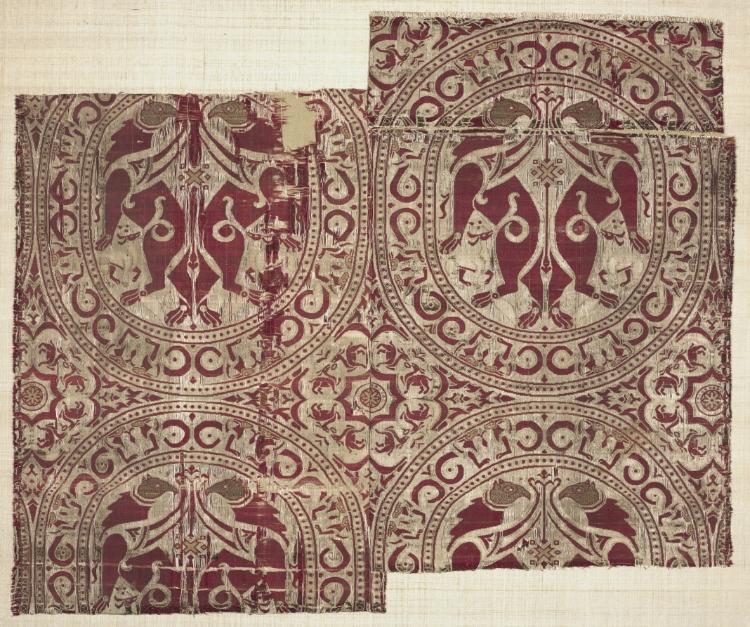
The Imperial Thread: A Study of the Lampas with Griffins in Roundels, Reliquary of Saint Librada
Provenance and the Language of Power
In the hushed, stone-veined ambulatory of Siguenza Cathedral, beneath the gilded gaze of reliquaries and the faint scent of beeswax, lies a fragment of textile that speaks not of provincial piety, but of imperial ambition. The lampas with griffins in roundels, preserved as the wrappings of the Reliquary of Saint Librada, is a masterclass in material diplomacy. It is a document written in silk, a ledger of power, and a testament to the enduring legacy of the great weaving ateliers of the medieval Mediterranean. For the discerning eye, this is not merely cloth; it is the very fabric of empire, a relic of a world where the loom was as potent an instrument of statecraft as the sword.
To understand this piece is to understand the Byzantine and, subsequently, the Islamic-Sicilian and Iberian silk industries as the arbiters of prestige. The lampas weave itself—a compound structure where a ground weave and a pattern weave are bound together, allowing for intricate, polychrome designs—was the pinnacle of technological achievement in its era. Unlike simpler twills or tabbies, a lampas permitted the weaver to create a tapestry-like clarity of image on a supple, drapeable ground. The griffin, a chimera of lion and eagle, was not a whimsical choice. In the imperial lexicon, it signified vigilance, strength, and the dual nature of Christ—human and divine. Its placement within a roundel, a perfect geometric circle, further reinforces a cosmology of order, a microcosm of the celestial sphere rendered in thread. This was a fabric designed to clothe emperors, to shroud the sacred, and to communicate a lineage that stretched back to the courts of Constantinople.
Materiality and the Art of the Loom
Let us consider the materiality with the gravity it deserves. This is not a coarse, utilitarian textile. The silk itself is of the highest grade—long, continuous filaments reeled from the cocoon of the Bombyx mori, a monopoly guarded fiercely by the Eastern Empire for centuries. The thread count is extraordinary; the weaver’s hand, guided by a drawloom of immense complexity, has produced a density of pattern that feels almost architectural. The griffins are not merely embroidered or printed; they are woven into the very structure of the cloth, their wings, talons, and curling tails rendered with a crispness that defies the softness of the medium. The palette, likely a deep, resonant red or blue derived from kermes or indigo, with accents of undyed silk for the highlights, would have shimmered under candlelight, creating a play of light and shadow that was nothing short of theatrical.
The technical mastery required for such a lampas is staggering. The weaver had to coordinate hundreds of warp threads, each controlled by a complex system of heddles and pattern cords, to execute the design. This was not a cottage industry; it was a state-sponsored manufactory, often housed within imperial palaces or royal workshops. The presence of such a textile in Siguenza, a cathedral in the heart of Castile, is a testament to the vast trade networks and diplomatic gifts that crisscrossed the medieval world. It arrived not as a bolt of cloth for a local tailor, but as a finished, prestigious object—perhaps a garment, a pall, or a length of fabric given as a royal endowment—later repurposed to enshrine the relics of a saint. This act of repurposing is itself significant. It is the ultimate elevation of material to the sacred, a transformation from the secular grandeur of a court to the eternal glory of a reliquary.
The Legacy of Imperial Silk Weaving
The legacy of this weaving tradition is not merely historical; it is a lineage of taste that persists to this day. The technical innovations of the Byzantine and Islamic looms—the drawloom, the compound weave, the use of metal-wrapped threads—were the precursors to the great European silk industries of Lucca, Venice, and Lyon. The griffin in a roundel, a motif that originated in the ancient Near East and was codified by Byzantine court artisans, became a recurring theme in Western heraldry and decorative arts. When a Savile Row tailor today selects a silk tie with a subtle, geometric pattern, or a couture house employs a jacquard weave for an evening gown, they are, consciously or not, heirs to this legacy. The jacquard loom, invented in the 19th century, is a direct descendant of the drawloom that produced the Siguenza lampas, using punched cards to replicate the binary logic of the warp and weft.
For the modern connoisseur, this fragment offers a profound lesson in the value of provenance and the integrity of material. It is a reminder that true luxury is not about novelty, but about mastery. It is about the patience of the artisan, the rarity of the material, and the weight of history embedded in every thread. The lampas with griffins is not a decorative afterthought; it is a primary source, a historical document that tells us more about the ambitions of empires and the devotion of the Church than any chronicle could. It is the ultimate bespoke garment, cut not for a single body, but for eternity.
Conclusion: A Fabric of Eternity
In the end, the lampas from the Reliquary of Saint Librada is a study in contrasts: the softness of silk against the hardness of stone; the ephemeral nature of fashion against the permanence of faith; the earthly power of emperors against the celestial authority of saints. It is a piece that demands to be read with the same rigor as any legal document or treaty. Its warp and weft are the threads of history, and its pattern is the signature of a civilization. For those who understand the language of cloth, this is not a relic of a bygone age; it is a living standard. It sets the bar for what we should expect from our own materials—not just beauty, but meaning; not just craftsmanship, but legacy. And that, in the final analysis, is the true hallmark of enduring quality. It is the cut that never dates, the cloth that never tires, and the story that never ends.