Category: Silk
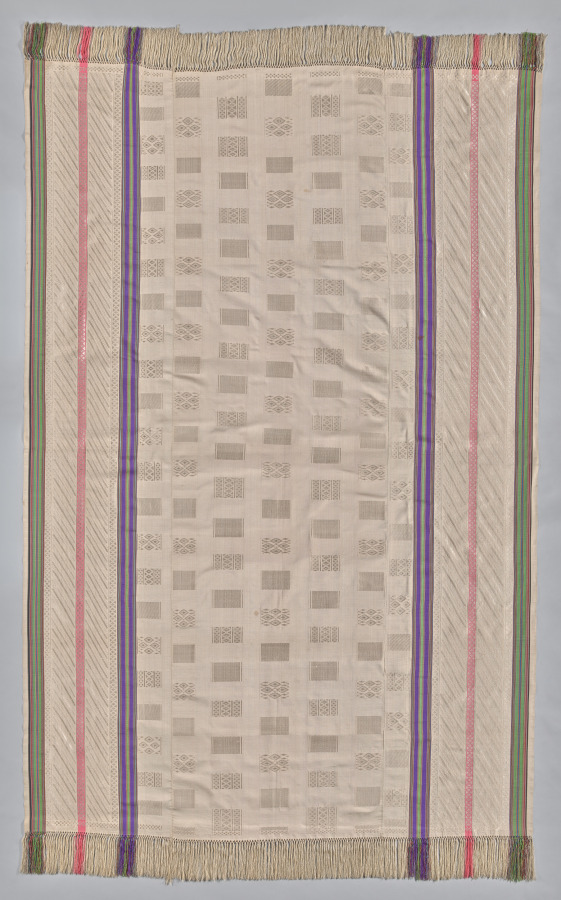
An Heirloom of Imperial Craft: The Wrapper (Lamba Akotifahana)
In the hushed, paneled quiet of a Savile Row fitting room, one speaks of cloth not as mere commodity but as biography. The cutter’s shears respect the nap, the tailor’s needle honors the weave, and the client understands that a garment is a covenant between maker, material, and moment. It is with this same reverence—this same exacting attention to provenance and hand—that we must approach the Wrapper (Lamba Akotifahana). This is not a scarf, nor a shawl, nor a decorative afterthought. It is a document of imperial ambition, a testament to the audacity of silk, and a masterpiece of Malagasy weaving that deserves a place in the canon of global luxury textiles.
The Lamba Akotifahana, at its most elemental, is a rectangular wrapper, typically measuring between two and three meters in length. But to reduce it to dimensions is to ignore the very soul of the piece. The name itself—akotifahana—translates from Malagasy as “woven with skill,” a modest descriptor for a textile that required the coordination of an entire aristocratic household and the patience of a saint. The materiality is unyielding: pure silk, often wild silk (landibe) or, in later iterations, imported Chinese filament silk, chosen for its tensile strength and its capacity to hold the most intricate of supplementary weft patterns. The ground weave is typically a plain or twill structure, but the genius lies in the lambamena technique—a discontinuous supplementary weft that allows the weaver to build up dense, figurative motifs that float upon the silk ground like embroidery, yet are inseparable from the cloth itself.
The Imperial Thread: Context and Provenance
To understand the Lamba Akotifahana, one must understand the court of the Merina Kingdom in 19th-century Madagascar, specifically under the reign of Queen Ranavalona I and her successors. This was an era of aggressive political consolidation and diplomatic engagement with European powers—chiefly Britain and France. The Merina elite, acutely aware of the symbolic power of dress, transformed the Lamba from a simple garment into a political uniform. The silk wrapper became the sartorial language of the court, a visual assertion of sovereignty, wealth, and cosmopolitan sophistication.
The imperial silk weaving industry was not a cottage craft; it was a state-sponsored enterprise. The Andriana (nobility) and Hova (freemen) classes oversaw the cultivation of mulberry trees and the rearing of silkworms, often under royal decree. The looms were not the narrow strip looms of West Africa, but wide, horizontal treadle looms, capable of producing a cloth of substantial width—a technical feat that allowed for grand, uninterrupted pictorial fields. The weavers, predominantly women of high status, were not anonymous laborers; they were artists whose reputations were tied to the precision of their geometric borders and the liveliness of their central medallions. To commission a Lamba Akotifahana was to commission a portrait of one’s own standing, rendered in lustrous thread.
Materiality and the Language of Silk
Why silk? The answer lies in the very physics of the fiber. Silk’s triangular prism-like structure refracts light, giving it a chameleon-like quality—it shifts from ivory to gold to deep amber as it catches the candlelight of a royal audience or the equatorial sun of the highlands. This optical dynamism was not lost on the Merina court. In a society where rank was visually codified, silk offered an unmatched medium for spectacle. The Lamba Akotifahana was worn draped over the shoulder or wrapped around the body, and with every movement, the silk rippled, the patterns—often featuring rosettes, zigzags, and stylized floral or zoomorphic forms—seemed to breathe.
The materiality also speaks to a deliberate engagement with the global silk trade. By the mid-19th century, Madagascar was not isolated. British missionaries and French traders brought with them not only Bibles and rifles but also textiles. The Merina weavers, however, did not simply imitate European brocades. They indigenized the material, subverting European floral motifs into distinctly Malagasy iconography. The result is a hybrid artifact—one that acknowledges the imperial silk routes (from China to India to Europe to the Indian Ocean) while asserting a fiercely local aesthetic. The silk is not a passive import; it is an active agent in a dialogue of power.
The Legacy of Imperial Weaving: A Cut Above the Ordinary
The legacy of this imperial weaving tradition is not merely historical; it is a standard against which contemporary luxury must be measured. The Lamba Akotifahana demands a level of craftsmanship that is almost extinct. Consider the count of the weft: a single wrapper may contain thousands of supplementary weft insertions, each one manually manipulated to create the raised, almost sculptural patterns. There is no room for error. A single misaligned thread compromises the entire geometric rhythm. This is not the mechanical precision of a Jacquard loom; it is the organic, breathing precision of a human hand guided by generations of embodied knowledge.
For the modern connoisseur—the client who appreciates the drape of a Huntsman overcoat or the structural integrity of a Gieves & Hawkes waistcoat—the Lamba Akotifahana offers a parallel experience. It is a garment that demands to be worn with intention. It is not casual. It is ceremonial. It is the textile equivalent of a bespoke suit cut from a bolt of cloth that no longer exists. The silk, often aged and mellowed to a patina that no chemical process can replicate, carries the memory of the imperial court. To handle a Lamba Akotifahana is to feel the weight of a kingdom’s ambition.
Moreover, the wrapper’s construction reveals a profound understanding of structural integrity. The selvedges are finished with a dense, woven border—often in a contrasting color such as deep crimson or indigo—which prevents fraying and provides a visual frame. This is not dissimilar to the meticulous edge finishing on a Savile Row lapel. The cloth is built to last, not for a season, but for generations. It is an heirloom in the truest sense, meant to be passed down, re-wrapped, and re-interpreted by each new custodian.
Conclusion: The Wrapper as a Living Standard
In an era of fast fashion and synthetic approximations, the Lamba Akotifahana stands as a quiet rebuke. It reminds us that luxury is not about logos or seasonal trends, but about material truth and artisanal integrity. The imperial silk weaving of Madagascar produced not just a cloth, but a philosophy: that the act of dressing is an act of self-definition, and that the materials we choose carry the weight of history.
For the Lauren Fashion Heritage Lab, this artifact is not a static museum piece. It is a reference point—a benchmark for what silk can achieve when it is placed in the hands of a master. The wrapper’s legacy is not confined to the Indian Ocean; it speaks to every atelier that values patience over speed, and every tailor who understands that a garment is only as good as its worst-kept secret: the hours of invisible labor that give it form. The Lamba Akotifahana is, in the final analysis, a lesson in restraint and excess—a paradox that lies at the very heart of true elegance. It is, and will remain, a masterpiece of imperial silk weaving, worthy of the most discerning wardrobe.