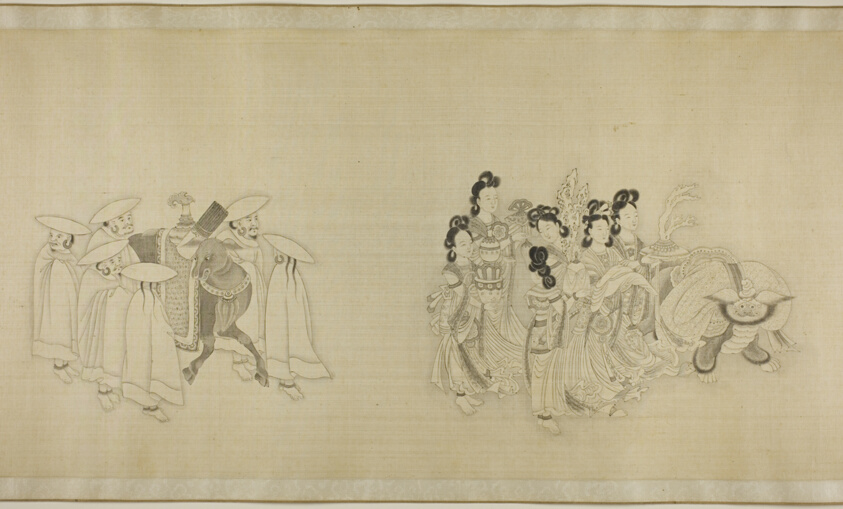
An Artefact of Diplomacy: Interpreting the Material Protocol of the Tribute Handscroll
The artefact under consideration—a handscroll depicting the formal presentation of tribute by foreign envoys—represents far more than a mere pictorial record. It is, in essence, a consummate exercise in material diplomacy. Executed in ink upon silk, its very constitution speaks to a profound understanding of protocol, hierarchy, and the theatre of statecraft. To analyse this piece is to engage with the foundational grammar of classical Sino-centric international relations, rendered not through text alone, but through the deliberate and eloquent selection of medium, form, and technique. The silk ground is not a passive substrate; it is the primary actor, the sanctioned stage upon which this ritual of power and reciprocity is permanently performed.
The Sovereign Ground: Silk as a Statement of Civilisational Pre-eminence
To commission a record of such a politically sensitive ceremony on silk is to make an immediate and unambiguous statement. In the context of the era from which this scroll emanates, silk was not merely a textile; it was a technological marvel, a cornerstone of economic power, and a definitive marker of cultural sophistication. Its use here is analogous to Savile Row’s unwavering commitment to bespoke woollens from specific British mills—it immediately establishes provenance, quality, and an unassailable position within a hierarchy of materials. The silk ground declares that the court receiving the tribute is the originator, the arbiter, and the pinnacle of a coveted civilisation. The envoys, by their very presence in the scene, acknowledge this pre-eminence. The scroll’s materiality, therefore, frames the narrative before a single brushstroke is observed: the central power provides the silk, just as it provides the world order the envoys have journeyed to engage.
Fluid Elegance: The Aesthetic of Unhurried Authority
The described quality of fluid elegance is the visual corollary to the political confidence of the host empire. The ink, applied by a master hand, exploits the unique properties of the silk surface. Unlike paper, silk offers a slight resistance, a subtle *tooth*, that allows for lines of unparalleled control and rhythmic grace. The drapery of the court officials' robes, the dignified postures of the envoys, the very flow of the procession—these are depicted with a continuous, modulated line that suggests neither haste nor uncertainty. This fluidity is the aesthetic of stability. It communicates a realm so assured in its protocols and its place in the world that its proceedings move with the inevitable, graceful cadence of a natural law. Observe the rendering of the tribute objects themselves; whether exotic fauna, intricate metalwork, or rare textiles, they are depicted with a precise, flowing line that simultaneously documents their novelty and subsumes them into the ordered, elegant visual lexicon of the centre. They are recorded, and thus possessed, by this fluidity.
The Handscroll as Ritual Object: A Controlled Revelation of Power
The format of the handscroll is critical to its function. It is not a static fresco for public consumption, nor a portable album leaf for private amusement. It is a performative object, designed for intimate, controlled viewing by a privileged audience—likely the emperor, his high ministers, or later, the scholarly elite. Unrolling it from right to left is a deliberate, sequential process, mirroring the temporal progression of the tribute ceremony itself. The viewer discovers the envoys' approach, the preparation at the periphery of the court, the moment of presentation, and the imperial response in a measured, narrative unveiling. This format allows for a meticulous choreography of perception. The composition undoubtedly guides the eye, using the silk’s expanse to create spatial hierarchies—distance implying inferiority, proximity implying favour. The scroll’s material construction, with its silk joins and reinforced mountings, ensures this ritual of viewing can be repeated across centuries, the narrative and its material statement enduring long after the specific envoys and their gifts have turned to dust.
Legacy and Connoisseurship: The Artefact in the Modern Context
Today, this handscroll exists as a peerless document of heritage, demanding a connoisseur’s eye. Its value is compound: historical, artistic, and profoundly material. The condition of the silk—its colour, sheen, and structural integrity—offers a narrative of its own, a biography of preservation and reverence. The stability of the mineral-based inks against the delicate silk speaks to the technical mastery of its creation, a mastery that ensured the scene’s legibility across dynasties. To engage with this artefact is to understand that the message was always inseparable from the medium. The tribute system was a complex language of politics and economics; this scroll is its most refined dialect, spoken in the language of silk and ink. It stands as a testament to the principle that true authority is expressed not through ostentatious display alone, but through a deep, confident mastery of form, material, and the subtle, fluid elegance of unquestioned convention. In the archive of human statecraft, it remains a definitive statement—a sartorial cut, if you will, in the timeless cloth of diplomacy, executed with a precision that forever sets the standard.