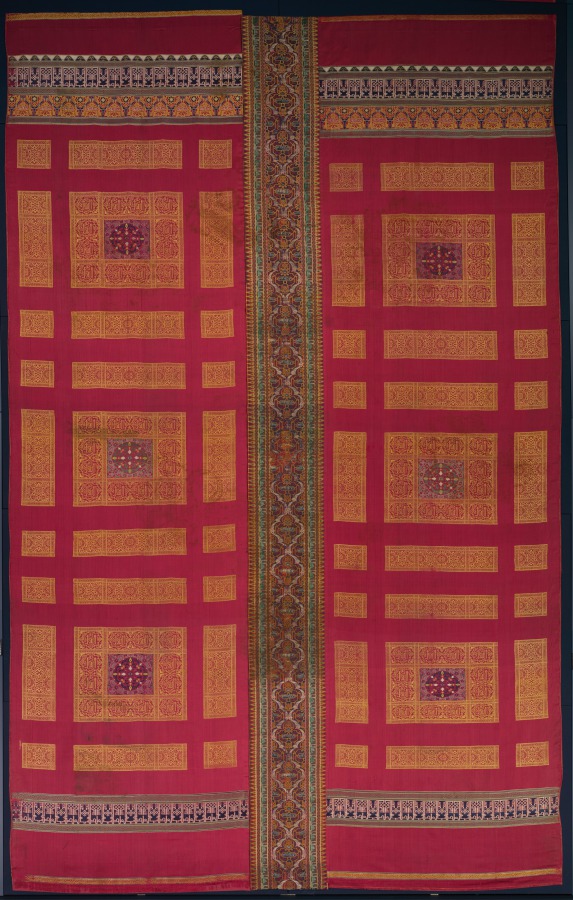
The Alhambra Palace Silk Curtain: A Study in Imperial Threads
Provenance and the Politics of the Loom
The Alhambra Palace Silk Curtain, a fragmentary yet resplendent survivor of Nasrid craftsmanship, is not merely a textile; it is a document of power, written in the language of the loom. To the discerning eye of Savile Row, where cloth is the ultimate arbiter of character, this piece speaks of a sophistication that predates the European tailoring tradition by centuries. Its materiality—pure, high-twist silk—is the first and most profound statement. In the arid climate of Andalusia, silk was not a casual luxury but a deliberate assertion of imperial reach, a thread connecting the Alhambra’s red towers to the distant mulberry groves of the East. The curtain’s very existence is a testament to the complex trade networks and artisanal hierarchies that sustained the Nasrid dynasty (1232–1492), the last great Muslim power in the Iberian Peninsula.
Unlike the sturdy wools and linens that would later define the British cloth trade, this silk was engineered for a specific, sensory purpose: to filter light, to demarcate space, and to envelop the monarch in a cocoon of divine authority. The weave structure, likely a compound twill or lampas, allowed for intricate patterning without sacrificing drape or durability. This is not a flimsy decorative piece; it is architectural in its construction, akin to the intricate stucco and tilework of the palace itself. The warp and weft are held in a taut, disciplined tension, much like the cut of a well-constructed jacket—every thread has a job, and every thread knows its place.
Materiality and the Grammar of Ornament
Examine the surface closely. The silk’s lustre, though aged and softened by centuries, retains a quiet, internal glow—a hallmark of the finest sericin-rich filaments, which were meticulously degummed and dyed using madder, indigo, and kermes. The colour palette, dominated by ivory, deep crimson, and faded gold, is not accidental. In the Nasrid lexicon, red signified life and victory, gold denoted the eternal, and white spoke of purity and the divine. The pattern, a dense repetition of epigraphic bands and geometric star motifs, is a visual prayer. The calligraphy, often quoting verses from the Quran or panegyrics to the sultan, is woven with such precision that it reads as a metallic inscription. This is where the curtain transcends mere furnishing and becomes a theological and political manifesto.
For a heritage specialist, the materiality demands a forensic approach. The silk’s tensile strength, even in its current fragmented state, indicates a high degree of twist in the warp yarns—a technique that imparted resilience and a subtle, ribbed texture. The weft, conversely, is softer, allowing the pattern to emerge with a slight relief. This interplay of hard and soft, of structural and decorative, mirrors the tailoring principle of structure versus softness that defines a Savile Row shoulder. The curtain was not meant to be seen from a distance; it was designed for intimate proximity, for the moment a courtier or ambassador approached the throne and felt the weight of the empire in the very air they moved through.
The Imperial Legacy: From Nasrid to Savile Row
The legacy of this curtain extends far beyond the fall of Granada in 1492. When the Catholic Monarchs took possession of the Alhambra, they did not discard the silk; they repurposed it, recognizing its inherent authority. Later, in the 19th century, the Romantic fascination with the Orient brought these textiles to European collectors, where they influenced everything from William Morris’s patterns to the opulent interiors of the Belle Époque. But the most resonant parallel lies in the philosophy of craft. The Nasrid weavers were bound by a tradition of oficio—a disciplined, passed-down mastery that bears a striking resemblance to the apprenticeship system of London’s tailoring houses. Both traditions demand a decade of silent observation before a single independent cut or throw of the shuttle is permitted.
Consider the structural parallels. The Alhambra curtain’s use of a repeat pattern, scaled to the architecture, is conceptually identical to the way a master cutter scales a check or a stripe to the proportions of a client’s frame. The silk’s ability to hold a fold, to create a sharp edge when pleated, is a property that a Savile Row tailor would recognise immediately. Indeed, the curtain’s original function—to divide space and create a theatrical reveal—is echoed in the dramatic unbuttoning of a bespoke jacket, where the inner canvas and hand-finished details are revealed like a hidden inscription. The imperial legacy is not one of mere imitation but of shared principles: precision, restraint, and the profound belief that material carries meaning.
Conservation and the Ethics of the Artifact
Today, the Alhambra Palace Silk Curtain exists in a state of controlled decay, preserved under low light and stable humidity in a museum environment. The ethical dilemma for the heritage specialist is one of intervention versus authenticity. Should we re-weave the missing sections, as was done in the 19th century with disastrous results, or allow the fragment to speak its own history of loss? The current consensus, much like the philosophy of a well-worn bespoke garment, is to honour the patina. The faded dyes, the slight fraying at the edges, the subtle distortions in the weave—these are not flaws but biographical data. They record the curtain’s journey from palace to battlefield, from royal court to auction house, from imperial symbol to object of scholarly study.
The materiality of the silk also dictates its conservation. Unlike wool, which can withstand a degree of abrasion, silk is proteinaceous and vulnerable to light, humidity, and pollutants. The very fineness that made it a luxury in the 14th century makes it a liability in the 21st. The specialist’s task is to create a microclimate that mimics the cool, dry storage of the Nasrid treasuries, where the curtain was likely kept rolled on wooden poles, protected by layers of linen. This is a lesson in humility: we do not own this textile; we are merely its custodians for a brief moment in its long, imperial life.
Conclusion: The Thread That Binds
The Alhambra Palace Silk Curtain is a masterclass in the power of materiality. It reminds us that silk is not just a fibre but a statement of intent—a declaration that the maker and the patron understood the alchemy of light, colour, and texture. For those of us trained in the language of cloth, it is a humbling ancestor. The Nasrid weavers achieved a level of technical and artistic integration that modern industrial looms, for all their precision, cannot replicate. The curtain’s legacy is not in its preservation but in its influence—on the patterns we see in haute couture, on the structural integrity we demand in a tailored sleeve, and on the quiet, persistent belief that what we wear and what we surround ourselves with is never merely decorative. It is, always, a political and personal testament.
As the sun sets over the Alhambra, casting long shadows through the arched windows, one imagines the curtain catching the last light, its silk threads glowing like a final prayer. It is a fitting metaphor for the heritage specialist’s craft: to hold a fragment of the past up to the light, to read its story, and to ensure that its thread—however fragile—remains unbroken for the next generation of discerning eyes.