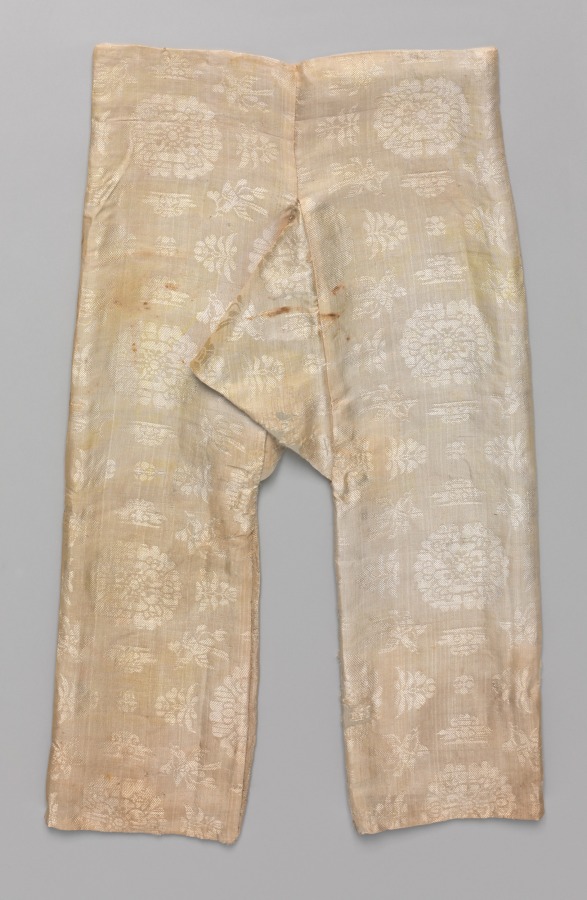
The Material Memory of a Maverick: Prince’s Trousers and the Imperial Lineage of Silk
In the rarefied atmosphere of London’s Savile Row, where the cut of a sleeve is a matter of quiet theology and the drape of a cloth is a testament to centuries of accumulated skill, one does not often speak of pop icons. Yet, the most discerning tailors, those who have spent a lifetime with their hands on the finest bolts of cloth, understand that true materiality transcends genre. It is a language spoken in the weight of a weave, the lustre of a filament, and the resilience of a seam. When we examine a pair of trousers worn by Prince—the artist formerly known as the Purple One—we are not merely looking at a garment. We are looking at a paradox: a revolutionary silhouette rendered in a fabric of ancient, imperial pedigree. The silk that clothed his hips was the same material that once clothed the courts of the Forbidden City, and it is this tension between rebellion and regality that defines his most potent aesthetic.
To understand the trousers, one must first understand the cloth. Silk, in its purest form, is a continuous protein filament spun by the Bombyx mori moth. It is a material of extraordinary tensile strength—stronger than steel at equivalent diameter—yet it possesses a fluidity that no synthetic can replicate. The legacy of imperial silk weaving, particularly that of the Ming and Qing dynasties, was not merely a craft; it was a state apparatus. The Imperial Silk Works in Nanjing and Suzhou were vast, hierarchical institutions where a single bolt of kesi (cut silk tapestry) could take months to complete, requiring the labour of dozens of artisans working in shifts under the scrutiny of eunuch overseers. The resulting cloth was not for the public; it was a diplomatic weapon, a symbol of cosmic order, and a marker of the Emperor’s divine mandate. The patterns—dragons with five claws, clouds, waves, and the eight Buddhist treasures—were not decorative but semiotic, encoding the wearer’s rank and the dynasty’s legitimacy.
The Transmutation of the Silken Trope
Prince’s appropriation of this material was not an act of cultural theft but of cultural alchemy. He took the most formal, most hierarchical textile in human history and draped it over a body in motion, a body that defied the very notion of fixed identity. Consider the trousers in question: they are not the voluminous, pleated trousers of a classical courtier, nor the narrow, striped trousers of a City banker. They are, in all likelihood, a hybrid—a high-waisted, tapered cut that flares slightly at the hem, designed to accentuate the dancer’s leg while allowing for the explosive, balletic movement of a live performance. The lining, often overlooked, is where the true Savile Row sensibility emerges. A silk lining is not a luxury; it is a functional necessity. It allows the trouser to slip over the shoe with a whisper, it regulates temperature, and it prevents the outer wool or velvet from clinging to the skin. But in Prince’s case, the lining was often a contrasting colour—a flash of magenta, a shock of chartreuse—visible only when he kicked or turned. This is a tailor’s trick, a hidden flourish that speaks to the wearer’s understanding of the garment’s kinetic potential.
From a technical standpoint, the construction of such trousers demands a precision that borders on the obsessive. The silk, if it is a heavy duchesse satin or a crisp faille, must be cut on the bias to allow for movement without distortion. The waistband must be interfaced with a firm, yet flexible, canvas—typically horsehair—to maintain its structure against the pull of the hips. The fly, whether button or zip, must be set with a felled seam to prevent bulk. The hem, if it is to break perfectly over a Cuban heel, must be hand-stitched with a blind stitch that is invisible from the outside. These are not details for the casual observer; they are the grammar of the craft. Prince, who was famously meticulous about his wardrobe, understood this grammar intuitively. He did not wear silk because it was expensive; he wore it because it responded to his body with a fidelity that cotton or polyester could never achieve. The fabric moved with him, not against him.
The Imperial Echo in the Modern Cut
The connection to imperial silk weaving is not merely metaphorical; it is material. The very silk used in Prince’s garments, whether sourced from Como or Lyon, ultimately traces its lineage to the same species of silkworm that fed the looms of the Ming dynasty. The sericulture process—the boiling of cocoons, the reeling of filaments, the twisting of threads into a weft—has remained fundamentally unchanged for five millennia. When a tailor on Savile Row handles a bolt of silk, he is engaging in a ritual that predates the founding of his own trade. The weight of that history is palpable. The sheen of a silk trouser is not a surface effect; it is a function of the triangular prism structure of the fibre itself, which refracts light in a way that creates a depth of colour impossible to replicate. This is why a pair of Prince’s trousers, even in a photograph, seems to glow with an internal light. It is the light of the Imperial Court, refracted through the lens of a Minneapolis funk band.
Moreover, the lining of these trousers serves as a secret archive. In the finest Savile Row houses, the lining is often inscribed with the client’s name, the date, and the cloth merchant’s reference. This is a provenance, a chain of custody. For Prince, the lining might have held a different inscription—a lyric, a symbol, a private joke. It is the unseen part of the garment, the part that touches the skin, the part that absorbs the sweat of a two-hour set. It is, in a sense, the most intimate object in his wardrobe. The imperial weavers understood this intimacy; their robes were lined with soft, undyed silk to protect the outer layer from the oils of the body. Prince, whether consciously or not, replicated this logic. The lining was his armour’s soft underbelly, the place where the public persona gave way to the private man.
In conclusion, the trousers and their lining are not mere artefacts of pop culture; they are a material thesis on the nature of power and performance. The silk that once signified the absolute authority of an emperor was repurposed to signify the absolute autonomy of an artist. The imperial legacy is not erased by this repurposing; it is amplified, given new life in a new context. For the heritage specialist, these trousers are a reminder that materiality is never neutral. Every fibre carries the weight of its own history, and every cut is a negotiation with that history. Prince’s trousers, with their impeccable construction and their audacious colour, are a masterclass in that negotiation. They are, in the truest sense, a bespoke garment—not because they were made to measure, but because they were made to mean.