← BACK TO ARCHIVES
Silk
Heritage Synthesis: A Myriad of Birds
Curated on Aug 03, 2026 // Node: LDN-01
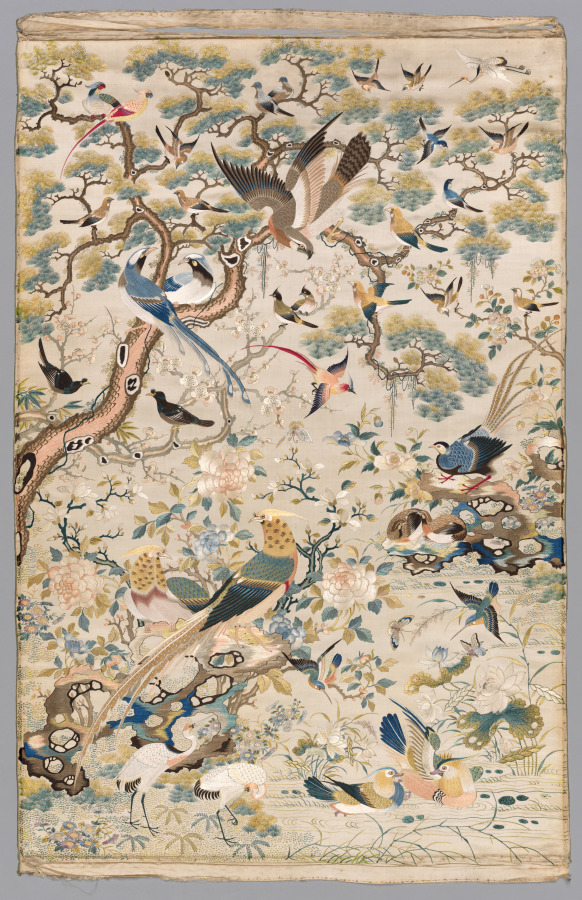
The Material Memory of Flight: Silk, Imperial Legacy, and the Ornithological Imagination
In the hushed, measured world of Savile Row, where a bolt of cloth is never merely cloth but a ledger of lineage, we understand that materiality precedes meaning. Silk, above all fabrics, carries the weight of empire in its very tensile strength. It is not simply a textile; it is a diplomatic treaty, a mercantile conquest, and a botanical secret smuggled across continents. When we speak of “A Myriad of Birds” rendered in silk, we are not discussing mere decoration. We are examining a cartography of power, painted in thread, where every feathered form is a cipher for the imperial gaze that commissioned it.
The Imperial Loom: Weaving Sovereignty into Warp and Weft
The legacy of imperial silk weaving—from the Suzhou workshops of the Qing court to the grand *manufactures* of Lyon under Louis XIV—was never an exercise in idle ornament. It was a state apparatus. The silkworm, *Bombyx mori*, was a biological asset more guarded than any gold bullion. The loom was a machine of political theology, producing textiles that did not merely clothe the sovereign but *embodied* the sovereign’s dominion over nature itself. In this context, the bird motif is profoundly significant. Unlike the dragon, which is a fixed symbol of imperial authority, or the phoenix, which is a mythological abstraction, the bird—specific, identifiable, and varied—represents the *empirical* reach of the empire. A myriad of birds is a claim to a myriad of territories.
Consider the eighteenth-century Qing dynasty, where imperial robes were not static garments but ceremonial ecosystems. The twelve symbols of the emperor included the pheasant, a bird of brightness and literary refinement. Yet the broader silks of the period, particularly those produced for the nobility and the tribute system, featured a breathtaking ornithological catalogue: the red-crowned crane (a symbol of longevity and high rank), the mandarin duck (fidelity), the magpie (joy), and the egret (purity). Each bird was not chosen for aesthetic whim but for its precise semantic value within the Confucian bureaucracy. To wear a silk robe with a specific bird was to declare one’s rank, one’s moral alignment, and one’s place in the cosmic hierarchy. The silk was the medium; the bird was the message.
The Ornithological Gaze: Silk as a Scientific Archive
Yet the “myriad” is key. This is not a single, heraldic emblem. It is a multiplicity, a catalogue. This shift from singular symbol to pluralistic representation mirrors the Enlightenment’s scientific impulse, which the imperial courts absorbed and adapted. The silk workshops of the eighteenth and nineteenth centuries began to produce lengths of fabric that functioned as proto-botanical and ornithological plates, woven with a precision that rivaled the engraved illustrations of Buffon or Audubon. The weaver’s draft became a taxonomic index.
The materiality of silk is crucial to this scientific function. Unlike cotton or wool, silk’s filament is a continuous protein fiber, allowing for an extraordinary density of warp and weft threads—often exceeding 120 threads per centimeter in high-grade imperial silks. This density permits the weaver to achieve a chromatic and linear fidelity that is almost painterly. The subtle iridescence of silk, its ability to shift hue under different light, mimics the living, shifting plumage of a bird in flight. The sheen of the fabric is not a decorative afterthought; it is a functional property that gives the bird’s eye a glint of life, the wing a suggestion of motion. In this sense, the silk is not a passive canvas. It is an active participant in the illusion of life, a frozen moment of avian vitality captured within the disciplined grid of the loom.
For the Savile Row tailor, this presents a unique challenge and a profound respect. We do not cut silk casually. A patterned silk with a myriad of birds demands a geometric mindfulness that borders on the obsessive. The pattern must be matched at the seams with a precision that respects the original weaver’s intent. To misalign a crane’s wing at the shoulder seam is not a tailoring error; it is a historical desecration. The tailor becomes a conservator, and the garment becomes a portable museum.
From Court to Clientele: The Modern Inheritance
The legacy of imperial silk weaving did not die with the fall of dynasties. It was transmuted. In the nineteenth century, as trade routes opened and the East India Company expanded its reach, these silks flooded into European markets. The great houses of London—the precursors to the modern Savile Row establishments—acquired these bolts of fabric, not as raw material but as finished artifacts. They were used for dressing gowns, for waistcoats, for the linings of opera capes. The imperial bird, once a symbol of Confucian authority, became a signifier of the British gentleman’s cosmopolitan taste and his empire’s global reach.
Today, when we handle a length of vintage silk bearing a myriad of birds, we are handling a palimpsest. Beneath the surface of the woven pattern lies the labor of the anonymous Chinese weaver, the mercantile ambition of the Dutch or British trader, and the aesthetic discernment of the Victorian dandy. The garment we create is a composite of these histories. It is not a reproduction; it is a reinterpretation. We honor the original materiality by allowing the silk to dictate the cut. A stiff, heavy imperial silk demands structure—a smoking jacket with a shawl collar, a Nehru jacket with a mandarin stand. A lighter, more fluid silk suggests a lining, a flash of color and pattern that reveals itself only in movement, a private joke between the wearer and the observer.
Conclusion: The Thread of Continuity
In the end, “A Myriad of Birds” in silk is a testament to the enduring dialogue between nature, power, and craft. The imperial looms are silent, but their output remains vibrantly, almost dangerously, alive. The birds are not dead specimens pinned to a board; they are woven into a fabric that moves, breathes, and catches the light. They are a reminder that the greatest luxury is not rarity alone, but the mastery of a material that can hold a moment of natural beauty within a disciplined, human-made structure.
For us on Savile Row, the task is to respect that mastery. We do not merely sell a suit; we offer a continuation of a legacy. When a client commissions a garment from a silk of this provenance, they are not buying a piece of clothing. They are acquiring a fragment of imperial history, tailored to their own contemporary form. The myriad of birds takes flight once more, not in a Chinese court, but on the streets of London—a silent, elegant testimony to the fact that true heritage is not preserved in amber, but woven into the very fabric of our lives. The thread holds. It always has.
Heritage Lab Insight
Lab Insight: CMA Silk Archive Node integration.