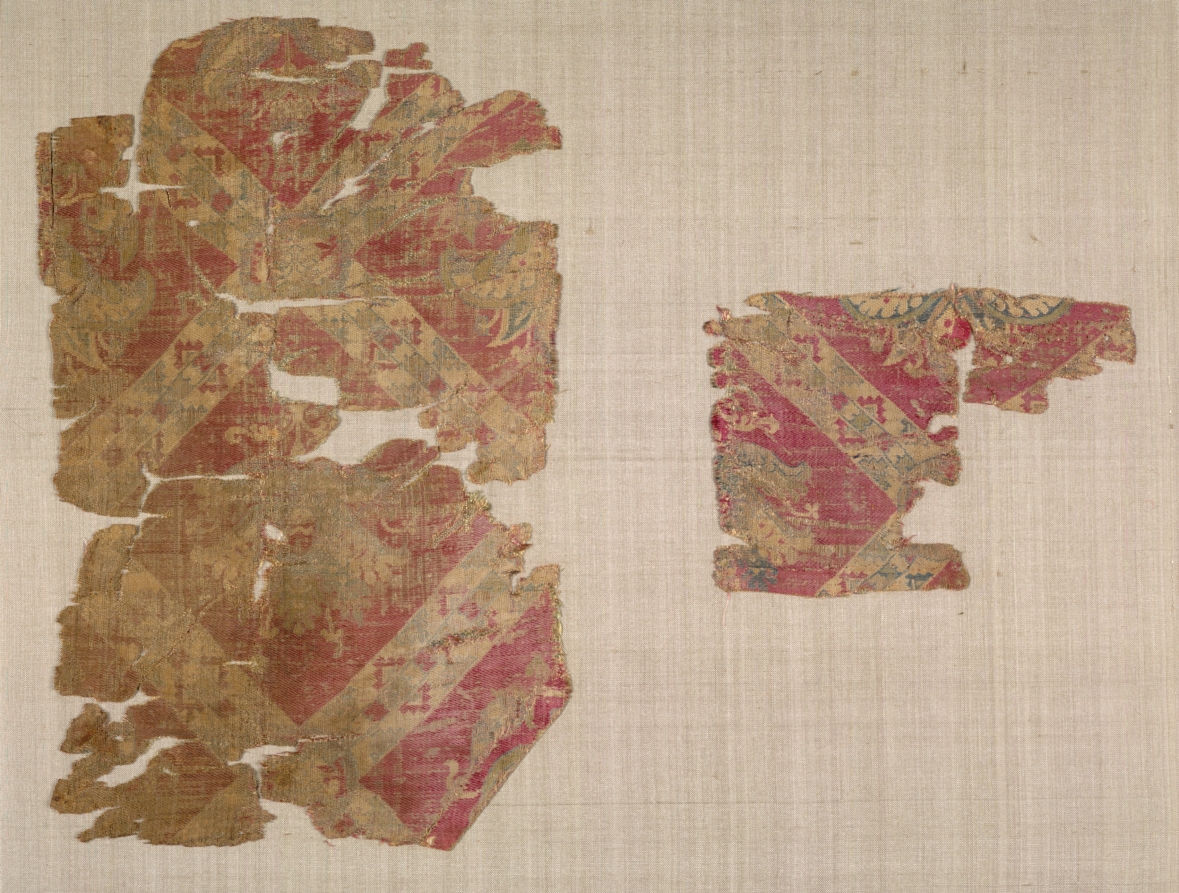
An Heirloom of the Loom: The Silk Fragment with Palmette Blossoms
Provenance and the Imperial Thread
Within the hushed archives of the Lauren Fashion Heritage Lab, certain objects do not merely speak; they resonate. The Silk Fragment with Palmette Blossoms is such an artifact. It is not a garment, nor a furnishing in the conventional sense, but a surviving chord from the grand symphony of imperial silk weaving. To hold this fragment is to hold a piece of the economic and aesthetic engine that powered dynasties, connected continents, and defined the very notion of luxury for over two millennia. Its materiality—the supple, resilient, and luminous silk—is the first and most profound testament to its origins. This is not the silk of a provincial workshop; this is the product of a state-sponsored atelier, a fabric woven under the watchful eye of imperial overseers, destined for the courts of power or the altars of reverence.
The very fibre itself is a narrative. Cultivated from the cocoons of *Bombyx mori*, the mulberry silkworm, this silk was the monopoly of the East for centuries. The secret of its production was guarded with a ferocity that bordered on the religious, and its trade along the fabled Silk Road was the lifeblood of global commerce. In this fragment, we see the culmination of that history—a material so precious that its creation was a ritualised act of statecraft. The hand of the weaver, likely a master artisan in a dedicated imperial manufactory, is evident in the evenness of the weave, the density of the thread, and the flawless tension that has allowed the fabric to survive, in remarkably good order, the depredations of time.
The Palmette: A Motif of Eternal Return
Our eye is then drawn, inevitably, to the design. The palmette blossom, a stylised fan of radiating leaves or petals, is a motif of profound antiquity, yet here it is rendered with a freshness and vitality that belies its age. It is not a static emblem but a living, breathing form, captured in a moment of perfect symmetry. The palmette’s journey is a cartographic exercise in cultural transmission. It appears in the acanthus leaves of Greek and Roman architecture, the lotus motifs of ancient Egypt, and the intricate arabesques of the Islamic world. But in the context of imperial Chinese silk, the palmette takes on a specific, resonant meaning. It is often associated with the Buddhist lotus, a symbol of purity and spiritual awakening, and with the peony, the king of flowers, representing wealth and honour.
Here, the palmette is not merely decorative; it is a coded language of status. The precise, almost mathematical arrangement of the blossoms suggests a design approved by the imperial court, a pattern that would have been reserved for the highest echelons of society. The colours, even in their faded state, speak of expensive, mineral-based dyes—the deep indigo of the background, the subtle ochre and cinnabar of the blossoms—pigments that were as costly as gold. To wear a garment woven from such cloth was to announce one’s place in the celestial hierarchy. It was a declaration of fidelity to the emperor, a visual affirmation of the cosmic order that placed the Son of Heaven at its apex.
Materiality and the Language of Touch
The materiality of this fragment is not a passive quality; it is an active agent in its story. The silk’s characteristic drape and its ability to catch and reflect light are intrinsic to its value. Unlike the heavier, more textured weaves of later periods, this fragment suggests a fabric of exceptional fineness, likely a plain or twill weave, designed to be worn close to the skin or used as a lining for a more substantial outer robe. The tactile sensation—the cool, smooth glide of the silk against the fingertips—is a direct link to the individual who once wore it. We can imagine the weight of the garment, the whisper of the fabric as the wearer moved, the subtle play of light across the palmette blossoms as they caught the flickering candlelight of a palace hall.
Furthermore, the condition of the fragment is a study in preservation. The edges are frayed, the colours have mellowed, and there are faint creases and folds that speak of a life lived, of being packed away, perhaps, in a cedar chest or a lacquered box. These imperfections are not flaws; they are the patina of history. They are the physical evidence of the object’s journey from the imperial loom to the present day. The fragment was likely part of a larger textile—a robe, a hanging, or a ceremonial banner—that was later cut down or repurposed. This act of re-use is itself a historical footnote, suggesting a period of transition or perhaps a change in fashion, when the old forms were deemed obsolete but the precious material was too valuable to discard.
Legacy and the Modern Connoisseur
For the modern connoisseur, for the discerning client of Savile Row, this fragment offers a profound lesson in the lineage of luxury. It is a reminder that true quality is not a fleeting trend but a timeless standard. The principles that governed the creation of this silk—the selection of the finest raw materials, the mastery of a complex craft, the adherence to a rigorous aesthetic standard, and the implicit understanding of the garment’s social significance—are the very same principles that underpin the finest tailoring in London today. The cut of a jacket, the fall of a trouser, the set of a sleeve: these are all acts of material storytelling, just as the weaving of this silk was an act of imperial narrative.
The palmette blossom, in its eternal return, finds a new resonance in the contemporary wardrobe. It is a motif that speaks to a globalised aesthetic, a recognition that beauty is a shared language that transcends borders and epochs. To incorporate a silk such as this into a modern design—perhaps as a lining for a bespoke dinner jacket or as the fabric for a statement scarf—is to engage in a dialogue with history. It is to acknowledge that the wearer is not merely a consumer of fashion but a participant in a continuum of taste and discernment that stretches back to the very origins of civilisation. The fragment, therefore, is not a relic to be admired from a distance. It is a source of inspiration, a benchmark of excellence, and a tangible reminder that the most enduring luxury is the one that carries the weight of its own history with grace and integrity. It is, in the truest sense, an heirloom of the loom.