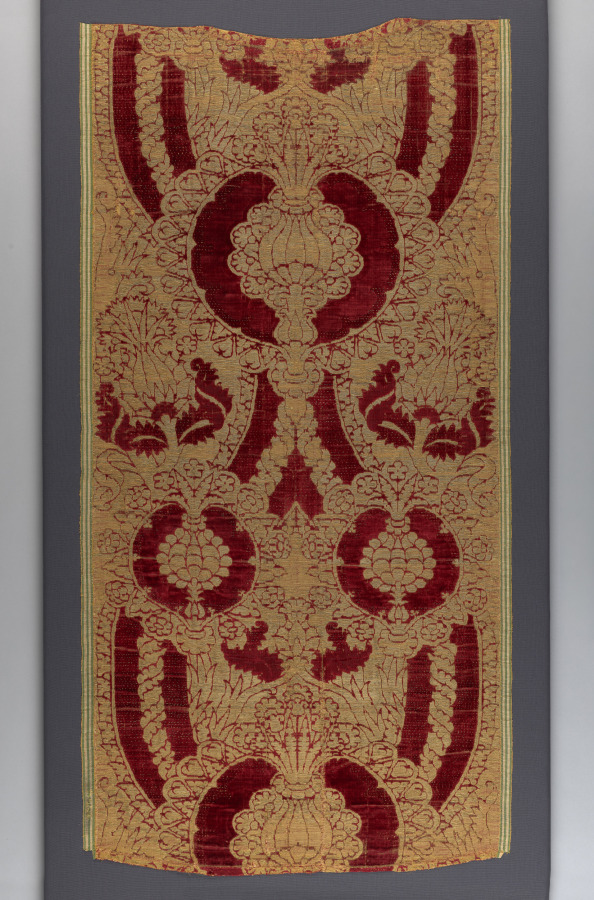
On the Substantive Nature of Silk Velvet: A Consideration of the Pomegranate Pattern in Gold
The connoisseur, upon first encountering a panel of imperial silk velvet, is struck not merely by its visual splendour but by a profound and immediate sense of substantiality. This is no gossamer gauze, no fleeting chiffon. Velvet, in its very essence, represents silk in its most assertive, most architectural form. The foundation is a ground of the finest mulberry silk, a tight, strong warp and weft forming the canvas. Upon this, a second set of warp threads is introduced, looped over a rod to create the pile. The subsequent cutting of these loops—a moment of irrevocable commitment by the master weaver—releases that dense, luminous plush which defines the cloth. The result is a material of extraordinary depth, both literal and figurative, possessing a weight and a gravity that commands respect. It is a textile that does not merely drape; it articulates. In the context of imperial legacy, this materiality was paramount. It translated abstract power into tangible, tactile experience, a medium through which authority could be physically felt.
The Pomegranate Motif: An Emblem of Sovereign Promise
To adorn such a consequential ground, a motif of equal rhetorical strength was required. The pomegranate, rendered in gold, fulfilled this role with impeccable symbolism. Its adoption was never a matter of mere ornament; it was a deliberate deployment of iconography. The fruit, bursting with a multitude of seeds, was a near-universal emblem of fertility, abundance, and dynastic continuity—concerns paramount to any imperial court. Its crowned calyx echoed the very regalia of monarchy, a natural coronet. The pattern, typically arranged in precise, repeating rows or within ornate ogival frameworks, presented a vision of perfect, ordered prosperity. It spoke not of wild, untamed nature, but of nature mastered, cultivated, and harnessed to the symbolic language of the state. The choice was, in essence, a statement of intent: a declaration that the realm would be fruitful, its lineage secure, and its bounty perpetual.
The Alchemy of Gold: Illuminating the Weave
The execution of this motif in gold thread elevates the textile from the exemplary to the sublime. This was not the simple application of metallic pigment, but the integration of actual gold, beaten into fine foil and wound upon a silk core. The technical prowess involved cannot be overstated. The gold thread, being less pliant than silk, demanded a slower, more deliberate loom action and a master’s touch to maintain tension and consistency. Its incorporation into the velvet pile created a surface of dynamic, kinetic luminosity. Unlike the flat gleam of satin, the piled gold of velvet possesses a mutable fire. Light does not simply reflect off it; it is captured, held within the depths of the pile, and re-emitted as a soft, glowing radiance that shifts with the observer’s position. This produced a garment or hanging that was quite literally illuminating, casting a warm aureate light upon the wearer and their immediate environs. The gold was both a display of staggering material wealth and a metaphor for the enlightening, glorifying presence of the sovereign.
Imperial Legacy Woven into the Very Warp
The legacy of imperial silk weaving is encoded in every element of this artifact. It represents the apex of a centralized, systematized, and fiercely protected industry. Imperial workshops, such as those of Byzantium, later the Ottoman Empire, and the Ming and Qing dynasties, were not ateliers in the romantic sense; they were highly disciplined manufactories of prestige. They controlled every variable: the cultivation of the finest silk, the secret dyes for the ground—often deep sapphire, emerald, or crimson—the sourcing of the gold, and the meticulously guarded pattern books. The pomegranate velvet was a product of this ecosystem of excellence, a collaborative masterpiece where the silkworm farmer, the dyer, the thread-beater, the pattern-draughtsman, and the master weaver each played a critical, if anonymous, role.
Furthermore, these textiles were instruments of statecraft. Bestowed as diplomatic gifts, they conveyed messages of alliance and superiority. Worn at court, they visually articulated the hierarchy, with the density of the gold and the complexity of the pattern scaling precisely with the rank of the wearer. They transformed spaces; throne rooms and audience chambers hung with such velvets became environments of overwhelming sensory power, designed to humble the visitor and exalt the ruler. The cloth was, therefore, an active participant in the theatre of power.
A Concluding Reflection on Enduring Substance
In the contemporary milieu, where fabric is often reduced to a disposable commodity, the study of such an artifact serves as a necessary corrective. This silk velvet with its gold pomegranate pattern stands as a testament to an age when textiles were considered a primary medium for expressing the most complex ideas of sovereignty, cosmology, and societal order. Its value lies not in nostalgia, but in its enduring demonstration of material intelligence.
It reminds us that true luxury—distinct from mere expense—resides in this confluence: the marriage of profound symbolic meaning with peerless technical execution, resulting in an object of palpable substance and enduring narrative power. The velvet’s weight, the depth of its pile, the burnished glow of its gold—these are the qualities that transcend the visual to become experiential. They affirm that heritage, when rooted in such tangible excellence, is never a relic of the past, but a permanent standard against which present endeavours may be, and perhaps should be, measured. It is a legacy not simply of beauty, but of formidable and considered achievement.