← BACK TO ARCHIVES
Silk
Heritage Synthesis: Chasuble Fragment with Realistic Animals
Curated on Aug 04, 2026 // Node: LDN-01
The Weight of Thread: A Chasuble Fragment and the Imperial Legacy of Silk
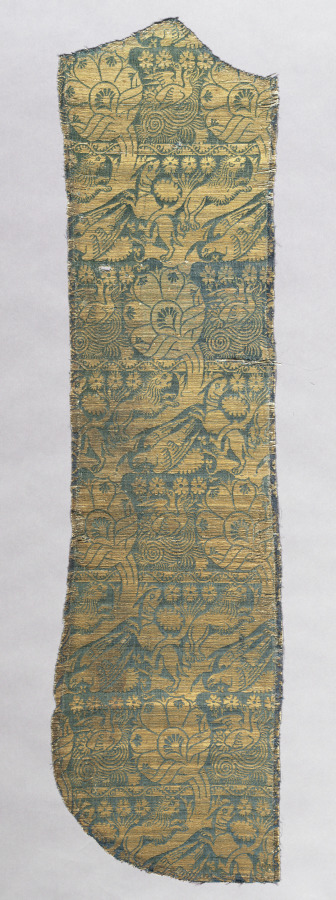
In the hushed, wood-panelled quiet of a private viewing room on Savile Row, where the air smells of aged cedar and the faint, reassuring tang of fine wool, one does not expect to be confronted by the divine. Yet here it lies, under a single beam of conservation-grade light: a fragment of a chasuble, no larger than a gentleman’s pocket square, rendered in silk. It is not the fabric’s sheen that arrests the eye, but its narrative. Woven into the warp and weft is a menagerie of startling realism—a stag, poised mid-leap, its musculature taut beneath a velvet hide; a falcon, wings folded in predatory patience, its eye a single, perfect knot of dark thread. This is not a textile. This is a testament, a contract between earthly power and celestial aspiration, signed in the most demanding medium known to the loom.
For the uninitiated, silk is a luxury. For the connoisseur, it is a language. And this fragment speaks in the fluent, authoritative dialect of imperial workshops. To understand its materiality is to understand the very architecture of empire. The silk itself—a compound weave, likely a lampas or a samite—is not a simple cloth. It is a structure of two or more sets of warps and wefts, where a ground weave provides the foundation and a pattern weave, often in a contrasting colour, rises to the surface. The result is a bas-relief in thread, a topography of light and shadow. The ground here is a deep, ecclesiastical crimson, a colour achieved not with a simple dye but with a mordant process involving kermes, the desiccated bodies of scale insects harvested from the oaks of the Mediterranean. The pattern, meanwhile, is a luminous, undyed ivory—the natural, unbleached secretion of the *Bombyx mori* silkworm. This dichotomy—the blood-red earth and the pristine, incorruptible thread—is the first layer of meaning.
The Loom as Imperial Instrument
The context of this fragment is not merely liturgical; it is geopolitical. The legacy of imperial silk weaving is a chronicle of monopolies, espionage, and the brutal economics of desire. From the Tang Dynasty’s Silk Road, where the fabric was a currency more stable than gold, to the Byzantine courts of Justinian, where the secret of sericulture was smuggled in the hollow of a pilgrim’s staff, silk was the hardware of statecraft. By the high Middle Ages, the mantle of this legacy had shifted to the Islamic world and, critically, to the Norman court of Sicily. The workshops of Palermo, established in the 12th century, were not merely factories; they were instruments of soft power, producing textiles that declared the king’s supremacy over both his Christian rivals and his Muslim subjects.
It is from this crucible—or its later iterations in Lucca, Venice, or even the great *manufactures* of 17th-century Lyon—that our fragment descends. The presence of *realistic* animals is the crucial diagnostic feature. Earlier medieval weaving, heavily influenced by Byzantine abstraction, favoured the griffin, the lion, or the eagle—heraldic, stylised, and rigidly symmetrical. They were symbols of authority, not observations of nature. Our stag and falcon, however, are different. They possess a kinetic energy, a specificity of anatomy that suggests the weaver was working not from a pattern book of fantastical beasts, but from direct observation, or at least from sketches that prioritised naturalism. This is a stylistic shift that points to the late Gothic or early Renaissance period, a time when the secular humanism of the emerging merchant class began to infiltrate even the most sacred of vestments.
The technical achievement here is staggering. To replicate the soft, dappled hide of a stag in silk, the weaver had to manipulate the pattern weft with a precision that borders on the obsessive. Each animal is not a single block of colour but a mosaic of tiny, interlocking shapes—diamonds, chevrons, and S-curves—that create the illusion of fur, feather, and muscle. This is the art of the *tessuto a opera*, a technique requiring a drawloom, a machine so complex that it necessitated a second operator, the *drawboy*, who sat atop the loom and pulled a series of cords to lift the correct warp threads for each pass of the shuttle. The pattern was not woven; it was programmed, cord by cord, in a pre-digital binary of raised and lowered threads. The margin for error was nil. A single snapped warp would cascade into a flaw that could ruin weeks of work.
From Altar to Archive: The Object’s Afterlife
The fragment’s journey from the altar to this leather-bound portfolio on Savile Row is a story in itself. A chasuble, the outer vestment worn by the priest during the Eucharist, is a garment of immense symbolic weight. To wear it is to don the yoke of Christ. To have it woven in imperial silk, with images of the hunt, is to conflate the priestly role with the princely prerogative. The stag, in Christian iconography, is the symbol of the soul thirsting for God (Psalm 42:1), while the falcon, a bird of prey, represents the swift, unerring pursuit of the divine will. The fragment, therefore, is not a mere decoration; it is a sermon in thread, a homily on the hunt for salvation.
But the physical state of the object—its edges frayed, its folds worn thin, its colours muted by centuries of candle smoke—tells a different tale. This is a relic of use, not of display. It was worn, folded, kissed, and wept over. It was laundered, mended, and eventually, when too fragile for service, it was cut apart. This was common practice. Ecclesiastical vestments were often dismantled, their precious materials repurposed into altar frontals, book covers, or, as is likely here, sold to collectors and dealers in the 19th century, when the Gothic Revival created a voracious market for medieval fragments. The chasuble was destroyed to preserve its essence, a paradox that haunts the object’s very presence.
For the modern inheritor of this legacy—the tailor, the cutter, the textile merchant—the fragment offers a profound lesson in the relationship between material and maker. On Savile Row, we speak of cloth as having a "hand," a "drape," a "body." We understand that a fabric is not a passive surface but an active participant in the creation of a garment. This chasuble fragment embodies that principle to an extreme degree. The silk was not merely a substrate for a design; the design was an expression of the silk’s structural potential. The weaver did not fight the thread; he collaborated with it, exploiting its tensile strength, its lustre, and its capacity for infinitesimal variation to create an image that is both tactile and transcendent.
In the end, this fragment is a memento mori of a different sort. It reminds us that the pursuit of perfection—whether in a medieval loom or a modern atelier—is a form of devotion. The imperial legacy of silk is not just a history of trade routes and royal decrees; it is a history of human hands, of patience, of the relentless, almost irrational pursuit of beauty. To hold this fragment is to hold a conversation with those hands across six centuries. The stag still leaps. The falcon still watches. And the silk, against all odds, still speaks. It is our job, as custodians of this heritage, to listen.
Heritage Lab Insight
Lab Insight: CMA Silk Archive Node integration.