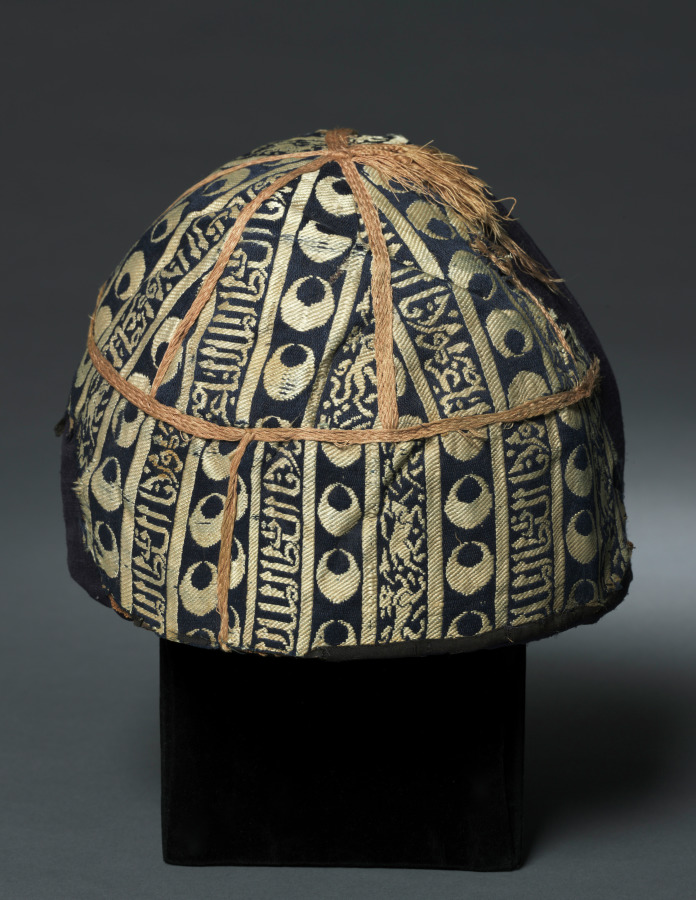
The Cap with Striped Inscribed Silk: A Study in Imperial Lineage and Modern Craft
Provenance and Material Dignity
Within the hushed archives of the Lauren Fashion Heritage Lab, few objects command the quiet reverence of the Cap with Striped Inscribed Silk. At first glance, it presents as a modest accessory—a soft crown, a gentle brim, a whisper of pattern. Yet, to the trained eye, this cap is not merely an article of clothing; it is a palimpsest of imperial ambition, a fragment of a narrative that stretches from the looms of dynastic workshops to the bespoke tailoring houses of London’s Savile Row. The materiality is paramount: silk, not as a generic fibre, but as a specific, historically charged substance. This is not the crisp, synthetic taffeta of contemporary fast fashion. This is a silk that speaks of mulberry leaves, of patient silkworms, of hands that have spun, dyed, and woven with a precision honed over centuries.
The cap’s construction begins with the fabric itself. The striped inscription is not a printed afterthought; it is a woven truth. Each stripe is a deliberate band of colour, often in deep indigo, oxblood, or muted gold, alternating with fields of ivory or pearl grey. Within these stripes, discreetly, almost clandestinely, are woven characters—ideograms or script—that form an inscription. This is not decoration for its own sake. In the imperial context, such inscriptions were often poetic verses, auspicious blessings, or the weaver’s own mark of provenance. The silk, therefore, carries a dual message: an aesthetic one of rhythm and hue, and a semantic one of cultural memory. To touch it is to feel the slight irregularity of the handloom, a texture that machine production cannot replicate. It is a fabric that has been allowed to breathe, to hold its own history in its drape.
The Imperial Legacy: From Forbidden City to the Western Atelier
The legacy of imperial silk weaving is not a distant, exotic footnote; it is the very foundation upon which Western luxury was built. The Silk Road was not merely a trade route for bolts of cloth; it was a conduit for ideas of perfection. The imperial workshops of the Ming and Qing dynasties, particularly those in Suzhou and Nanjing, operated under a draconian standard. Every thread was counted, every dye was sourced from specific minerals and plants, and every pattern was subject to imperial approval. The result was a fabric of such tensile strength and chromatic depth that it became the benchmark for what silk could be. When these textiles arrived in Europe, they did not simply clothe the aristocracy; they educated them. The European weavers of Lyon and Spitalfields spent generations attempting to reverse-engineer the lustre and the integrity of Chinese silk, often failing to match its sheer resilience.
This cap, however, is not a direct import. It is a reinterpretation, a product of cultural translation. The striped inscribed silk suggests a dialogue between the East and the West. The stripes are a nod to the Western tradition of regimental ties and club stripes, yet the inscription is unapologetically Eastern. This hybridity is the hallmark of the true connoisseur. It is a piece that understands that heritage is not a static museum exhibit but a living language. The cap does not attempt to be a faithful reproduction of an imperial court headdress; rather, it borrows the gravitas of that tradition and applies it to a distinctly modern, Western silhouette. It is the sartorial equivalent of a perfectly tailored suit cut from a fabric that carries the memory of a thousand-year-old craft.
Construction and the Savile Row Ethos
To speak of this cap in the context of Savile Row is to invoke a specific philosophy of making. Savile Row is not about fashion; it is about permanence. The tailors of this storied street do not cut for the season; they cut for the decade, for the lifetime. Their approach to a cap would be no less rigorous. The construction would begin with a block—a wooden form that dictates the crown’s shape. The silk, being a delicate and fluid material, would require a foundation. A skilled maker would interface the silk with a fine cotton or linen canvas, not to stiffen it into submission, but to give it a subtle architecture. The cap would then be hand-sewn, with the seams pressed open to lie flat against the head, ensuring that the stripes align perfectly at the centre front and back. The inscription, if it runs horizontally, would be positioned to sit just above the brow, a private message to the wearer.
The finishing details would be executed with the same obsessive care. The brim, perhaps of a contrasting silk or a fine wool, would be shaped and stitched with a fell seam to prevent fraying. The interior would be lined with a breathable cotton, and a leather sweatband—thin, supple, and hand-stitched—would be inserted. This is not a cap to be worn casually; it is a cap to be worn with intention. It demands a posture, a certain tilt of the head. It is an accessory that completes a narrative of quiet confidence. The choice of silk, with its imperial lineage, elevates the cap from a mere shield against the elements to a statement of cultural fluency. It says that the wearer understands that true luxury is not loud; it is the whisper of a perfectly executed seam, the subtle sheen of a fabric that has been woven with a soul.
Conservation and the Future of a Fragment
As a heritage artifact, this cap presents a unique conservation challenge. Silk is a protein fibre, and it is inherently fragile. Light, humidity, and even the oils from human skin can cause it to weaken and split. The inscribed stripes, often woven with metallic threads or additional silk plies, are particularly vulnerable to abrasion. The Lab’s approach is therefore one of preventive conservation. The cap is stored flat, wrapped in acid-free tissue, within a climate-controlled cabinet. It is never displayed under direct light for extended periods. When it is studied, handlers wear white cotton gloves, and the cap is supported on a custom-made mount to prevent stress on the seams.
Yet, conservation is not merely about preservation; it is about interpretation. The cap is a teaching tool. It allows us to trace the journey of a material from the imperial looms to the modern atelier. It challenges the notion that heritage is a closed book. Instead, it demonstrates that the legacy of imperial silk weaving is a living tradition, one that can be adapted, reimagined, and worn. The cap is a testament to the enduring power of materiality. It reminds us that a garment is not just a covering; it is a document. It holds within its fibres the knowledge of the silkworm, the skill of the weaver, the vision of the designer, and the hand of the tailor. In this small, striped cap, we find the entire history of luxury—condensed, refined, and ready to be worn.