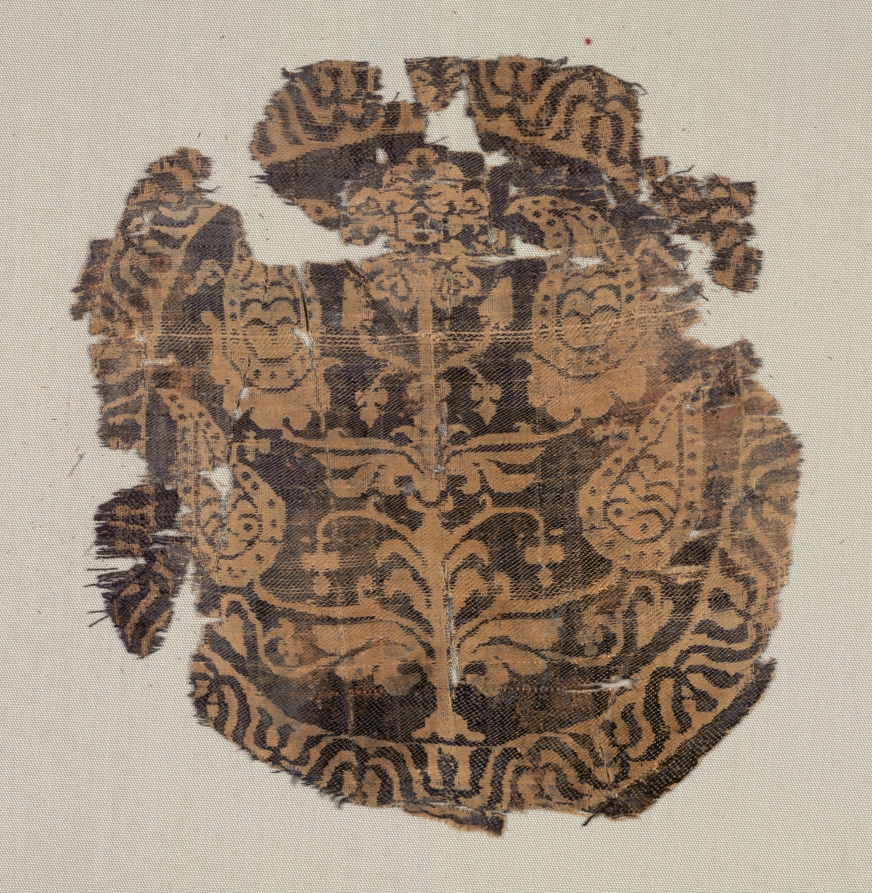
The Persistent Geometry of Power: A Study of the Roundel with Curvilinear Palmette Tree
Provenance and the Imperial Loom
In the hushed, wood-panelled ateliers of London’s Savile Row, where a tape measure is a sceptre and a basted seam is a promise, we do not merely cut cloth. We cut history. The artifact under examination—a fragmentary roundel featuring a curvilinear palmette tree, excised from a larger tunic—is not simply a piece of ancient silk. It is a ledger of imperial ambition, a memorandum of conquest, and a testament to the enduring dialogue between structure and ornament. Its materiality, the very warp and weft of its being, speaks to a legacy of imperial silk weaving that predates the industrial loom by over a millennium, yet its principles remain the bedrock of our own craft: precision, restraint, and the quiet assertion of authority through impeccable construction.
The roundel itself is a masterclass in disciplined composition. Within its circular boundary—a shape that in itself suggests eternity, totality, and the unbroken cycle of dynastic rule—we find the palmette tree, a motif of ancient Near Eastern origin, yet here rendered with a distinctly Sasanian or early Byzantine sensibility. The curvilinear treatment is crucial. It is not a static, hieratic image. The fronds of the palmette do not simply sprout; they curl, they twist, they fold back upon themselves in a rhythmic, almost calligraphic flow. This is not the wild growth of a natural organism; it is the controlled, stylised efflorescence of a courtly garden, a symbol of paradise on earth, ordered and governed by the will of the sovereign.
Materiality as Imperial Signature
Let us examine the cloth itself. The silk is not a mere substrate; it is the protagonist. In the context of imperial weaving, silk was not a commodity. It was a currency of power, a diplomatic tool, and a marker of the highest social strata. The production of such a textile required an infrastructure of staggering complexity. The sericulture, the reeling of the filament, the dyeing, and finally the weaving on a drawloom—each stage demanded specialised knowledge and a level of artisanal control that was state-sponsored and state-protected. The very fact that this roundel survives, that its colours—likely a deep madder red or indigo ground with a reserved pattern in a contrasting hue—retain a ghost of their original vibrancy, speaks to the quality of the dyeing and the fineness of the thread. This was not cloth for the masses; it was a textile engineered for the elite, its very fibres imbued with the authority of the imperial household.
The technical achievement of the weave is where the Savile Row mind finds its greatest resonance. The curvilinear nature of the palmette tree presents a formidable challenge to the weaver. Unlike simple geometric patterns, which can be achieved with a basic harness, the flowing curves of this design require a drawloom, a device that allows for the individual control of warp threads. The weaver, or more accurately the drawboy, would have to follow a complex pattern notation to lift the correct warp threads for each pass of the weft. The result is a fabric where the pattern is not embroidered or printed onto the surface, but is structurally inherent to the cloth itself. This is the essence of true luxury: the design is not an appliqué; it is the very architecture of the textile. It is the difference between a printed imitation of a pinstripe and a woven one—the former is a surface effect, the latter is a statement of integrity that can be felt in the hand and seen in the drape.
The Legacy of Imperial Weaving in the Modern Atelier
This legacy of imperial silk weaving is not a distant, dusty relic. It is a living tradition, a set of principles that continue to inform the most exacting standards of tailoring. When a cutter on Savile Row insists on a hand-stitched lapel, or a finisher presses a seam with a weight and a damp cloth, they are engaging in a practice that echoes the discipline of the ancient loom. The imperial weaver’s obsession with structural integrity—that the pattern must be woven, not applied—finds its modern analogue in the tailor’s insistence on a floating canvas, which allows the jacket to mould to the body without the stiffness of a fused interlining. Both are acts of faith in the material, a belief that true quality is not a veneer but a core property.
The curvilinear palmette tree, in its controlled asymmetry and rhythmic flow, also offers a lesson in the balance between ornament and restraint. In the best tailoring, the pattern of a fabric—be it a Prince of Wales check or a subtle glen plaid—is cut and matched with obsessive care. The stripes must align at the shoulder seam; the check must meet perfectly at the lapel notch. This is not mere fussiness; it is a form of respect for the cloth and for the history it carries. The ancient weaver who created this roundel understood that the power of the design lay not in its loudness, but in its perfect integration with the garment’s structure. The tunic was not a canvas for the roundel; the roundel was a component of the tunic’s overall authority. Similarly, a well-cut suit is not a vehicle for a loud fabric; the fabric and the cut are in a state of mutual elevation.
Furthermore, the very notion of the roundel as a discrete, medallion-like motif has a direct lineage to modern menswear. The medallion on a tie, the crest on a pair of socks, the subtle emblem on a pocket square—these are all descendants of the imperial roundel. They are small, contained statements of identity, a way of signalling allegiance or taste without resorting to overt display. The palmette tree, with its connotations of growth, vitality, and cosmic order, is a particularly potent symbol. To wear it, even in its modern, distilled form, is to align oneself with a tradition of cultivated power, a power that is expressed not through brute force but through the quiet confidence of impeccable taste.
Conclusion: The Unbroken Thread
In this fragment of silk, we see the full arc of a tradition. We see the technical mastery of the imperial loom, the aesthetic sophistication of the Sasanian court, and the enduring power of a symbol that has traversed continents and centuries. For the practitioner of Savile Row, this roundel is more than a historical curiosity. It is a reminder that our craft is not an invention but an inheritance. The principles that governed the creation of this ancient textile—structural integrity, disciplined ornamentation, and the use of material as a medium of power—are the very principles that govern the construction of a fine garment today. The thread that connects the ancient weaver to the modern tailor is unbroken, and it is woven with the same unyielding standard: that what is made to last must be made with intention, with skill, and with a profound respect for the material in hand. The palmette tree may have been a symbol of an empire, but its curvilinear grace remains a blueprint for the enduring elegance of a well-made garment. It is, in the truest sense, a heritage artifact that continues to inform the future of dress.