The Fragment as a Ledger: Reading Imperial Silk Through an Ogival Lens
Provenance and the Weight of Thread
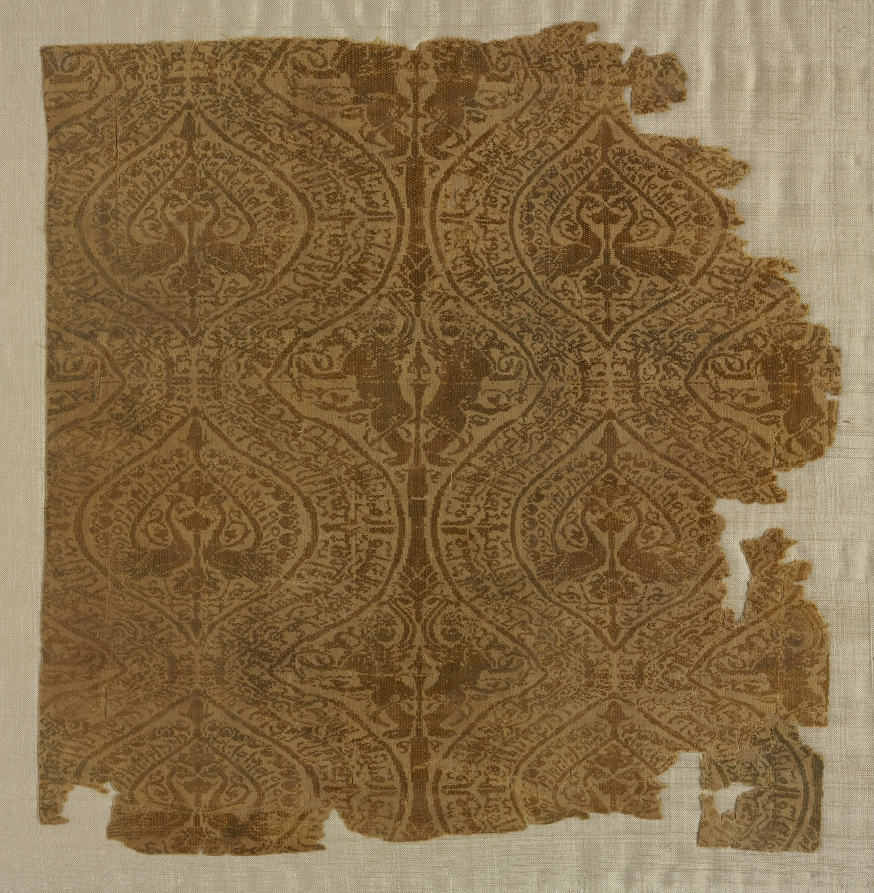
This fragment—a square of silk, no larger than a gentleman’s pocket square—is not merely a textile. It is a surviving page from the ledgers of empire, a material contract between the weaver’s loom and the sovereign’s ambition. The ogival pattern, with its mirrored, lanceolate leaves enclosing two confronting peacocks, is a motif of profound pedigree. It speaks not of a single artisan’s whim, but of a bureaucratic system of taste, a codified visual language that travelled from the courts of Safavid Persia through the Ottoman ateliers and into the great silk houses of Lyon and Spitalfields. To hold this fragment is to hold a compressed history of trade routes, dynastic power, and the relentless human desire to capture the ephemeral—the shimmer of a bird’s plume—in the permanence of spun protein.
The materiality is the first testament. This is not a sturdy, utilitarian silk. The warp and weft are exceptionally fine, suggesting a high-twist, organzine thread, the kind reserved for luxury goods destined for the aristocracy or the church. The weave structure, likely a lampas or a compound twill, allows the peacocks to emerge with a subtle, three-dimensional relief. The ground, a deep, undyed ivory or a muted celadon, is designed to let the pattern breathe. The peacocks themselves are not rendered in garish colour; rather, their bodies are defined by a change in weave direction, creating a moiré-like play of light that shifts with the viewer’s angle. This is a quiet luxury, a signal of discernment rather than ostentation. In the Savile Row context, one might say the fragment is the equivalent of a perfectly cut, unstructured overcoat in a dark vicuña—the luxury is in the hand, not the label.
The Ogival Architecture: A Geometry of Power
The ogival lattice is the structural skeleton of this design. It is a repeating, sinuous framework of intersecting curves, often described as a ‘pinecone’ or ‘artichoke’ motif, but here it functions as a formal cage. Within each compartment, the peacocks are perfectly symmetrical, facing each other in a heraldic pose. This symmetry is not accidental. It is a visual assertion of order, of the controlled and the rational. The ogive, derived from the Arabic *‘awj* (to bend), was adopted by European weavers in the late medieval period, but it reached its apotheosis in the imperial workshops of the 17th and 18th centuries. The pattern’s strict geometry mirrored the hierarchical structure of the court itself: each element has its place, each curve is subordinate to the whole.
This is the legacy of imperial silk weaving. The looms of the *Manufacture des Gobelins* or the Venetian *botteghe* were not merely producing fabric; they were producing a physical manifestation of state ideology. The peacock, the bird of Juno and a symbol of immortality and resurrection in early Christian iconography, was repurposed as a royal emblem. To wear such a silk—as a waistcoat, a dressing gown, or an ecclesiastical vestment—was to literally clothe oneself in the grammar of authority. The fragment, therefore, is a political document. It is a sample of the visual rhetoric that supported the divine right of kings and the infallibility of the church. The weaver, though anonymous, was a state functionary, his skill a form of statecraft.
From Court to Cloth: The Savile Row Translation
How does this ancient fragment resonate on Savile Row? The answer lies in the philosophy of *appropriation* and *restraint*. The Row’s relationship with heritage is not one of mere replication, but of translation. A modern tailor, commissioned to create a bespoke smoking jacket or an evening waistcoat, might source a contemporary silk that echoes this ogival pattern. However, the Row’s genius is in the editing. The full, overwhelming grandeur of the imperial original—often woven in gold and crimson—would be subdued. The pattern might be scaled down, the colours muted to a midnight blue or a charcoal grey, the peacocks reduced to a subtle shadow stripe.
This is the crucial distinction. The imperial silk was designed for the *public* body—for processions, audiences, and coronations. The Savile Row garment is designed for the *private* body—for the club, the drawing-room, or the quiet dinner. The Row takes the vocabulary of power and renders it in a conversational tone. The client who commissions such a piece is not seeking to emulate a monarch; he is seeking to acknowledge a lineage. He is saying, “I understand the history of this cloth, and I choose to wear it with the confidence of one who does not need to shout.” The fragment, in this context, becomes a reference point, a benchmark of quality and intent. It is the difference between a museum piece and a heirloom.
The Imperfect Legacy: Preservation and the Human Hand
Finally, we must consider the fragment’s condition. The edges are frayed, the silk has a slight, inevitable crease, and the dye has faded in places to a softer, more melancholic tone. These imperfections are not flaws; they are the authenticating marks of time. The imperial silk was a product of perfect machinery, but its survival is a testament to human care—or neglect. It was likely preserved in a chest, a drawer, or a church vestry, perhaps forgotten for decades. This accidental preservation is the ultimate irony: the very fragility of the silk, its susceptibility to light and humidity, is what makes its survival so precious.
For the modern practitioner, this fragment offers a lesson in material honesty. The Row does not chase the sterile perfection of a digitally printed replica. Instead, it values the *hand*—the slight irregularity in the weave, the subtle variation in the dye lot. These are the fingerprints of the artisan, the evidence that a human being, not a machine, was responsible for the cloth. The fragment, with its frayed edges, reminds us that beauty is not immutable. It is a living thing, subject to decay, and it is precisely this mortality that gives it its power. To wear a silk inspired by this fragment is to participate in a dialogue with the past, acknowledging that we are but temporary custodians of a craft that will outlast us.
In the end, this small square of silk is a mirror. It reflects the ambitions of emperors, the skill of forgotten weavers, and the enduring taste of those who understand that true luxury is not loud, but legible. It is a fragment, yes—but a fragment that contains a world.