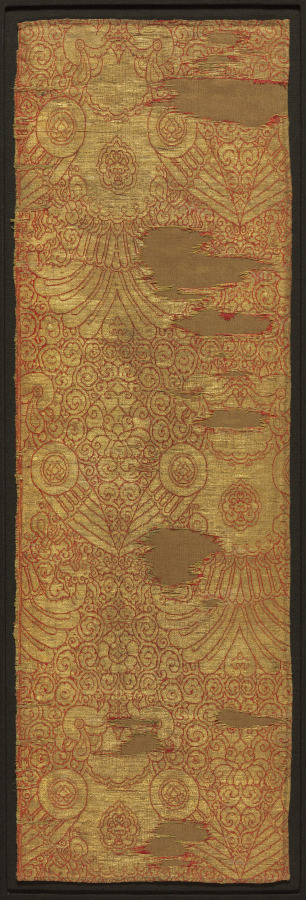
A Discourse on Material Authority: The Cloth of Gold and the Displayed Falcon
To comprehend the artefact—a fragment of silk brocade known as the ‘Cloth of Gold: Displayed Falcons’—is to engage not merely with a textile, but with a treatise on power, rendered in thread. It is a document of statecraft, as consequential as any treaty, yet articulated through the silent, luminous vocabulary of the loom. The material in question, sir, is silk: not as mere fabric, but as the supreme medium of imperial ambition. Its legacy in weaving is not one of simple craft, but of administered brilliance, a monopoly of expression as tightly controlled as any treasury or army.
The Substance of Sovereignty
Consider first the foundation: the raw silk itself. Its procurement, from the mulberry groves of China to the sericulture establishments of Byzantium and later, the Italian peninsula and Lyon, was a geopolitical endeavour of the first order. To possess the means of its production was to hold a secret, a leverage. But to master its transformation—as seen in this fragment—was to declare a cultural and technological sovereignty. The silk here is not simply a ground; it is a field of light. The yarn, meticulously thrown and dyed with pigments of immense cost—crimson from kermes, gold from actual bullion—possesses a inherent luminosity. It catches and bends light, a quality engineered to command attention in dim, cavernous halls of state. This is not a cloth designed for comfort; it is a cloth designed for consequence.
The Iconography of Command: The Displayed Falcon
The pattern, the Displayed Falcon, is heraldry in its most assertive form. The bird is rendered not in profile, but affronté, wings outstretched, talons ready, gaze direct. This is the pose of imperial authority—unambiguous, confrontational, and total. To wear or to display this motif was to cloak oneself in the attributes of the raptor: keen sight, swift judgement, and lethal prerogative. The falcon is a hunter by right, a creature of the apex. Woven into the very fabric of a robe of state or a diplomatic hanging, it transformed the wearer or the space into a theatre of dominance. The repetition of the motif across the cloth’s surface is not decorative rhythm; it is the relentless reinforcement of a message, a visual mantra of control.
The Alchemy of the Loom: Weaving as Imperial Technology
Here lies the crux of the legacy. The true marvel—and the core of the imperial silk weaving tradition—is the material execution. This is brocade of the most complex order, likely executed on a draw-loom, the supercomputer of its age. The incorporation of gold thread—often a strip of gilt membrane wound around a silk core—required a separate weft, beaten in with immense care. The resulting cloth is heavy, stiff with its own opulence. It rustles with a sound unlike any other; a low, metallic whisper that announces presence before its wearer enters the room. The technique speaks of a vast, coordinated infrastructure: designers of peerless skill, dyers guarding alchemical recipes, weavers of almost unimaginable patience operating under the direct patronage, and scrutiny, of the court. The workshop itself was a microcosm of the ideal state: hierarchical, precise, and producing objects that perfectly embodied the regime’s self-image.
Savile Row and the Silent Continuum
One might ask, what has this to do with the modern atelier? The connection, though seemingly distant, is profound. It resides in the understanding of material as argument. Just as the imperial weaver knew that a cloak of this cloth was an instrument of policy, so does the modern cutter understand that the drape of a worsted or the resilience of a tropical wool is foundational to the statement a suit makes. The legacy is in the reverence for the inherent property of the material, and the technical mastery required to release it. The precision with which a lapel is rolled, the strength of a hand-padded chest canvas, the absolute alignment of a pattern at the seams—these are the descendants of the draw-loom’s precision. They are quiet declarations of excellence, understood by those who know the language. The imperial silk was a uniform of power; the bespoke suit, in its highest form, is a uniform of authoritative discretion.
A Fragment as Testament
The ‘Cloth of Gold: Displayed Falcons’ fragment, therefore, is far more than a relic. It is a condensed lesson in the projection of authority through supreme material intelligence. The silk is its medium, the falcon its message, and the unparalleled skill of its weaving its unassailable proof. It reminds us that true luxury—then as now—is never merely ornamental. It is functional. Its function is to communicate hierarchy, taste, and capability without a word being spoken. It is the armoury of the civilised, woven not for battlefields, but for the subtler, yet no less decisive, theatres of human endeavour. To study it is to understand that the most enduring empires are often those built not only on law and land, but on the loom.