← BACK TO ARCHIVES
Silk
Heritage Synthesis: Fragment with star pattern and griffins
Curated on Aug 05, 2026 // Node: LDN-01
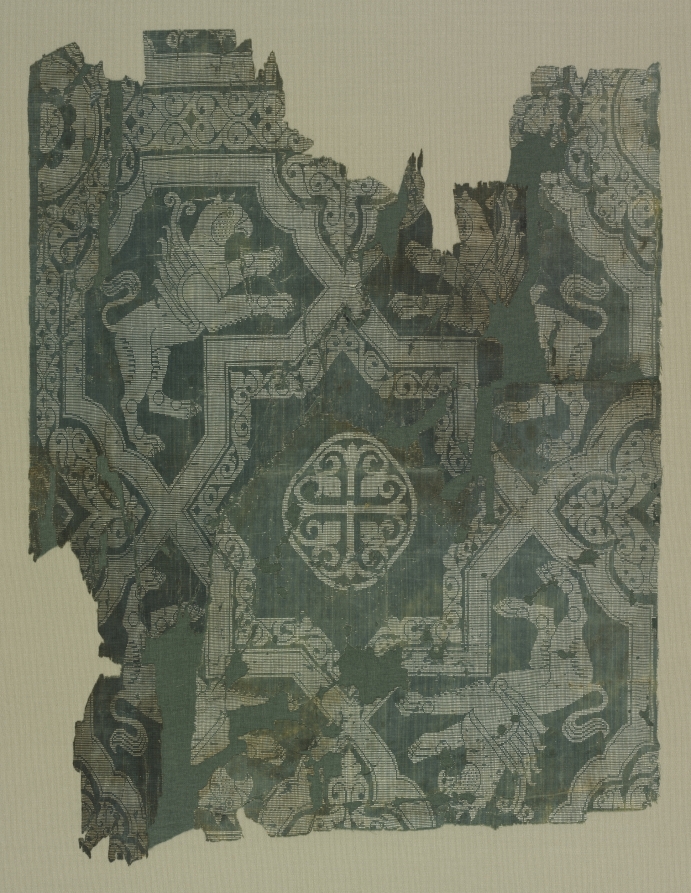
The Fragment with Star Pattern and Griffins: A Study in Imperial Silk and the Discipline of Restraint
In the hushed, wood-panelled ateliers of Savile Row, where cloth is not merely cut but *argued* with—where a lapel’s roll is debated with the gravity of a treaty—there exists a profound respect for the artefact. We do not deal in ephemera. We deal in *evidence*. The fragment before us, a shattered pane of imperial silk bearing a star pattern and the fierce, winged form of the griffin, is precisely such evidence. It is not a remnant; it is a deposition. To handle it is to read a legal brief written in thread, a testament to a system of production, patronage, and power that modern tailoring merely echoes. This is the legacy of imperial silk weaving, and its lesson is one of absolute, unyielding discipline.
Materiality and the Grammar of the Loom
The first and most unforgiving witness is the material itself. Silk, in its imperial context, was never a passive substrate. It was an active agent of hierarchy. The fragment’s weave—likely a compound twill or a lampas structure—is not a decorative afterthought. It is a structural argument. The warp and weft do not merely intersect; they *negotiate*. The ground weave provides the quiet, unbroken field, while the pattern weft, often in a contrasting colour—here, a muted gold against a deep, now-faded crimson—rises to the surface to articulate the design. This is not printing. This is building. Each pass of the shuttle is a decision, a commitment. The density of the weave, the fineness of the filament, the precision of the tie-downs: these are the metrics of an imperial standard. A Savile Row cutter understands this instinctively. We speak of a cloth’s “hand,” its “drape,” its “body.” This silk possesses all three, but with a severity that modern mills rarely achieve. It has the *grain* of authority.
The star pattern, geometrically rigorous, is not a whimsical constellation. It is a cosmic diagram, a map of celestial order imposed upon the terrestrial. The griffin—half lion, half eagle—is not a mere beast. It is a guardian of treasure, a symbol of divine power, and, critically, a marker of *sovereignty*. In the lexicon of imperial weaving, the griffin is a heraldic claim. It does not ask for attention; it commands it. The fragment, therefore, is not merely beautiful. It is a piece of propaganda, woven with the same precision that a modern diplomat might use to draft a treaty. The pattern is the message, and the message is *order*.
The Legacy of Imperial Silk: A System of Absolute Control
To understand this fragment, one must abandon the romantic notion of the solitary artisan. Imperial silk weaving was an industry of terrifying scale and bureaucratic exactitude. From the mulberry groves to the imperial ateliers, every stage was monitored, measured, and taxed. The silkworms were not livestock; they were a strategic resource. The reeling of the filament, the throwing of the silk, the dyeing of the yarn—each step was governed by edicts that would make a modern quality-control manager weep with envy. The weaver was not an artist. He was a technician executing a pre-approved design, often under the supervision of court officials who held the power of life and death over the quality of the output.
This system produced a cloth that was not just luxurious but *legally* significant. The use of specific colours, motifs, and weave structures was often restricted to the imperial family and the highest echelons of the nobility. To wear such a silk was to wear a rank. To possess it without the right was a crime. The fragment, with its griffins and stars, would have been part of a garment or furnishing reserved for a person of immense consequence. It was not made to be comfortable. It was made to be *authoritative*. The stiffness of the silk, the weight of the brocade, the way it would catch the light—these were not accidents. They were designed to create a presence that preceded the wearer, to announce power before a single word was spoken.
This is the profound legacy that Savile Row inherits, albeit in a secularised form. The bespoke suit is not merely clothing; it is a system of signals. The choice of cloth, the cut, the construction—all are a form of coded communication. A heavy worsted flannel says “stability.” A crisp, high-twist fresco says “action.” A silk lining, glimpsed only in a moment of movement, says “private wealth.” The imperial weaver understood this grammar perfectly. The star and griffin fragment is a masterclass in that language. It does not whisper; it declaims. And yet, there is a restraint, a *discipline* in its execution that is the hallmark of true mastery.
Reading the Fragment: A Tailor’s Analysis
Let us examine the fragment as we would a bolt of cloth on the cutting table. The first thing we note is the *scale* of the pattern. The stars are not tiny, scattered pinpricks. They are substantial, geometric medallions, arranged in a repeating grid that suggests infinite extension. This is a pattern that was designed for a large surface—a robe, a hanging, a throne covering. It was not meant to be seen in a small swatch. It was meant to be experienced as an environment. The griffins, positioned within or between the stars, are rendered with a stylised, almost heraldic rigidity. They are not naturalistic. They are *iconic*. Their wings are spread, their claws are extended, their beaks are open. They are frozen in a moment of eternal vigilance.
The colour palette, though faded, speaks of a sophisticated understanding of pigment. The deep red (likely derived from madder or kermes) would have been a symbol of power and vitality. The gold (from silk dyed with weld or, in more precious examples, gilded thread) would have signified the sun, divinity, and incorruptibility. The contrast is not gentle. It is stark. The gold *attacks* the red, just as the griffin attacks its prey. This is not a cloth for quiet contemplation. It is a cloth for *confrontation*.
From a technical standpoint, the fragment reveals the weaver’s virtuosity. The precision of the pattern repeat, the clean edges of the motifs, the evenness of the ground weave—all point to a loom of immense sophistication and a weaver of extraordinary skill. There is no sloppiness, no hesitation. Every thread is where it should be. This is the result of years of training, a lifetime of discipline, and a system that demanded nothing less than perfection. It is the same ethos that underpins the construction of a great suit: the invisible seam, the perfectly matched stripe, the buttonhole that is a work of art in itself. The fragment is a reminder that true luxury is not about excess. It is about *control*.
Conclusion: The Tailor’s Inheritance
The fragment with star pattern and griffins is not a relic to be admired from a distance. It is a working document. It is a challenge to the modern practitioner. It asks: Do you understand the weight of cloth? Do you understand the power of a pattern? Do you understand that what you make is not just a garment, but a statement about the world and your place within it?
The legacy of imperial silk weaving is not merely a matter of technique. It is a matter of *intent*. The imperial weaver did not ask if the client would be comfortable. He asked if the client would be *obeyed*. The cloth was a tool of governance, a physical manifestation of authority. Savile Row, in its finest moments, operates on a similar principle. A bespoke suit is not a compromise with the body; it is a correction of it. It imposes a structure, a line, a silhouette that speaks of confidence and self-possession. It is, in its own way, a fragment of a larger pattern—a pattern of discipline, tradition, and the enduring power of well-made things.
This silk, with its stars and its guardians, is a testament to that enduring truth. It is a fragment of a lost world, but its language is universal. It speaks of the marriage of art and power, of beauty and control. And for those of us who work with cloth, it remains a benchmark—a reminder that the cloth we cut is never just cloth. It is history, re-woven for the present. And we must handle it with the respect it demands.
Heritage Lab Insight
Lab Insight: CMA Silk Archive Node integration.