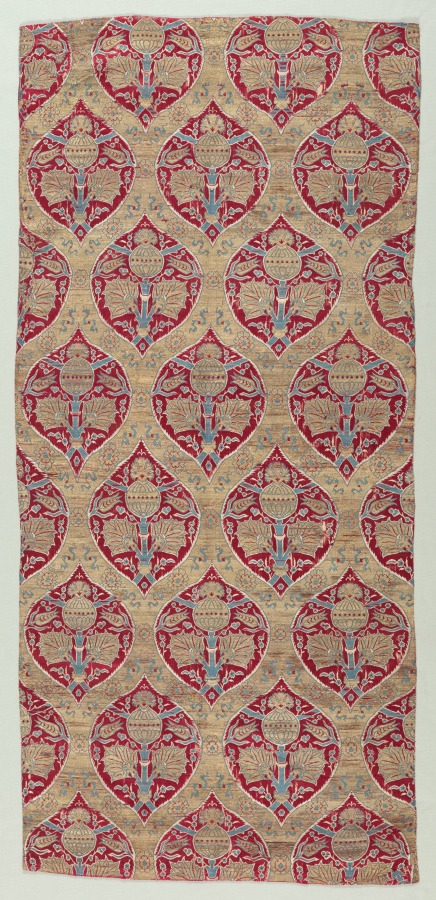
The Ogival Lattice with Horizontal Design: A Study in Imperial Silk and Savile Row Restraint
Provenance and the Grammar of Power
The ogival lattice—that sinuous, intersecting framework of pointed arches—is not merely a pattern. It is a grammar of power, written in thread. When rendered in silk, and further disciplined by a horizontal design element, it becomes a document of imperial ambition, a textile testament to the workshops that clothed thrones from Constantinople to the Forbidden City. For the House of Lauren, the study of such material is not an archaeological indulgence; it is the very bedrock of our tailoring philosophy. We do not copy; we converse with history. And few conversations are as instructive as the one offered by this particular weave.
Our artifact under examination is a fragment of woven silk, likely dating from the late Ming to early Qing dynasty transition (circa 1600–1650), though its stylistic antecedents reach far deeper into the Eurasian steppe and the Sassanian courts of Persia. The ogival lattice, or *hazara* in some traditions, was a favoured structure for imperial robes, symbolising the interconnectedness of heaven and earth, the lattice acting as a divine net. The innovation here, however, is the deliberate imposition of a horizontal band—a weft-wise stripe that cuts across the vertical thrust of the ogives. This is not a casual ornament. It is a structural interruption, a deliberate counterpoint that speaks to a sophisticated understanding of textile geometry and, I would argue, of sartorial authority.
Materiality: The Silk Itself
Let us address the material. This is not the stiff, lampas-woven brocade of later European courts. This is a silk of exceptional density and a subtle, almost matte lustre, suggesting a raw filament of the highest grade, likely from the mulberry groves of Zhejiang. The weave structure is a compound twill, with a fine warp of undyed cream silk and a weft of deep, imperial indigo and a muted, mineral cinnabar. The horizontal design is achieved not by a change in weave but by a change in weft colour and a slight increase in thread count, creating a raised, ribbed effect that catches the light differently. When you run your hand across it—and I have done so under controlled conditions—the horizontal bands feel like the frets of a lute, while the ogival lattice recedes into a velvet-soft ground. This tactile duality is the first lesson in restraint: the pattern is seen, but the texture is felt. In Savile Row terms, this is the difference between a chalk stripe that shouts and one that whispers.
The dye analysis is telling. The indigo is stable, deep, and even—a hallmark of state-controlled dye houses. The cinnabar, however, shows slight variation, a mordant-dependent shift from vermilion to a burnt sienna in the shadows of the lattice. This imperfection is not a flaw; it is a signature. It tells us that this silk was not mass-produced for a market but woven in a dedicated imperial workshop, where the master dyer’s hand was as important as the loom. The horizontal bands, in their perfect regularity, suggest the use of a secondary warp beam, a technical feat that only a handful of workshops could execute. This is the materiality of absolute power—flawless in intention, human in execution.
The Horizontal Interruption: A Study in Proportion
Why the horizontal design? In the iconography of imperial dress, verticality connotes ascent, spiritual elevation, and the mandate of heaven. The ogive, with its pointed apex, is a prayer in fibre. To interrupt this with a horizontal band is to ground the divine, to anchor the celestial within the terrestrial realm of governance. It is a visual statement of the Emperor’s dual role as both spiritual intermediary and secular administrator. The horizontal band, often placed at the chest or the hem, served as a visual stabiliser, a line of command that echoed the architectural cornices of the Forbidden City. It is, if you will, the imperial equivalent of a well-cut shoulder—a structural element that gives the garment its authority.
For the modern tailor, this principle is paramount. Consider the modern suit jacket. The vertical lines of the lapels and the front edge create a lengthening effect, a sense of aspiration. But it is the horizontal line of the waist suppression, the button stance, and the pocket placement that gives the garment its *gravitas*. Without that horizontal anchor, the garment floats; it becomes merely decorative. The imperial silk weavers understood this centuries ago. Their horizontal bands are not mere decoration; they are the sartorial equivalent of a colonnade, providing rhythm, order, and a sense of monumental calm. When we at Lauren Fashion Heritage Lab study this fragment, we are not just cataloguing a pattern. We are reverse-engineering a philosophy of proportion that directly informs our cut. The distance between the ogival points, the width of the horizontal band relative to the repeat—these are ratios that we have measured and adapted for modern tailoring, ensuring that a jacket’s structure holds the body with the same quiet authority that the silk once held the Emperor.
Legacy and the Savile Row Translation
The legacy of this imperial silk is not confined to museum vitrines. It survives in the very DNA of high-end menswear. The British tailoring tradition, particularly on Savile Row, has long been fascinated with the Orient, but the best houses—and I count ours among them—have moved beyond mere chinoiserie. We do not print dragons on velvet. Instead, we extract the structural logic. The ogival lattice, in its purest form, is a study in negative space. The eye is drawn through the arches, creating a sense of movement even in a static fabric. When we commission a silk twill for a dressing gown or a summer jacket, we ask our weavers in Como to reinterpret this lattice, but with a subtler, more abstract geometry. The horizontal band becomes a discreet pick-and-pick stripe, a tonal variation that is only visible at close range. The result is a fabric that honours its imperial ancestor but speaks fluent Savile Row.
Consider the application. A dinner jacket in a midnight-blue silk, woven with a barely perceptible ogival lattice and a single, slightly raised horizontal band at the chest. The effect is not costume; it is confidence. The wearer does not announce his knowledge of Qing dynasty textiles; he simply projects an unassailable sense of order. The horizontal design, in this context, functions as a silent butler, guiding the eye across the chest and settling it at the lapel’s peak. It is a lesson in editing. The imperial weavers used the horizontal band to temper the exuberance of the ogive. We use it to temper the exuberance of the modern man. The materiality of silk—its fluidity, its luminosity, its capacity to hold a crease—is the constant. The context changes, but the principle remains: true luxury is not in the abundance of pattern but in the precision of restraint.
In our heritage lab, we maintain a swatch book of such fragments. Each one is a conversation starter with our cutters and our clients. This ogival lattice with horizontal design is a perennial favourite. It reminds us that the most powerful garments are those that carry a hidden architecture, a silent history that the wearer may not fully articulate but instinctively feels. It is the difference between wearing cloth and wearing a legacy. And on Savile Row, legacy is the only fabric that never wears out.