← BACK TO ARCHIVES
Heritage-Black
Heritage Synthesis: Terracotta fragment of a kylix (drinking cup)
Curated on Aug 05, 2026 // Node: LDN-01
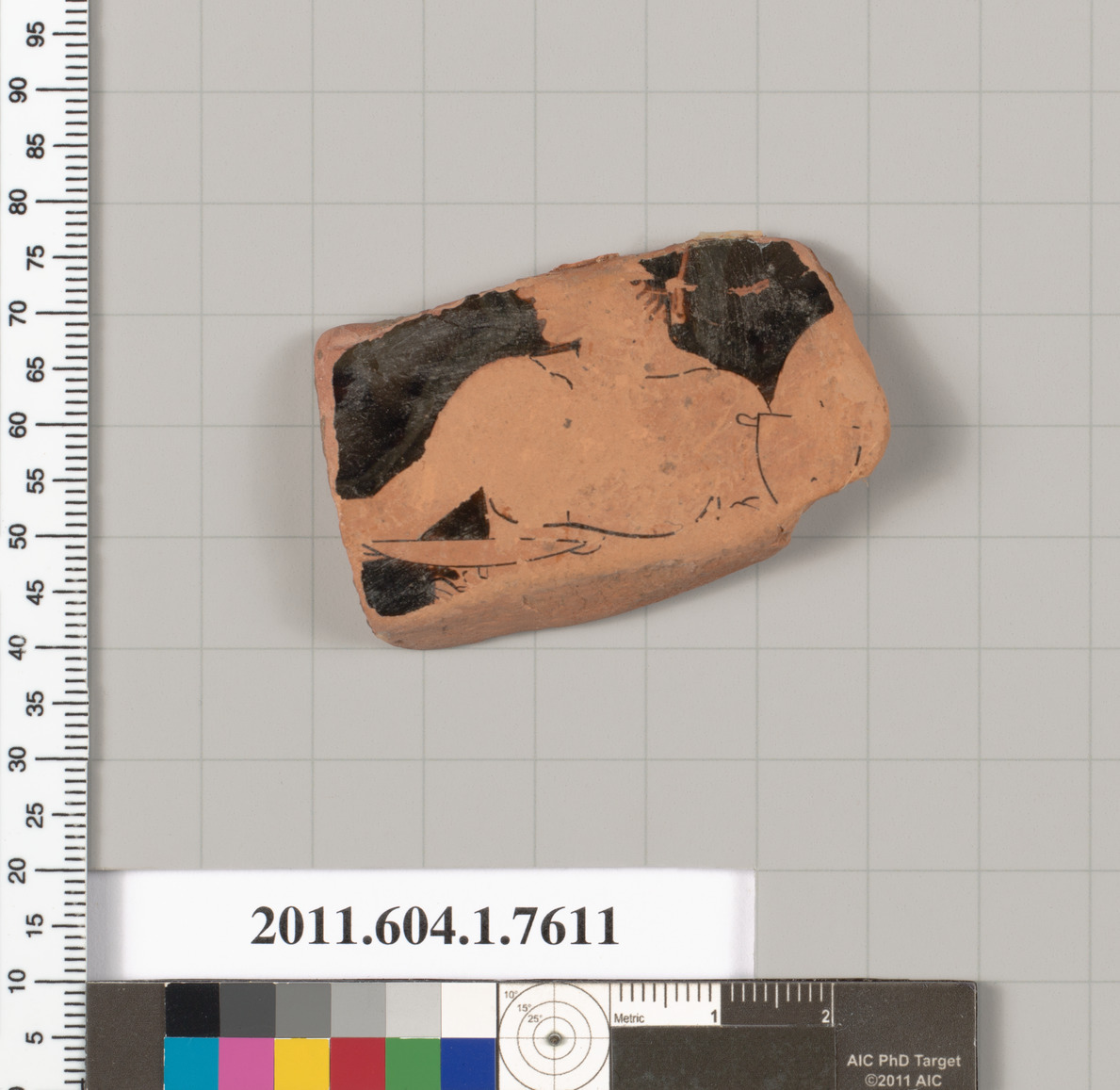
The Dialectics of Stillness and Motion: A Terracotta Kylix and the 2026 Old Money Silhouette
The internal genetic code of Lauren Fashion Heritage Lab—rooted in the dialectical tension between the Zen stillness of a Japanese temple plaque and the kinetic cosmology of a Han dynasty bronze mirror—finds an unexpected, yet profoundly resonant, counterpart in the museum artifact before us: a terracotta fragment of an Attic kylix. At first glance, the leap from Edo-period calligraphy and Han metalwork to a shard of Greek drinking vessel seems anachronistic. Yet, when read through the lens of our heritage methodology, this fragment is not merely a relic of symposiastic leisure; it is a compressed universe, a manual on the very principles that must govern the 2026 Old Money silhouette. The kylix, with its broken rim and surviving tondo, offers a masterclass in the aesthetics of *controlled imperfection*, *circular authority*, and *the quiet power of the ground*—all of which are the unspoken grammar of contemporary quiet luxury.
I. The Fragment as a Philosophy of Restraint
Unlike the pristine, gilded surfaces of the Japanese plaque or the dazzling inlaid brilliance of the Han mirror, the terracotta kylix fragment presents itself as an object of *loss*. Its value does not derive from completeness but from the eloquence of its fracture. The exposed clay—a warm, iron-rich orange—speaks to a material honesty that modern Old Money aesthetics increasingly crave. In the 2026 silhouette, this translates directly into a rejection of overt ornamentation in favor of *structural integrity*. The kylix teaches us that the true luxury of a garment lies not in its surface appliqué but in the precision of its cut, the weight of its drape, and the integrity of its seams. Just as the fragment’s broken edge reveals the ceramic body’s internal density, so too does a perfectly constructed wool overcoat or a cashmere twin-set reveal its quality through its *interior logic*—the invisible canvas, the hand-finished buttonholes, the unbleached cotton lining. The fragment’s aesthetic is one of *negative space*; the missing portions of the bowl are as significant as the extant shard. For the 2026 Old Money wardrobe, this translates into silhouettes that breathe—garments with generous, sculptural volumes that create their own architectural voids, rather than clinging to the body. The power lies in what is *not* there: no logos, no loud patterns, only the quiet authority of form.
II. The Tondo and the Geometry of Quiet Power
If the fragment’s edge represents the philosophy of restraint, its surviving interior—the tondo—represents the philosophy of *circular order*. In the kylix, the tondo is the only decorated surface visible to the drinker; it is a private revelation, a secret image meant for the individual, not the crowd. This concept of the *private icon* is crucial for the 2026 Old Money aesthetic. The Han bronze mirror and the Japanese plaque were public or ritual objects, displayed for communal contemplation. The kylix, however, is intimate. Its decoration—often a single figure, a piece of armor, or a floral motif—is a personal talisman. Translating this to fashion, the 2026 silhouette must incorporate *internalized luxury*. This manifests as a hidden plaid lining inside a solid grey flannel suit, a discreet monogram stitched inside a leather glove, or a meticulously crafted jacquard pattern that is only visible when the wearer turns a cuff. The tondo also dictates a geometric principle: the circle as a symbol of cyclical perfection and containment. The 2026 Old Money silhouette will therefore favor circular motifs in its construction—rounded shoulders (a deliberate move away from the aggressive, sharp tailoring of the past decade), curved pocket flaps, and circular, dome-like hats. These forms echo the kylix’s rim, suggesting a worldview that is self-contained, confident, and unbothered by external trends. The circle is the ultimate symbol of *eternal return*—the same cyclical philosophy that saw the 优昙花 bloom once every three millennia, and the same cosmic order that contained the galloping horses of the Han mirror within a bronze ring.
III. Terracotta’s Chromatic Lexicon and the Ground of Being
The raw, unglazed terracotta of the fragment offers a chromatic directive that will define the 2026 palette. This is not the stark white of neoclassical revivalism, nor the gilded opulence of baroque revival. It is the color of *earth, of the kiln, of the primordial ground*. In our heritage code, the Han mirror’s gold and the Japanese plaque’s lacquer represent the *apex* of material transformation, but the terracotta represents the *source*. For the 2026 Old Money wardrobe, this translates into a foundational palette of *mineral tones*: burnt sienna, clay ochre, deep rust, and the warm greys of unglazed stone. These are not “trend colors”; they are *ground colors*, the hues that underpin a wardrobe’s architecture. They will appear in the heavyweight flannels of a double-breasted overcoat, the brushed surface of a vicuña scarf, and the sueded finish of a split-toe derby. This chromatic choice aligns perfectly with the “静” (stillness) of the temple plaque—these colors do not shout; they absorb light and project a sense of geological permanence. The terracotta fragment also teaches us about *textural depth*. Its surface is not smooth; it has a tactile, granular quality that invites touch. The 2026 silhouette must replicate this through fabric innovation: wool crepes with a dry, dusty hand; cashmere with a nubby, unpolished finish; and linens that feel like weathered stone. This is the antithesis of the high-shine, tech-fabric aesthetic of contemporary streetwear. It is a return to the *haptic*—the pleasure of touching a garment and feeling the weight of history within its fibers.
IV. Synthesis: The Kylix as a Bridge Between East and West
The Attic kylix, the Han mirror, and the Japanese plaque are not disparate objects; they are nodes in a single, continuous conversation about *transcendence through craft*. The Han mirror’s dynamic horses are frozen in a circular dance; the kylix’s tondo isolates a moment of heroic stillness within a vessel of social motion; the plaque’s calligraphy captures the breath of a flower’s bloom in a single stroke. For the 2026 Old Money silhouette, the kylix fragment is the ultimate *sartorial metaphor*. It reminds us that true heritage is not about preservation of the *whole*, but about the curation of the *essential*. A wardrobe built on this philosophy is not a collection of complete “outfits” but an assemblage of perfect fragments—a beautifully cut trouser, a masterfully draped coat, a hand-stitched shirt—that, when combined, form a life of quiet, unassailable elegance. The kylix’s broken state is not a tragedy; it is a liberation from the tyranny of the new. It allows us to see the *structure* beneath the decoration, the *material* beneath the image. In 2026, the Old Money aesthetic will not be about displaying wealth or lineage. It will be about displaying *judgment*—the judgment to choose a fragment of perfection over a mass of mediocrity, the judgment to understand that the most profound statement of luxury is the silent confidence of a well-worn, beautifully constructed, and deliberately incomplete narrative. The kylix, in its broken glory, is not a relic of the past; it is a blueprint for the future of enduring style.
Heritage Lab Insight
Genetic Bridge: Archive node focusing on Heritage-Black craftsmanship.