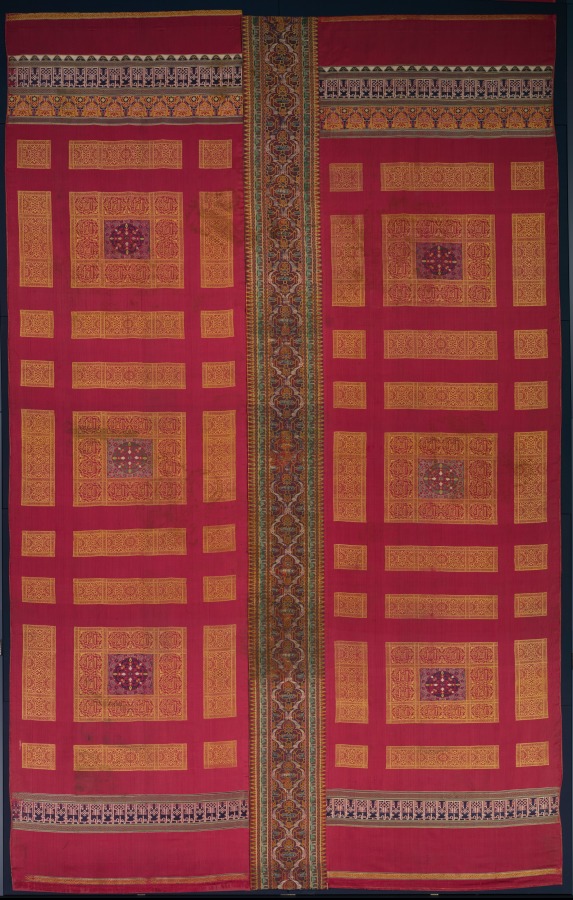
The Alhambra Silk: A Study in Imperial Threads and the Architecture of Desire
Provenance and the Paradox of Preservation
To hold a fragment of silk from the Alhambra is to hold a paradox. The palace, a monument of Nasrid dynasty architecture in Granada, is celebrated for its stucco, its tilework, its carved wood—all materials of permanence, of earth and stone. Silk, by contrast, is a material of ephemerality, of breath and light. That a curtain of such delicate substance has survived the centuries is less a testament to its durability than to the reverence—or the sheer neglect—that allowed it to escape the ravages of use, humidity, and the voracious appetites of moths. This artifact, therefore, is not merely a textile; it is a survivor, a whispered fragment of a conversation between a sovereign and his court, conducted in the language of imperial luxury.
Our examination begins with the material itself. The silk is of a grade that speaks to a sophisticated, state-sponsored weaving industry. The warp and weft are exceptionally fine, suggesting a reeled filament from *Bombyx mori*, the domesticated silkworm, whose production was a closely guarded secret in the medieval Mediterranean. The weave structure, likely a compound twill or a lampas, is not a simple cloth. It is an engineered architecture of threads, designed to carry a complex polychrome pattern. The surviving colour palette—a faded madder red, a residual indigo, and the ghost of a gilt thread—points to a dyeing and gilding technology that was the apex of medieval chemical knowledge. This is not the silk of a provincial workshop; this is the product of an imperial *tiraz*, a state-run manufactory that produced textiles not merely for clothing, but for the projection of power.
The Imperial Tiraz: Weaving Sovereignty
The legacy of imperial silk weaving is one of controlled scarcity. From Byzantium to Persia, from the Abbasid Caliphate to the Nasrid Kingdom, the *tiraz* system was the engine of this control. These were not factories in the modern sense, but rather court-adjacent ateliers, often housed within the palace complex itself. The weavers were highly skilled artisans, their status elevated by their proximity to the sovereign. Their output was not for the market; it was for the court, for diplomatic gifts, and for the vestments of the elite. To wear or to display such silk was to participate in a coded system of allegiance and rank. The Alhambra curtain, therefore, is not a decorative afterthought. It is a political document, woven with the threads of statecraft.
The pattern itself, though fragmentary, is instructive. We can discern the *ataurique*, the intricate vegetal arabesque that is the hallmark of Nasrid art. But this is not a naturalistic representation of foliage. It is a geometric abstraction, a mathematically precise lattice that suggests infinity and the divine order. The silk, in this context, becomes a medium for theological and philosophical expression. The curtain, hanging before a window or a doorway, would have filtered the Andalusian sun, casting a patterned, coloured light into the interior. It was a device for transforming architecture into a living, breathing entity. The stone walls of the Alhambra are static; the silk curtain was kinetic, moving with the air, shimmering with the light. It was the soft, breathing membrane of the palace, in stark contrast to the hard, unyielding bones of its structure.
The Materiality of Power: Silk as a Political Instrument
Let us consider the specific function of this curtain. It was not a curtain in the modern, domestic sense. It was a *sitr*, a hanging used to demarcate space, to create thresholds, and to control the visual access to the sovereign. The Nasrid sultan, like his Byzantine and Persian counterparts, was a figure of sacred authority. His person was not to be seen directly, but through layers of mediation. The silk curtain was the final layer. To part it was to enter the presence of power. To glimpse the sultan through its translucent weave was to experience a moment of profound intimacy and awe. The curtain, therefore, was an instrument of choreography, managing the drama of courtly life.
The choice of silk for this purpose was not arbitrary. Silk has a unique optical and tactile quality. It is lustrous, catching the light in a way that no other fibre can. It is also remarkably strong for its weight, and it drapes with a fluidity that is almost liquid. In the dry, high-altitude climate of Granada, silk would have felt cool to the touch, a sensual counterpoint to the warm stone. The imperial legacy of silk weaving, from the Chinese court to the Mediterranean, was built on this very sensuality. Silk was not just a fabric; it was a technology of desire. It signalled wealth, refinement, and a connection to the exotic and the distant. To possess it was to command the world's trade routes, to have the resources to bring the finest materials from the ends of the earth to the heart of your palace.
Conservation and the Modern Gaze
Today, this fragment resides in a climate-controlled vault, its colours faded, its fibres brittle. The conservation of such an artifact is a delicate act of negotiation. We cannot stop time; we can only slow its effects. The silk must be kept in darkness, at a stable humidity, and with minimal handling. Every fibre is a record of its creation, its use, and its decay. The modern viewer, accustomed to the mass-produced textiles of the industrial age, may struggle to appreciate the sheer labour and skill embodied in this piece. The weaver, working on a horizontal loom, would have manipulated thousands of threads, each one a potential point of failure. The pattern, which appears so fluid, was the result of a rigid system of cords and heddles, a proto-computational logic that translated a design into a physical object.
What, then, is the legacy of this imperial silk? It is a legacy of ambition. It speaks to the human desire to control nature, to transform a caterpillar's cocoon into a symbol of divine right. It speaks to the power of trade and cultural exchange, as techniques and motifs travelled across continents, adapted and reimagined by each new culture. And it speaks to the fragility of all human achievement. The Alhambra still stands, but the empire that built it is gone. The silk curtain, once a symbol of that empire's power, is now a symbol of its memory. It is a reminder that the most enduring monuments are not always those of stone, but sometimes those of thread. In its delicate weave, we find the strength of an idea, the resilience of a craft, and the enduring allure of a world that has long since passed into history. The curtain is closed, but the story it tells remains open, waiting for the next hand to part its fibres and look through.