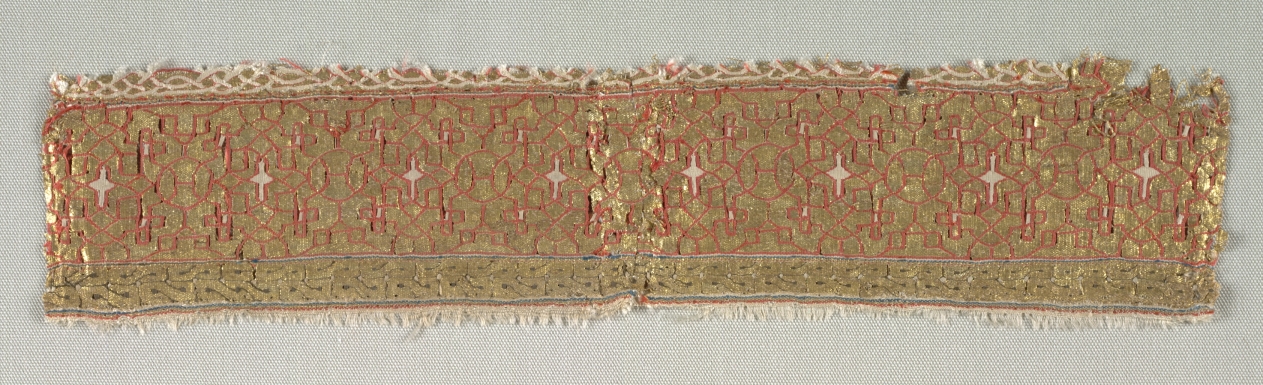
The Guilloche Band of San Valero: A Study in Imperial Continuity and Material Mastery
Provenance and the Weight of Legacy
Within the hushed, climate-controlled vaults of the Museo de la Catedral de San Valero, a fragment of silk—no wider than a gentleman’s pocket square, yet infinitely more consequential—commands a particular reverence. This is the guilloche band, a decorative trim excised from the dalmatic of the saint himself. To the untrained eye, it is a ribbon of interlocking circles, a pleasing pattern of geometric precision. To the discerning student of textile heritage, it is a palimpsest of imperial ambition, a surviving thread from the very loom of Byzantium’s golden age. This artifact is not merely a piece of fabric; it is a codified document of power, faith, and the unbroken mastery of a craft that defined the Mediterranean world for a millennium.
The materiality is unequivocal: silk. Not the coarse, wild tussah of the East, but the cultivated, lustrous filament of the domesticated *Bombyx mori*, a monopoly so fiercely guarded by the Eastern Roman Empire that its export of raw material was a matter of state policy. The very presence of this silk in a Spanish cathedral speaks to a complex network of diplomatic gift-giving, ecclesiastical patronage, and the profound prestige attached to Imperial workshops. To wear this band, or to have it adorn the vestments of a venerated bishop, was to cloak oneself in the tangible authority of Constantinople. It was a statement that transcended the merely aesthetic, aligning the wearer with the divine mandate of the Emperor, the *Basileus*, who was God’s representative on Earth.
The Guilloche Motif: Geometry as Imperial Signature
The guilloche pattern itself—a series of interlocking or overlapping circles creating a braided, chain-like effect—is a masterclass in controlled complexity. In the context of imperial silk weaving, this was not a casual decorative choice. The motif, often rendered in contrasting weft threads against a solid ground, is a testament to the weaver’s absolute command of the drawloom. Each circle, each intersection, required a precise sequence of heddle manipulations, a choreography of thousands of threads executed with the unerring accuracy of a Swiss watchmaker. The pattern’s inherent symmetry and infinite repeatability were a metaphor for the eternal, ordered cosmos over which the Emperor presided. It was a visual assertion of stability, of a world where every element had its place, a microcosm of the Imperial bureaucracy itself.
In this specific band, the guilloche is executed with a fineness that borders on the miraculous. The silk filament is so fine that the resulting fabric has a gossamer quality, yet its tensile strength is formidable. The dye, a deep, resonant tone that has faded to a dignified umber over centuries, was likely derived from the kermes insect or madder root, both staples of the Imperial dye works. The precision of the weave, the uniformity of the pattern, and the quality of the raw material all point to a provenance within the *gynaecea*, the state-run textile factories that were the crown jewels of the Byzantine economy. This was not the output of a provincial workshop; this was the product of a state apparatus dedicated to the production of perfection.
From Constantinople to the Ebro: A Journey of Prestige
The journey of this band from the workshops of Constantinople to the treasury of a cathedral in Aragon is a narrative of diplomatic and ecclesiastical exchange. Such textiles were the ultimate diplomatic currency. Emperors gifted them to allied monarchs, to powerful patriarchs, and to sees deemed worthy of Imperial favor. The arrival of such a piece in the hands of San Valero, a bishop of Zaragoza in the early 4th century, would have been a signal honour, a physical manifestation of the Church’s alliance with the Imperial throne. It is a poignant irony that Valero, who would later be exiled for his faith under the Diocletianic Persecution, would be associated with a product of the very state that persecuted him. Yet, this only underscores the complexity of the period; the silk’s value was as much about its material and artistic merit as it was about its political symbolism.
The dalmatic, from which this band was later removed, would have been a garment of considerable splendor. The guilloche band likely served as a decorative trim, bordering the cuffs, the hem, or the neckline, framing the central panels of figured silk. Its function was to delineate, to define the sacred space of the vestment, much as a frame defines a masterpiece. The band’s survival is itself a miracle of conservation. Textiles are among the most perishable of historical artifacts, vulnerable to light, humidity, and insects. That this fragment has endured for over sixteen centuries is a testament to the arid conditions of the Spanish interior and the reverence with which it was preserved within the cathedral’s treasury.
The Legacy of the Loom: A Standard for Eternity
The legacy of this guilloche band extends far beyond its physical presence. It is a benchmark for understanding the technical zenith of imperial silk weaving. The complexity of its pattern, the fineness of its yarn, and the sophistication of its dyeing process represent a pinnacle of pre-industrial manufacturing. It is a standard against which all subsequent European silk production, from the medieval Lucchese workshops to the great French manufactories of the 17th century, must be measured. When we examine a damask from Lyon or a brocade from Spitalfields, we are looking at distant descendants of this very tradition. The technical vocabulary—the drawloom, the pattern harness, the use of multiple wefts—was bequeathed to Europe by the Byzantine Empire, and this band is a surviving, tangible example of that foundational knowledge.
For the modern scholar, the band offers a profound lesson in the intersection of art, power, and technology. It is a reminder that the most exquisite objects are often the most potent political statements. It challenges us to look beyond the surface beauty and to read the material culture of the past with the acuity of a detective. The guilloche band of San Valero is not merely a relic; it is a voice from the past, speaking of an empire’s ambition, a church’s faith, and a weaver’s genius. It is a piece of history that you can hold in your hand, a fragment of eternity woven in silk. And in its quiet, persistent pattern, we find the enduring legacy of a craft that shaped the very fabric of Western civilization.