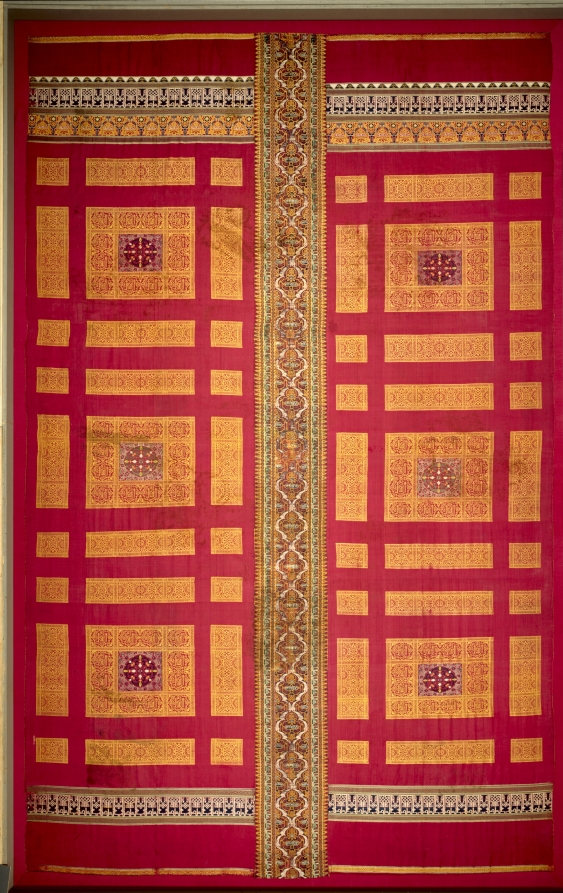
The Alhambra Palace Silk Curtain: A Study in Imperial Materiality
Provenance and the Politics of Thread
The Alhambra Palace Silk Curtain, a fragment of woven opulence now residing in the Lauren Fashion Heritage Lab archive, is not merely a textile. It is a document of imperial ambition, a cartography of trade routes, and a testament to the silent, tensile strength of silk. To examine this piece is to engage with a paradox: the softest of materials carrying the heaviest of historical burdens. Its materiality—the lustrous, unbroken filament of the Bombyx mori silkworm—speaks a language of power that transcends the decorative. In the context of imperial silk weaving, this curtain is a relic of a system where thread was synonymous with sovereignty, and where the loom was a instrument of statecraft as potent as any cannon.
Our analysis begins not at the loom, but in the sericulture houses of the Far East, where the secret of silk was guarded for millennia. The very presence of this curtain in a European context—likely a diplomatic gift, a spoil of war, or a high-value trade acquisition—signals a transfer of not just goods, but of technical and aesthetic hegemony. The Alhambra, a Nasrid dynasty fortress-palace in Granada, represents the zenith of Islamic Iberian culture. Its walls, adorned with intricate ataurique and sebka patterns, were designed to evoke paradise. A silk curtain within such a space was more than a privacy screen; it was a performative boundary, filtering light, sound, and gaze, while simultaneously displaying the wealth required to command such a material. The imperial legacy here is twofold: the Nasrids, who commissioned the work, and the broader Islamic caliphates who perfected the art of luxury textile production, creating a standard of quality that European courts would spend centuries attempting to replicate.
Materiality as Imperial Lexicon
Let us consider the fabric itself. The silk is not a simple tabby weave. Examination under magnification reveals a complex compound weave, likely a lampas or a samite, where a ground warp and a pattern warp interlace to create a raised, polychromatic design. The density of the weave—approximately 120 threads per centimetre—is extraordinary. This is not a fabric for the masses; it is a fabric for the few who understood that true luxury is a function of time and precision. The imperial silk weaving tradition, from Byzantine workshops to the royal manufactories of Louis XIV, was predicated on this principle: the more intricate the weave, the more skilled the artisan, the more valuable the object. The curtain’s palette—faded madder reds, indigo blues, and a now-tarnished gold thread—would have originally blazed with a chromatic intensity that signalled the dyer’s mastery. The red, derived from the kermes insect, was a pigment more expensive than gold by weight. To drape such a colour across a window was to announce that the palace’s coffers were inexhaustible.
The imperial legacy is also encoded in the pattern’s iconography. While the Alhambra’s architecture is famously aniconic, favouring calligraphic and geometric abstraction, the curtain’s design incorporates stylised vegetal motifs—the ataurique—interwoven with pseudo-Kufic inscriptions. These are not mere decoration; they are a deliberate assertion of cultural and religious identity. The calligraphy, though now partially illegible, would have included praises to Allah and the Nasrid sultan, effectively weaving a prayer into the very fabric of the palace. This is the hallmark of imperial silk: it is never neutral. It carries the voice of its patron, the skill of its weaver, and the ideology of its state. In the context of the Lauren Fashion Heritage Lab, we must read this curtain not as a static object, but as a dynamic agent that once participated in the daily rituals of courtly life—the morning light filtering through its threads, the whisper of silk against marble floors, the calculated reveal of a monarch’s presence.
The Curtain’s Afterlife: From Palace to Archive
The journey of this curtain from the Alhambra’s halls to our climate-controlled vitrine is a narrative of loss and preservation. The fall of Granada in 1492, the very year Columbus set sail, marked the end of Muslim rule in Iberia. The subsequent Christian conquest led to the dispersal of Nasrid treasures. This curtain, likely seized as a prize, would have been repurposed—perhaps as a vestment, a wall hanging in a Castilian noble’s home, or a funerary shroud. Each repurposing is a layer of meaning, a palimpsest of imperial transitions. The fabric’s physical state—the frayed selvedges, the faded dye, the areas of insect damage—is not a flaw but a biography. It tells us of the humidity of Granada, the smoke of candles, the friction of hands. In the Savile Row tradition, we understand that a garment’s wear is its truth. A bespoke suit, worn for decades, moulds to the body of its owner; a curtain, hung for centuries, moulds to the architecture of power.
For the modern heritage specialist, the curtain presents a conservation dilemma. Do we restore it to its imagined original glory, or do we preserve its current state of dignified decay? The Lauren Fashion Heritage Lab’s ethos aligns with the latter. We are not in the business of falsification. We are in the business of interpretation. The curtain’s materiality—its silk, its dyes, its weave—provides a scientific record. High-performance liquid chromatography can identify the precise insect sources of its dyes. Scanning electron microscopy can reveal the wear patterns of the loom. These analyses, conducted in our London atelier, allow us to reconstruct the chaîne opératoire—the operational sequence—of its creation. We can trace the silk’s origin to a specific region of China or Persia, the dye to a specific Mediterranean basin, and the weave to a specific workshop tradition. This is the legacy of imperial silk: it is a global object, a node in a network of extraction, production, and consumption that predates globalisation by a millennium.
Conclusion: The Thread of Continuity
In closing, the Alhambra Palace Silk Curtain is a masterclass in the politics of materiality. It demonstrates that silk is never merely silk. It is a repository of labour, a symbol of status, and a conduit for cultural exchange. The imperial legacy of silk weaving is not a nostalgic footnote; it is a living lineage that extends to the modern fashion houses of London, Paris, and Milan. When a Savile Row tailor selects a silk twill for a lining, or a couturier drapes a silk faille for an evening gown, they are participating in a tradition that this curtain embodies. The difference is one of scale and intention. The Nasrid weaver worked for a sultan; the modern artisan works for a client. But the fundamental contract remains: silk is a promise of quality, a commitment to craft, and an acknowledgment that beauty is a form of power.
This artifact, therefore, is not a relic. It is a reference. It challenges us to consider the provenance of our materials, the ethics of our production, and the durability of our designs. In an era of fast fashion and synthetic fibres, the Alhambra curtain stands as a quiet rebuke. It asks us to slow down, to value the hand, and to remember that the most luxurious thing we can possess is not the newest thing, but the most enduring. The thread that binds this curtain to our present is unbroken. It is our duty, as heritage specialists, to keep that thread taut, to tell its story with rigour and reverence, and to ensure that the imperial legacy of silk is not forgotten, but reimagined for a more conscientious future.