← BACK TO ARCHIVES
Silk
Heritage Synthesis: Gold-patterned Silk with Falcons and Heraldry
Curated on Aug 06, 2026 // Node: LDN-01
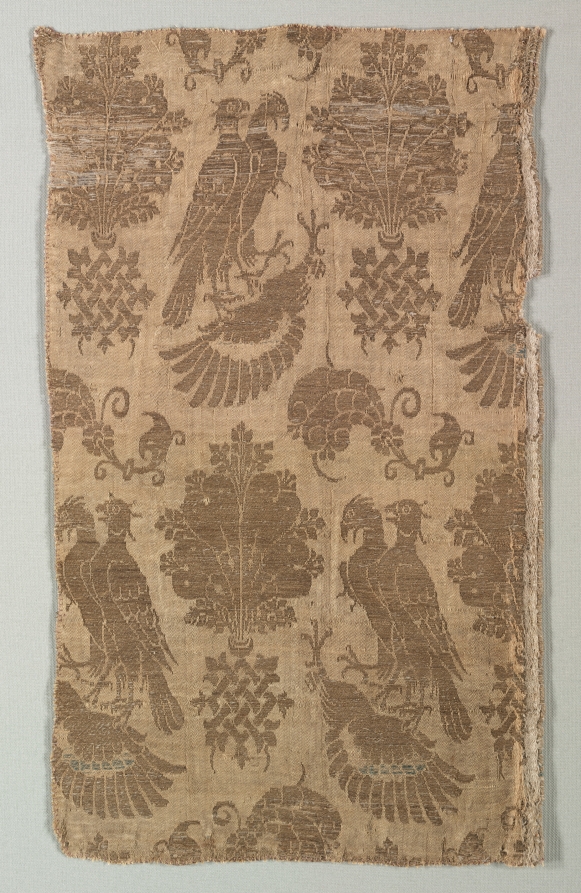
The Gilded Thread: Deconstructing the Falcon and Heraldry Silk
In the rarefied atmosphere of London’s Savile Row, where a suit is not merely constructed but *engineered* for posterity, one learns to read cloth as a biography. The fabric is the first and final argument. It is here, amidst the chalk stripes and the measured whispers of master cutters, that we must approach the subject of the gold-patterned silk bearing falcons and heraldic devices. This is not a textile; it is a document of dynastic power, a frozen moment of imperial ambition rendered in a medium that is both brutally fragile and eternally resilient. To handle such a piece is to hold the pulse of an empire that believed its sun would never set.
Materiality as Sovereignty: The Weight of Gold on Silk
The materiality of this artifact is its primary thesis. Silk, the filament of the mulberry worm, was the original global currency—a luxury so coveted that it launched fleets and toppled treasuries. But this is not mere silk. This is silk *augmented*, a surface transformed by the alchemist’s art of the gold thread. The gold is not a dye; it is a physical presence. Typically, this would be a gilded membrane—beaten gold leaf applied to a parchment or animal-gut core, then sliced into microscopic filaments and wound around a silk or linen core. The result is a warp or weft that catches the light with a metallic, almost liquid, authority.
In the context of imperial weaving, this gold-patterned silk was not intended for the soft hands of a courtier’s casual attire. Its weight—both physical and symbolic—precluded frivolity. The density of the gold thread would have made the fabric stiff, almost architectural. This was a textile designed for the throne, for the ceremonial state portrait, for the moment of coronation or investiture. The very stiffness of the cloth was a form of discipline; it held the body erect, it forced a posture of command. The materiality, therefore, is not merely decorative. It is a coercive technology of sovereignty. The wearer does not don the silk; the silk *armors* the wearer in a carapace of wealth and divine right.
Heraldry and the Falcon: A Lexicon of Power
The iconography—the falcon and the heraldic shield—demands a precise reading. In the lexicon of European and Near Eastern heraldry, the falcon is never a casual choice. It signifies the pinnacle of the predatory hierarchy, the bird of kings, the hunter that strikes with speed and precision from a great height. In imperial contexts, the falcon was often associated with the solar deity, with Horus in Egyptian tradition, or with the falconer’s art as a metaphor for the sovereign’s absolute control over his domain. The bird, hooded or unhooded, perched or in stoop, is a symbol of vigilance and swift justice.
The heraldry itself is a complex code. The shield, or escutcheon, is a geometric field upon which the family’s history is written in symbols. The tinctures (colors) and metals (gold and silver) are not arbitrary. Gold (Or) signifies generosity and elevation of the mind; it is the metal of the sun. The charges—the devices placed upon the field—might include lions (courage), towers (fortitude), or fleur-de-lis (purity). In the context of imperial silk weaving, the heraldry is not merely identifying. It is a claim of *continuity*. It asserts that the current wearer is the legitimate heir to the martial and moral virtues of his ancestors. The silk, therefore, becomes a physical manifestation of the dynastic contract.
The combination of falcon and heraldry on a gold-patterned ground is a deliberate escalation. The falcon provides the kinetic, predatory energy; the heraldry provides the static, legal framework. Together, they create a visual argument for absolute authority: *We are swift to strike, and we are lawfully entitled to do so.* This is not a message for the common street; it is a message for the court, for foreign ambassadors, and for the gods themselves.
The Legacy of Imperial Weaving: From Byzantium to the Great Houses
To understand this artifact, we must trace the legacy of imperial silk weaving. The tradition begins in earnest with the Byzantine Empire, where the imperial workshops in Constantinople held a monopoly on the production of purple silk and gold-woven fabrics. These were the *vestes* of the Emperor, reserved exclusively for the imperial family and the highest-ranking nobles. The secret of sericulture was a state secret, guarded as fiercely as any military intelligence. The silk was not merely a product; it was an instrument of statecraft, a way of distinguishing the imperial person from the mere mortal.
When the knowledge of silk weaving spread westward—through the Islamic caliphates, into Norman Sicily, and then into the great Italian city-states of Lucca, Venice, and Florence—the imperial aesthetic traveled with it. The looms of Lucca in the 14th century produced the grand *diasprum* and *baldacchino* fabrics, woven with gold and silver threads, often featuring heraldic eagles, lions, and falcons. These fabrics were commissioned by the great mercantile dynasties—the Medici, the Sforza—who sought to emulate the visual language of royalty. The silk was no longer the exclusive property of emperors, but it still carried the *memory* of imperial power. To wear a gold-patterned silk with heraldry in Renaissance Florence was to claim a lineage that stretched back to the Caesars, even if that lineage was purchased with florins rather than blood.
The legacy culminates in the great European courts of the 17th and 18th centuries—the France of Louis XIV, the Russia of Peter the Great, the Ottoman Sublime Porte. The imperial weaving workshops of Lyon, under the direction of the Gobelins and the Savonnerie, produced silks of such complexity that they required years to complete. The patterns became more naturalistic, yet the heraldic core remained. The falcon, once a rigid hieratic symbol, began to soar across the fabric with a new dynamism, yet its message remained unchanged: this is the cloth of the man who commands the sky and the earth.
Conservation and the Modern Eye
For the contemporary viewer, and for the tailor on Savile Row, this gold-patterned silk presents a paradox. It is too fragile to be worn. The gold threads, though beautiful, are brittle; the silk ground is susceptible to light damage and desiccation. To wear such a garment today would be an act of vandalism. Yet, its influence is inescapable. The modern luxury industry, in its pursuit of exclusivity, constantly references this imperial past. The jacquard looms of today can replicate the structure, but they cannot replicate the *soul* of the artifact—the knowledge that this was woven by hand, over months, by artisans who were themselves part of the imperial apparatus.
As a heritage artifact, this silk demands a dual approach. It must be conserved with the rigor of a museum piece—controlled humidity, low light, minimal handling. But it must also be *studied* as a living document. The heraldry can be deciphered to identify the original patron. The weave structure can be analyzed to date the piece and determine its workshop of origin. The gold content can be assayed to understand the economic resources at the disposal of the commissioner. Each thread is a data point in a vast historical narrative.
In conclusion, the gold-patterned silk with falcons and heraldry is the apotheosis of the weaver’s art. It is a material object that transcends its own materiality to become a symbol of political theology. It is a reminder that clothing, at its highest level, is never merely functional. It is a statement of being. And for those of us who work with cloth, who understand the drape and the fall, the weight and the sheen, this artifact is the ultimate benchmark. It is the standard against which all subsequent luxury must be measured—a standard that, frankly, we have never quite surpassed. We may have the technology, but we have lost the patience. The falcon has flown; we are left only with the shadow of its wing, cast in gold upon a field of silk.
Heritage Lab Insight
Lab Insight: CMA Silk Archive Node integration.