← BACK TO ARCHIVES
Heritage-Black
Heritage Synthesis: Terracotta rim fragment of a kylix (drinking cup)
Curated on Aug 06, 2026 // Node: LDN-01
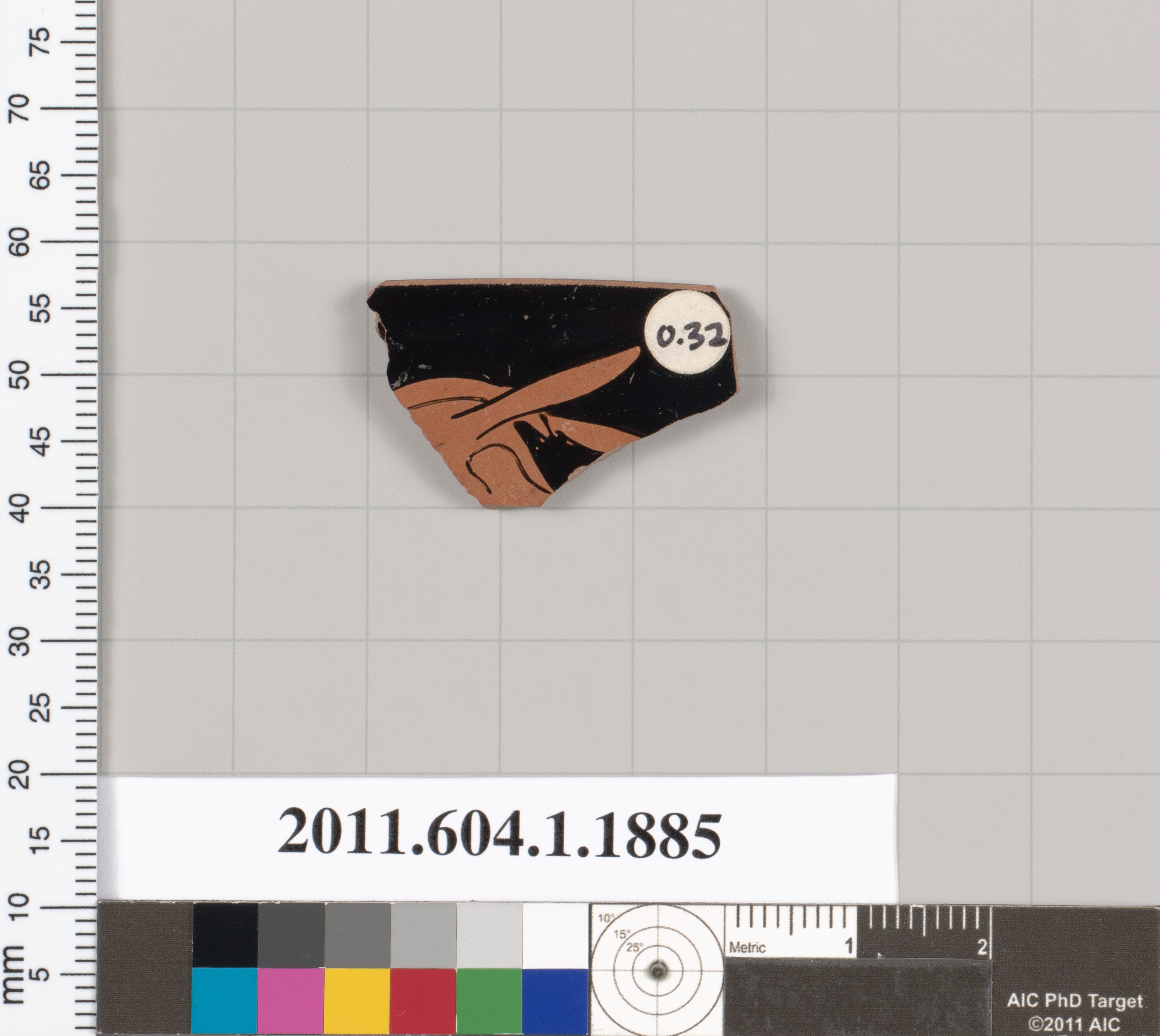
The Dialectics of the Vessel: Terracotta Fragments and the Architecture of Old Money Restraint
In the rarefied discourse of luxury fashion, the term “Old Money” has devolved into a shorthand for beige cashmere and understated tailoring. Yet a deeper archaeological reading reveals that the aesthetic DNA of inherited wealth—its preference for patina over polish, for structural integrity over surface novelty—finds a profound analogue in the fragmentary remains of antiquity. The terracotta rim fragment of an Attic kylix, a humble drinking vessel shard, offers a surprisingly potent hermeneutic lens through which to decode the 2026 Old Money silhouette. When placed in dialogue with our internal archive—specifically the philosophical tension between the *Udumbara* temple plaque and the *Beast-and-Grape* bronze mirror—this Greek fragment illuminates a core principle: **true luxury is not the accumulation of ornament, but the disciplined revelation of essence through material integrity and structural proportion.**
I. The Fragment as a Moral Imperative: Incompleteness as Status
The Attic kylix fragment, in its raw terracotta state, is an object of negation. It is not a complete vessel; it lacks its twin handles, its painted tondo, its glazed interior. Yet this very incompleteness is its most eloquent feature. In the 2026 Old Money silhouette, this translates into a deliberate, almost aristocratic refusal of the “total look.” We are witnessing a shift away from the head-to-toe branded ensemble—the contemporary equivalent of a fully painted Panathenaic amphora—toward a sartorial language of *strategic erosion*. Garments are cut with a sense of historical memory: a shoulder seam that references a 1930s riding jacket, a hemline that recalls a 1960s Givenchy shift, but each element is deliberately “fragmented” from its original context. The result is a wardrobe that feels excavated, not purchased.
The terracotta’s porous, unglazed surface—its visible grit and mineral inclusions—offers a direct material directive for 2026. We are moving away from the high-shine, microfiber-dominated textiles of the past decade toward fabrics that *breathe with geological time*. Think of heavyweight Irish linen with its slubs left visible, raw-edge silk twill that catches light like unpolished marble, and, most critically, the resurgence of *uncut* velvet—a fabric whose pile, when left unshorn, mimics the tactile irregularity of ancient ceramic. The Old Money consumer of 2026 does not seek to conceal the hand of the maker; she seeks to display the *trace* of the material’s journey. A jacket in undyed, organic wool that retains the lanolin’s faint golden cast is the textile equivalent of a terracotta shard—it speaks of earth, of origin, of a process that predates the fashion system.
II. The Rim as a Structural Principle: Proportion and the Contained Void
The rim fragment is, architecturally, a boundary condition. It defines the vessel’s opening, the threshold between interior and exterior, between the contained liquid (wine, water, ritual offering) and the surrounding world. For the 2026 Old Money silhouette, this translates into an obsessive focus on *internal architecture*—the unseen seams, the horsehair canvas, the floating chest piece that gives a jacket its “rim.” The new luxury is not in the visible surface but in the *negative space* created by precise tailoring.
Drawing from our internal archive, the *Udumbara* temple plaque’s aesthetic of “空灵” (ethereal emptiness) and “简淡” (austere simplicity) finds its secular, three-dimensional expression here. Just as the Udumbara flower—a microscopic bloom that appears once in three millennia—demands a contemplative gaze rather than a casual glance, the 2026 Old Money garment demands a *knowing* eye. The silhouette is not minimal in the sense of being empty; it is minimal in the sense of being *fully resolved*. A perfectly cut double-breasted blazer in midnight navy, devoid of any logo, with a lapel roll that curves with the precision of a kylix rim, is an act of aesthetic defiance against the noise of contemporary fashion. It is a “召唤结构” (call structure), inviting the observer to project status, lineage, and taste onto its silent surface. The garment becomes a vessel for the wearer’s own biography, not the designer’s ego.
III. The Beast-and-Grape Dialogue: From Dionysian Excess to Apollonian Control
The *Beast-and-Grape* bronze mirror, with its teeming imagery of fertility and abundance, represents the Dionysian pole of our aesthetic spectrum. The Attic kylix, however, was the very vessel of Dionysian ritual—the drinking cup of the symposium. Yet our fragment, stripped of its painted revelry, speaks a different truth. It is the *after* of the feast, the archaeological residue of ecstasy. This is the crucial pivot for 2026 Old Money: the silhouette must contain the memory of abundance without succumbing to it.
We see this in the return of the *column coat*—a garment that falls in a straight, unbroken line from shoulder to hem, reminiscent of a Greek *peplos* but executed in a heavy, fluid wool. The silhouette is austere, almost monastic, yet its volume and drape carry an implicit knowledge of the body beneath. It is a gesture of *controlled fullness*, akin to the kylix’s capacity to hold wine without spilling. Similarly, the 2026 evening gown for the Old Money clientele will not feature the overt floral embroidery of the Beast-and-Grape mirror. Instead, it will employ *architectural pleating*—each fold a deliberate, repeatable unit that echoes the fluting of a Greek column or the radial symmetry of a kylix base. The ornament is not applied; it is *structural*. The richness of the grape is transmuted into the discipline of the pleat.
IV. The Mirror and the Shard: A Unified Theory of Patina
The final synthesis lies in the concept of *patina*—the surface transformation wrought by time. The bronze mirror, once gleaming, now bears the green-brown corrosion of centuries. The terracotta fragment, once painted, now shows only its clay body. In both, value is accrued through *loss*. For 2026 Old Money, this is the ultimate luxury signifier: the garment that looks as if it has been lived in, not merely worn. This is not a manufactured “distressing” (a vulgar, commercial mimicry) but a *design for aging*. Fabrics are chosen for their ability to develop a beautiful patina—cotton that softens and fades, leather that creases and darkens, tweed that molds to the wearer’s posture. The silhouette itself is designed to accommodate the body’s changes, to drape with increasing grace over a decade of wear.
This is the philosophical convergence of our internal artifacts. The *Udumbara* plaque teaches us that the eternal is found in the ephemeral; the *Beast-and-Grape* mirror teaches us that the material world, when ordered with symbolic intent, becomes a mirror of cosmic order. The terracotta fragment teaches us the most practical lesson: **that the broken, the partial, and the weathered can possess a higher aesthetic authority than the pristine and the complete.**
In 2026, the Old Money silhouette will not be a uniform. It will be a *collection of fragments*—a beautifully tailored trouser, a hand-finished shirt, a coat with a history—assembled with the care of an archaeologist reconstructing a kylix from shards. The result will not be a perfect vessel, but a vessel that tells the truth of its making, its use, and its survival. And in that truth lies the only luxury that cannot be counterfeited: the quiet confidence of a thing that has endured.
Heritage Lab Insight
Genetic Bridge: Archive node focusing on Heritage-Black craftsmanship.