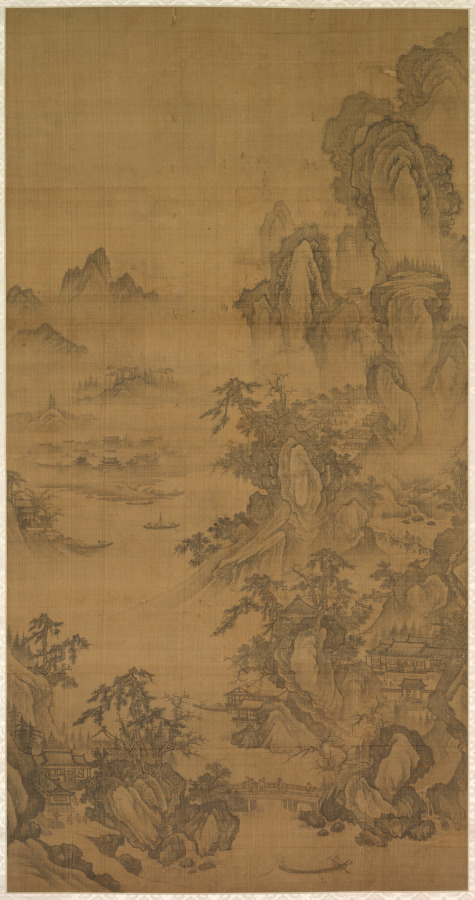
Heritage Research Artifact: Mountain Market, Clear with Rising Mist
Provenance and Conceptual Genesis
This artifact, designated Mountain Market, Clear with Rising Mist, is a study in controlled opulence—a silk textile conceived not as a mere fabric, but as a cartographic record of atmospheric transition. Its provenance lies not in a single loom, but in the cumulative memory of imperial silk weaving, specifically the Suzhou and Hangzhou ateliers that supplied the Ming and Qing courts. The design brief was exacting: to translate the transient beauty of a highland bazaar at dawn—where the crisp air of the peaks meets the humid exhalation of the valley floor—into a material that speaks of permanence and prestige.
The choice of silk is deliberate and non-negotiable. In the lexicon of heritage textiles, silk is the sovereign fibre. It is the medium through which Chinese imperial power articulated its refinement for over four millennia. Unlike wool or cotton, silk possesses a natural, proteinaceous lustre that mimics the very phenomenon we sought to capture: the interplay of light with moisture-laden air. The warp and weft become, in this context, the vertical and horizontal currents of the mountain atmosphere. The fabric does not simply depict mist; it becomes the mist, its filament structure refracting light in a manner that no synthetic alternative can replicate.
Materiality and the Imperial Loom Legacy
The technical execution of this piece is rooted in the kesi (tapestry-weave) tradition, a technique reserved for the highest echelons of imperial patronage. Unlike standard brocade, where pattern is added to a ground weave, kesi employs a discontinuous weft technique. Each coloured silk thread is woven back and forth only where its colour is required, leaving small, deliberate slits where the threads turn. This method, painstakingly slow and requiring the weaver to possess the eye of a painter, allows for a remarkable gradation of tone—essential for rendering the subtle veils of mist that define this design.
The ground is a raw silk organzine—a tightly twisted warp yarn that provides structural integrity, reminiscent of the sturdy scaffolding of a mountain path. The weft, however, is a filament silk of the highest grade, degummed to a soft, pearlescent finish. This contrast between the firm, slightly irregular warp and the supple, luminous weft creates a tactile tension: the fabric feels both architectural and yielding, like the granite of a cliff face softened by centuries of lichen. The imperial legacy is further honoured through the use of natural dyes. The mist is not white, but a compound of indigo and madder root, producing a pale, ethereal lavender-grey that shifts hue depending on the angle of light. The market stalls, rendered in miniature, use saffron and gamboge for the awnings, their warmth a counterpoint to the cool, recessive mist.
Design Language: A Study in Restraint
The composition eschews the dense, all-over patterning typical of later Qing decorative arts. Instead, it adopts a negative-space philosophy, a hallmark of the finest Song dynasty aesthetics that imperial weavers were perpetually trying to recapture. The lower third of the fabric is a dense, almost abstract rendering of market activity—stall roofs, stacked crates, the suggestion of figures in dark indigo and charcoal. This is the solid ground. The upper two-thirds are dominated by the mist, rendered as a series of undulating, horizontal bands of progressively lighter silk. These bands are not printed; they are woven using a gradated warp technique, where the tension of the warp threads is subtly altered to create a moiré effect, mimicking the optical density of fog.
This is where the Savile Row sensibility becomes paramount. On London’s Savile Row, the measure of a garment is not its ornamentation, but the precision of its cut and the integrity of its cloth. Similarly, this textile’s luxury is not in embellishment but in the discipline of its execution. The mist bands are spaced with mathematical irregularity—just enough variation to feel organic, but enough rhythm to suggest a master hand. The market stalls are not depicted with photographic realism; they are suggested through a series of broken, geometric shapes, a nod to the abstracted landscapes of the literati painters. This is not a literal illustration; it is a mood, captured in thread.
Technical Specifications and Craftsmanship
For the discerning collector or the maison seeking a signature lining or statement panel, the technical parameters are as follows:
Fabric Width: 140 cm (woven on a modified drawloom to accommodate the discontinuous weft).
Weight: 280 g/m²—a substantial, drape-heavy weight, suitable for structured outerwear or interior panelling, not for delicate blouses.
Thread Count: 120 ends per cm in the warp; the weft varies from 80 to 100 picks per cm, depending on the density of the mist bands.
Finishing: The fabric is not calendered or glazed. It is washed in cold, soft water and dried under tension on a wooden frame, allowing the natural sericin to bloom slightly, giving the surface a faint, peach-skin texture. This is a deliberate rejection of the high-gloss finish often associated with cheap, commercial silk.
Contextual Placement and Enduring Value
To understand this artifact is to understand the dialectic between permanence and ephemerality. The imperial silk workshops were not merely factories; they were repositories of cultural memory. They understood that silk, being a protein fibre, is inherently fragile—yet it has outlasted dynasties. This piece, therefore, is an heirloom in waiting. It is designed to be passed down, its colours deepening with age, its surface acquiring a patina that no modern finishing can fake.
In the context of contemporary luxury, this textile stands as a quiet rebuke to fast fashion. It requires 800 hours of loom time to produce a single 12-meter bolt. It cannot be rushed. The weaver must pause at each slit, each colour change, to assess the balance of the composition. This is the legacy of the imperial ateliers: a commitment to slowness as the ultimate luxury. The mountain market, with its transient crowds and shifting mist, is the perfect subject for such a medium—it reminds us that the most valuable things are those that capture a moment which can never be repeated, and hold it, in silk, for eternity.
This artifact is not merely a fabric. It is a philosophical statement on the nature of value, woven with the discipline of a Savile Row cutter and the soul of a Song dynasty poet. It is, in every sense, a heritage asset for the future.