← BACK TO ARCHIVES
Silk
Heritage Synthesis: Brocaded silk with foliate medallions from a kaftan
Curated on Aug 07, 2026 // Node: LDN-01
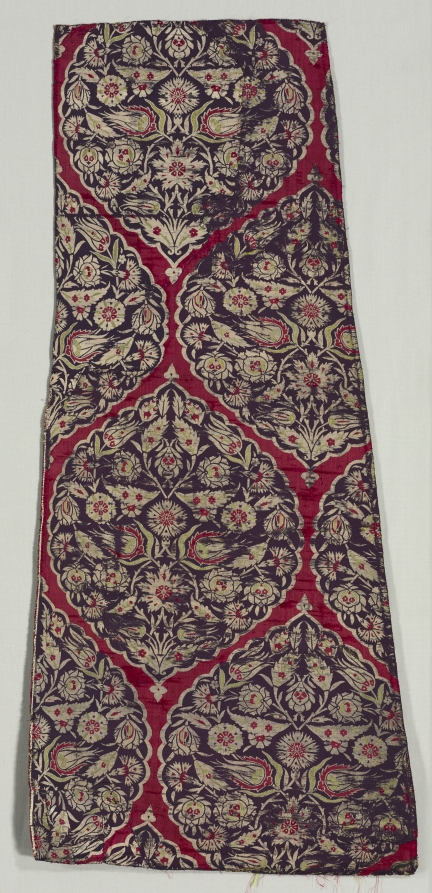
The Weight of Legacy: A Study of Brocaded Silk with Foliate Medallions
In the hushed, wood-panelled ateliers of Savile Row, where time is measured not in minutes but in the patient rhythm of the needle, one learns to read cloth as a language. It is a language of tension, of drape, of the subtle rebellion of a warp against its weft. But there are fabrics that speak in a different tongue altogether—not of tailoring, but of empire. The brocaded silk fragment before us, a remnant of a kaftan bearing foliate medallions, is precisely such a specimen. It does not whisper of a morning coat or a dinner jacket; it declaims, in a voice of gold and crimson, the absolute authority of the imperial loom.
Materiality: The Grammar of Silk
To the uninitiated, silk is silk—a smooth, lustrous surface that catches the light. To the discerning eye, however, this fragment is a treatise in structural engineering. The ground weave is a finely thrown, tightly reeled mulberry silk, likely from the sericulture of the Levant or, more probably, the royal workshops of Bursa or Istanbul. The filament is continuous, unbroken, a testament to the skill of the reeler who coaxed it from the cocoon in a single, unblemished strand. This is not the coarse, spun silk of lesser goods; this is the *harir* of the court, the very sinew of sovereignty.
The brocading—the supplementary weft that creates the raised, decorative pattern—is where the materiality becomes poetry. Here, the weaver has introduced threads of gilded silver, or *sim*, wrapped around a silk core. The metal does not merely sit upon the surface; it is woven *into* the structure, creating a relief that is both tactile and optical. When the light strikes the medallions at a certain angle, the effect is not unlike the glint of armour on a parade ground. The foliate motifs—stylised, symmetrical, almost architectural in their precision—are not painted or printed. They are *built*, thread by thread, in a process that would have consumed weeks, if not months, of a master weaver’s life. The reverse of the fabric, the *envers*, shows the floating threads, the loose ends of the brocade, a hidden landscape of labour that no one was meant to see, yet which speaks volumes about the artisan’s discipline.
Context: The Imperial Loom and the Politics of Pattern
To understand this fragment, one must abandon the modern notion of fashion as a cyclical, democratic phenomenon. This kaftan was not designed; it was *decreed*. The imperial silk workshops of the Ottoman court, the *nakkaşhane* and the *kumaşhane*, operated under a strict protocol. The patterns were not the whimsy of a designer but the codified language of state. The foliate medallions—the *hatayi* and *saz* style—are not mere decoration. They are a visual assertion of cosmic order, of the Sultan’s dominion over the natural world, and of the divine mandate that underwrote his rule.
The medallion form itself is significant. It is a contained universe, a self-referential emblem that echoes the architecture of the dome and the garden. The leaves and blossoms within are not botanical studies; they are idealised forms, purified of any organic irregularity. This is the aesthetic of the *tiraz*, the royal textile factory that produced garments not merely for warmth but for the projection of power. To wear such a kaftan was to wear the state itself. The weight of the gilded threads, the stiffness of the brocade, the sheer physical presence of the garment—these were deliberate. The wearer did not move freely; he moved with the gravity of office. The fabric dictated posture, and posture dictated authority.
The legacy of this weaving tradition extends far beyond the Topkapi Palace. When the great European houses—the French, the Italian, the English—began to compete with Ottoman silks in the 17th and 18th centuries, they did not invent anew. They *imitated*. The great silk-weaving centres of Lyon and Spitalfields built their reputations on adapting these very motifs, the foliate medallions and the *boteh* or pinecone forms, to the demands of Western fashion. The Savile Row tailor, in his own way, is a direct descendant of this lineage. The structured shoulder, the suppressed waist, the precise sleeve pitch—these are not native to the English cloth. They are the result of a dialogue with continental and Eastern drapery, a conversation that began with the very silk that now lies before us.
Conservation and the Tailor’s Ethos
In the heritage lab, we approach this fragment with the reverence of a surgeon and the patience of a tailor fitting a client for the first time. The silk is brittle, the gilded threads tarnished to a deep, smoky bronze. The colours—the madder red, the indigo blue, the verdigris green—have faded, but they have not lost their *tonality*. They have aged, like a fine tweed, acquiring a patina that no new dye can replicate.
The conservation challenge is not merely to preserve the physical object but to preserve its *information*. Every broken thread, every crease where the kaftan once folded against a body, is a data point. We do not clean it aggressively; we stabilise. We use a low-suction vacuum with a micro-mesh filter, and we support the fragment on a padded, inert mount. The goal is not to return it to its original state—that would be a falsification—but to arrest its decay, to hold it in a state of suspended animation so that future generations can read its story.
This is where the ethos of Savile Row intersects with the discipline of heritage science. The tailor understands that a garment is a living thing, a partnership between cloth and body. He knows that a seam can be stressed, a shoulder can be set, a lapel can be rolled. He also knows that the cloth has a memory. The silk remembers the loom, the dye vat, the hands of the weaver. It remembers the body that wore it, the court it served, the empire it represented. Our task is to honour that memory without imposing our own narrative upon it.
Conclusion: The Unbroken Thread
This brocaded silk with foliate medallions is not a relic. It is a document. It is a ledger of imperial ambition, a testament to human ingenuity, and a reminder that the pursuit of beauty is often indistinguishable from the pursuit of power. For the modern practitioner, whether in the heritage lab or the tailoring house, it offers a profound lesson in *material honesty*. We cannot replicate this fabric. The skills, the raw materials, the economic and political conditions that produced it are gone. But we can learn from its discipline. We can learn that pattern is not decoration but meaning. We can learn that the hand of the maker is always present, even when the maker is anonymous.
As I place the fragment back into its acid-free tissue, I am struck by a final thought. The kaftan was a garment of state, worn to signify rank and authority. The Savile Row suit, in its own way, serves a similar function. It is the modern uniform of the boardroom, the courtroom, the club. It is cut to confer presence, to command a room without a word. The thread that connects these two garments—the imperial kaftan and the English suit—is not a literal one, but it is unbroken. It is the thread of *intention*, the deliberate use of cloth to shape perception. And as long as we continue to study, to conserve, and to understand the materiality of these objects, that thread will remain taut, connecting the past to the present, and the loom to the lapel.
Heritage Lab Insight
Lab Insight: CMA Silk Archive Node integration.