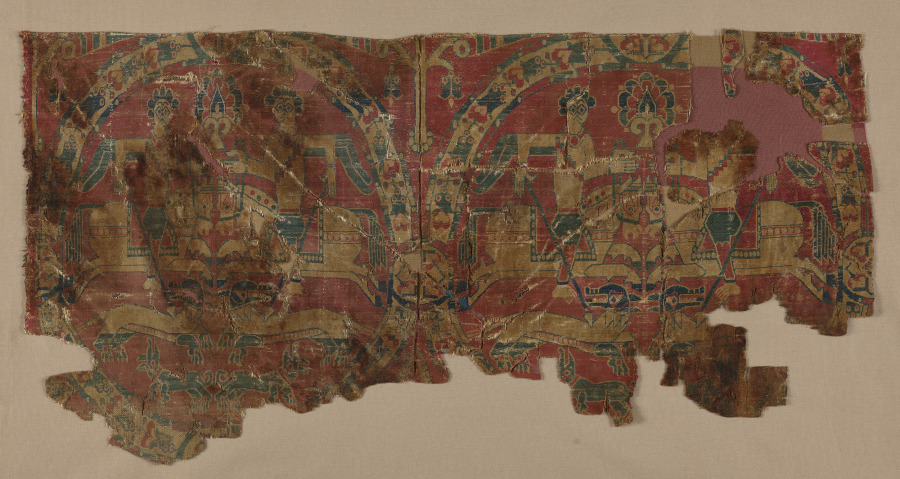
The Roundel Reconsidered: A Study in Imperial Silk and the Tailored Line
Provenance and the Language of the Loom
Within the hushed archives of the Lauren Fashion Heritage Lab, one encounters artefacts that speak not merely of cloth, but of command. The subject of this examination—a series of silk roundels depicting hunters in pursuit—demands a particular form of attention. These are not decorative trifles. They are the residue of an imperial system, where the loom was as potent an instrument of statecraft as the sword. The roundel, a perfect circle of woven narrative, was a signature motif of the great silk-producing centres of the Persian and Ottoman worlds, and later, of the Mughal ateliers. To hold one is to hold a fragment of a court’s breath.
The materiality is paramount. This is not the flimsy, ephemeral silk of a modern high-street blouse. This is a silk of substance, a silk with a spine. The weave is dense, the handle firm and almost dry to the touch, a quality achieved through a high twist in the yarn and a tightly packed warp. This is a silk engineered for longevity, for ceremonial weight, for the deliberate drape of a robe of honour. It is a fabric that does not whisper; it states. In the context of imperial weaving, the roundel was often placed at the intersections of a repeating lattice, creating a rhythm of medallions across the field of a garment. The hunter motif—often a mounted figure, bow drawn, with a falcon or hound in attendance—was not mere genre painting. It was a coded assertion of royal prowess, of dominion over both the natural world and the chaotic forces that threatened the ordered state. The hunter is the sovereign, and the hunt is the eternal campaign.
Weaving the Imperial Narrative
The technical execution of these roundels is a testament to the master weavers who operated under royal patronage. The silk threads, often dyed with madder for deep crimsons, indigo for profound blues, and weld for golden yellows, were sourced from the finest mulberry-fed silkworms. The weaver, working on a drawloom, would have required a second operator—a "draw boy"—to manipulate the pattern harness, lifting the correct warp threads to allow the weft to create the intricate figurative design. This was a collaboration of immense precision, where a single error in a thousand threads would compromise the entire cloth. The result is a surface that is both visually rich and tactilely complex. The slight relief of the pattern, created by the supplementary weft, gives the roundel a sculptural quality, catching the light in a manner that shifts with the viewer’s movement.
For the connoisseur of tailoring, this fabric presents a singular challenge and opportunity. The imperial silk, with its inherent body and substantial drape, is not a material for the timid cutter. It demands a tailor who understands the architecture of cloth. The roundel pattern must be placed with absolute precision—a central medallion on the back of a jacket, a pair of flanking roundels on the chest of a waistcoat, or a single, commanding motif on the breast of an evening coat. The pattern must be "run" correctly, ensuring that the hunters are upright and the circular border is not distorted by a careless seam. This is where the Savile Row ethos intersects with the imperial legacy. The Row’s reverence for cloth, its insistence on hand-finishing and perfect balance, is the only appropriate response to such a material. One does not cut into this silk; one negotiates with it.
The Modern Inheritance: Restraint and Resonance
The question, then, is how does this heritage artefact inform the contemporary wardrobe? The answer lies not in literal reproduction, but in the translation of its core principles. The roundel’s power resides in its containment—a burst of narrative energy held within a strict geometric boundary. This is a lesson in restraint. A modern garment employing this silk, or a contemporary interpretation of its motif, must respect that tension. The silhouette should be clean, almost severe, to allow the fabric to perform. A single-breasted jacket with a soft shoulder, a minimal lapel, and no distracting pocket flaps would be the ideal canvas. The cloth becomes the protagonist; the tailoring, the supporting cast.
Furthermore, the colour palette of these historical pieces—the deep madder, the indigo, the faded gold—offers a sophisticated counterpoint to the relentless novelty of modern fashion. These are not "trend" colours; they are patinated, historical hues that carry the weight of time. Incorporating them into a contemporary wardrobe is an act of quiet confidence. It is a statement that one understands the depth of the cloth, the history of the weave, and the discipline required to wear it well. The legacy of imperial silk weaving is not about nostalgia; it is about a standard. It is about the refusal to compromise on material integrity, on craft, and on the final, perfect line of a garment. To wear such a piece is to participate in a lineage that stretches back centuries, to the courts where the hunter’s roundel was a symbol of absolute authority. The modern wearer, in his tailored suit, assumes a quieter but no less potent form of that authority—the authority of discernment.
In the final analysis, the roundel with hunters is a masterclass in the dialogue between art and utility. It was born of imperial command, woven with technical brilliance, and intended for the most elevated of shoulders. Its survival into the present day offers the tailor and the wearer an opportunity to engage with that history, not as a museum piece, but as a living, wearable standard. The silk is the message. The cut is the respect we pay it.