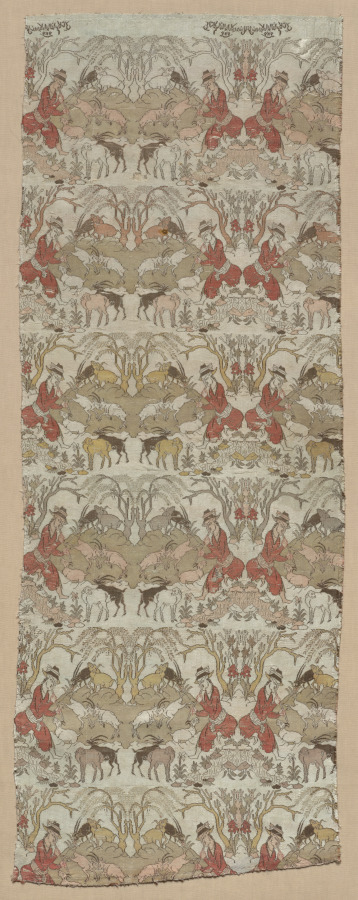
An Heirloom of Empire: The Silk Textile with Goatherds in a Landscape
Provenance and the Imperial Loom
To hold this silk is to hold a fragment of a forgotten diplomacy. The textile before us—a woven tableau of goatherds tending their flocks amidst a pastoral idyll—is not merely a decorative length of fabric. It is a material testament to the zenith of imperial silk weaving, a period when the loom was as potent an instrument of statecraft as the treaty or the tariff. This piece, likely originating from a royal manufactory in Lyon or a closely guarded atelier in Spitalfields, speaks to a legacy that transcends the mere production of cloth. It embodies a system of patronage, technical mastery, and cultural exchange that defined the opulent courts of eighteenth-century Europe.
Consider the materiality itself. The silk is not a flat, uniform ground. The warp and weft have been manipulated with a sophistication that borders on the alchemical. The ground is a deep, lustrous ivory, achieved through a meticulous degumming process that preserves the natural protein of the filament, allowing light to play across its surface with a liquid sheen. Upon this foundation, the scene is rendered in a palette of muted terracotta, sage green, and a blue that recalls the distant hills of a Claude Lorrain painting. The figures—the goatherds themselves—are not crude, folkloric representations. They are rendered with a classical precision, their drapery falling in folds that mimic the sculptural reliefs of antiquity. This is not a pastoral scene observed from life; it is a pastoral scene *idealised*, filtered through the lens of classical mythology and aristocratic fantasy. The goatherd is a modern-day Arcadian, a symbol of a golden age that the courtly elite wished to believe they inhabited.
The Language of the Loom: Technique as Power
The technical execution is where the true imperial narrative unfolds. The weave structure is a complex compound satin, likely a five-end or eight-end satin foundation, with a supplementary weft for the pattern. This is not a simple brocade. The pattern is not *added* to the ground; it is *integrated* into it, creating a fabric that is both structurally sound and pictorially rich. The goatherds’ faces, for instance, are not embroidered or painted. They are woven with such fineness that the individual threads are imperceptible to the naked eye, creating an effect akin to a miniature painting in thread. This level of detail required a drawloom, a machine that was the supercomputer of its age. The operator, the *tireur de lacs*, would have worked from a complex notation system, pulling a series of cords to lift the correct warp threads for each pass of the shuttle. A single repeat of this pattern could require thousands of such pulls, each one a discrete act of calculation.
This technical prowess was a form of soft power. The ability to produce such a fabric was a closely guarded national secret, a marker of economic and technological superiority. France, under Colbert’s mercantilist policies, had established the Gobelins and other royal manufactories to break the Italian monopoly on luxury silks. The result was not just a domestic industry but a weapon of cultural dominance. When a European court received a gift of such silk, it was not merely receiving a beautiful object; it was receiving a demonstration of the weaver’s nation’s industrial might and artistic refinement. The goatherd, in this context, is a Trojan horse. The pastoral calm of the scene belies the aggressive economic and political ambition woven into its very structure.
The Savile Row Perspective: Cut, Cloth, and Continuity
From the vantage of Savile Row, this textile is not a museum piece to be admired behind glass. It is a primary source, a foundational text. Our craft is predicated on the relationship between cloth and the human form, and this silk demands a specific kind of reverence. The hand of the fabric—its drape, its weight, its resilience—is the first point of dialogue. This is not a stiff, upholstery-grade silk. It has a fluidity, a *give*, that suggests it was intended for a garment of considerable structure, perhaps a formal justaucorps or a mantua. The scale of the pattern is crucial. The goatherds and their charges are rendered at a scale that would have been visible and impactful when worn, yet not so large as to overwhelm the wearer’s silhouette. It is a pattern designed for the body in motion, for the gesture of the arm, for the turn of the head.
Our approach to such a material is one of deference and intervention. We do not cut against the grain of the narrative. The pattern must be placed with surgical precision. The primary motif—the central goatherd—must sit at the point of the chest, the focal point of the garment’s lapel. The secondary figures must flow naturally over the shoulder and down the sleeve, creating a sense of continuous movement. The seamstress’s task is to make the cloth appear as if it grew that way, as if the garment were a natural extension of the woven landscape. This requires a deep understanding of the fabric’s bias and its propensity to shift. We use a silk-thread basting to hold the layers in place, and we press with a cool iron, never allowing the heat to crush the lustrous surface. The lining, of course, would be a contrasting silk—perhaps a deep, muted crimson—to provide a counterpoint to the ivory ground and to add a whisper of colour when the garment moves.
This silk is a reminder that our trade is not merely about tailoring. It is about stewardship. We are the custodians of a lineage that stretches back to those imperial looms. When we work with a fabric of this calibre, we are not just making a suit or a gown; we are participating in a continuum of craftsmanship that has defined Western dress for centuries. The goatherd is our ancestor, and the loom is our shared heritage. The challenge, and the privilege, is to ensure that this heritage remains not a relic, but a living, breathing part of how we dress today. The cloth is the history; the cut is the interpretation. And in that synthesis, we find the true, enduring legacy of imperial silk.