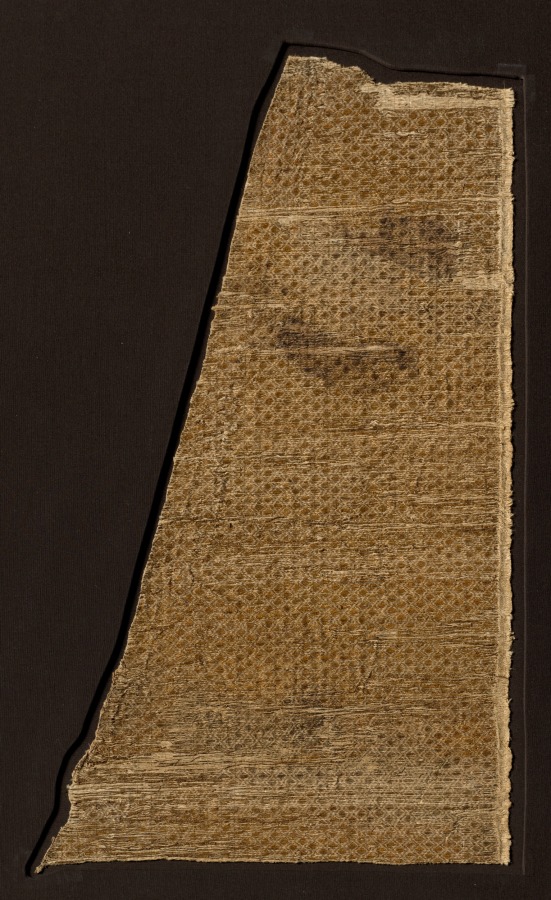
The Textile with Diamonds: A Study in Imperial Silk and the Geometry of Power
In the hushed ateliers of Savile Row, where cloth is not merely cut but argued with, measured, and ultimately persuaded into form, one encounters a material that transcends mere tailoring. The textile with diamonds—a pattern of interlocking, faceted forms rendered in silk—is not a design. It is a document. It is a ledger of imperial ambition, a cartography of light, and a testament to the very particular genius of the loom. This artifact, drawn from the Lauren Fashion Heritage Lab, demands to be read not as a decorative flourish, but as a structural assertion of authority.
Materiality: Silk as Sovereign Medium
Let us first address the substrate. Silk is not a neutral canvas. It is a protein filament, extruded by the Bombyx mori moth, that possesses a unique optical property: a triangular prismatic cross-section that refracts light, creating an internal lustre that no synthetic fibre can counterfeit. For the imperial courts of China, Persia, and later Byzantium, silk was not a luxury; it was a diplomatic currency, a form of soft power that preceded armies. To wear silk was to declare one’s participation in a global economy of taste and tribute. The diamond motif, when executed in this medium, does not sit upon the surface. It emerges from the weave, catching the candlelight of a throne room or the grey afternoon of a London club with equal authority.
The legacy of imperial silk weaving is fundamentally a legacy of tension. The warp and weft are held in a state of disciplined opposition, each thread resisting the other to create a stable, yet supple, plane. This is the physics of power. A diamond pattern, with its sharp vertices and converging diagonals, amplifies this tension. The eye is drawn to the points, where two lines meet and resolve. In the imperial context, this geometry mirrored the structure of the court itself: a central authority (the diamond’s heart) from which all lines of influence radiate and to which all loyalty returns.
The Diamond Motif: Geometry as Governance
Consider the specific iteration of the diamond in this artifact. It is not a simple lozenge. It is a faceted form, suggesting the cut of a precious stone. This is a deliberate conflation of mineral wealth with textile craft. The imperial weaver, working on a drawloom that could require two operators—one to manipulate the pattern harness, one to throw the shuttle—was effectively programming a binary system centuries before Babbage. Each diamond is a unit of information, a pixel of prestige. The repetition of the motif is not monotonous; it is liturgical. It establishes a rhythm, a cadence of opulence that the wearer’s body is expected to inhabit.
In the Byzantine court, silk with geometric patterns was reserved for the highest echelons of the hierarchia. The clavi and segmenta—the woven bands and roundels—were not merely decorative; they were rank insignia, encoded in thread. The diamond, in particular, carried a dual resonance. It evoked the vesica piscis, the intersection of two circles that in Christian mysticism symbolised the divine, but it also echoed the tetractys, the Pythagorean figure of the perfect number ten. To wear a diamond in silk was to claim a mathematical and metaphysical order. It was to say: I am not subject to chaos; I am the pattern.
Imperial Legacy and the Savile Row Translation
The journey from the imperial looms of Chang’an or Constantinople to the cutting tables of Savile Row is not a linear one. It is a story of appropriation, refinement, and recontextualisation. The 18th-century European silk mills of Lyon and Spitalfields inherited the technical vocabulary of the East—the drawloom, the compound weave, the use of multiple warp threads—but they re-inflected it with a Western sensibility for structure and restraint. The diamond motif, once a symbol of cosmic order, became a marker of civic discipline. It appeared in waistcoats of the Georgian era, in dressing gowns of the Regency, and, crucially, in the lining of tailored jackets.
Here, on Savile Row, the textile with diamonds acquires its final, most potent meaning. The exterior of a bespoke suit is often sober—a charcoal worsted, a midnight blue serge. The interior, however, is a private theatre. A silk lining in a diamond pattern is a secret indulgence, a hidden assertion of selfhood. It is the wearer’s private acknowledgement that beneath the conformist exterior lies a pattern of individual authority. The imperial legacy is not about ostentation; it is about controlled revelation. The courtier who wore diamonds in silk did so to signal proximity to the throne. The Savile Row client who commissions a diamond-patterned silk lining is signalling proximity to his own standards.
Technical Execution: The Weaver’s Calculus
To fully appreciate this artifact, one must respect the technical achievement. A diamond pattern in silk requires a satin weave ground, where the floats of the warp are long, allowing maximum light reflection. The diamond itself is often formed by a twill or damask structure, where the design is created by reversing the weave direction. This is not a printed pattern; it is a structural one. The design is integral to the cloth. It cannot be washed out, faded, or peeled away. It is the cloth.
The density of the weave—often upwards of 200 threads per square inch—creates a fabric that is both fluid and substantial. It drapes with a liquid quality, yet it holds a crease with authority. This is the paradox of imperial silk: it is soft to the touch but unyielding in form. The diamond motif, with its sharp angles, reinforces this paradox. It suggests a crystalline structure, a mineral hardness, within the supple textile. This is the essence of the imperial aesthetic: strength disguised as elegance.
Conclusion: The Pattern Persists
In the end, the textile with diamonds is a mnemonic device. It remembers a time when cloth was a primary medium of political communication. It remembers the hands of the weaver, the patience of the drawboy, the ambition of the court. And it remembers, most importantly, that power is not worn; it is woven. As we handle this artifact in the Heritage Lab, we are not merely preserving a fabric. We are preserving a grammar of authority, a syntax of status that continues to inform the quiet language of bespoke tailoring. The diamond is not a shape. It is a statement. And in silk, it is immortal.