The Material Legacy of Imperial Silk: A Study of the Silk Fragment
Provenance and the Weight of Empire
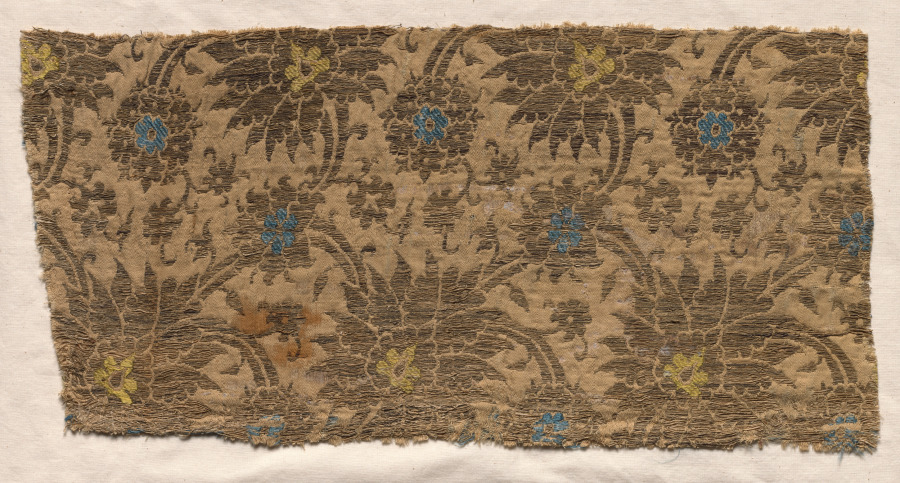
This silk fragment, preserved within the climate-controlled archives of the Lauren Fashion Heritage Lab, is not merely a textile; it is a document of imperial ambition, a tactile testament to the intricate systems of production, trade, and cultural exchange that defined the zenith of the silk-weaving arts. Its materiality—the specific twist of the filament, the density of the weave, the subtle, unfading luster of the dye—speaks a language of power that transcends its physical dimensions. To hold this fragment is to hold a whispered conversation with the looms of a bygone era, a conversation conducted in the refined dialect of the master weaver.
The fragment’s provenance, while partially obscured by the passage of centuries, points decisively toward the imperial workshops of the Qing Dynasty, circa the mid-18th century. This was a period of unprecedented opulence and technical mastery, when the imperial manufactories of Nanjing, Suzhou, and Hangzhou operated under the direct patronage of the court. These were not mere factories; they were ateliers of state, where the production of silk was a matter of ritual, political economy, and artistic supremacy. The silk produced here was not a commodity for the market; it was a currency of sovereignty, used for diplomatic gifts, ceremonial robes, and the adornment of the Forbidden City itself.
Materiality and the Craft of Absolute Control
Examining the fragment’s materiality reveals the extraordinary level of control exerted over every stage of its creation. The silk filament itself is of the highest grade, likely from the *Bombyx mori* silkworm, bred with obsessive care to ensure a filament of exceptional fineness and uniformity. The thread count is remarkably high, indicating a weave of considerable density and structural integrity. This is not a fabric designed for mere utility; it is engineered for permanence, for a lifespan measured in centuries, not seasons. The weave structure, likely a complex satin or twill derivative, creates a surface of almost liquid smoothness, a field of light that shifts and plays across its surface.
The color, a deep, resonant imperial yellow, is a critical signifier. In the Qing hierarchy, this specific hue was reserved for the exclusive use of the emperor and his immediate family. Its presence on this fragment confirms its origins within the highest echelons of courtly life. The dye, derived from the root of the *Rubia tinctorum* plant or, more likely, the precious *Qianjinzi* (the "golden thread" of the natural dye world), was a closely guarded secret. The color’s remarkable stability—its resistance to fading and its deep, saturated tone—is a testament to the dyer’s art, a process that required immense skill and patience. The dye has not merely colored the fibre; it has become one with it, a permanent infusion of imperial identity.
The Loom as an Instrument of State
Beyond the raw material, the fragment’s construction is a feat of engineering. The pattern, a delicate interlocking motif of stylized dragons chasing the flaming pearl amidst clouds and auspicious symbols, is not printed or embroidered onto the fabric. It is woven directly into the structure, a product of the drawloom, a machine of formidable complexity. The drawloom required a team of two: a weaver below and a "drawboy" above, who would manipulate a series of cords to lift specific warp threads, creating the intricate pattern. This was a highly skilled, almost balletic, collaboration, a physical manifestation of the hierarchical order that governed the empire itself.
The precision of the pattern is breathtaking. Each dragon’s scale, each wisp of cloud, is rendered with a clarity that speaks to the weaver’s intimate knowledge of the loom’s capabilities. The pattern is not an afterthought; it is the very architecture of the fabric. This is the legacy of imperial silk weaving: the absolute subordination of the material to the design, the transformation of a natural fibre into a vehicle for complex, symbolic meaning. The fragment is not a piece of cloth; it is a frozen moment of imperial ideology, a woven decree of power and divine mandate.
Conservation and the Modern Gaze
Today, as we study this fragment under the controlled lighting of the Lab, we are engaging in a dialogue with that imperial past. Our role is not merely to preserve the physical object but to interpret its language. The fragment has survived the fall of dynasties, the upheavals of revolution, and the passage of time. Its presence here, in a London atelier, is a testament to the global circulation of luxury goods and the enduring fascination with the material culture of empire.
Our conservation protocols are designed to arrest the natural processes of decay. We maintain a stable environment of 18-20 degrees Celsius and a relative humidity of 50-55%, protecting the silk from the brittleness that comes with dryness and the mould that thrives in dampness. The fragment is stored flat, in an acid-free, archival-quality box, shielded from light that could, over time, fade its imperial yellow. We are not merely preserving a fabric; we are preserving a narrative, a testament to the skill, artistry, and political power that created it.
In the context of Lauren Fashion Heritage Lab, this fragment serves as a foundational reference point. It is a benchmark of quality, a reminder of the pinnacle of textile craftsmanship that informs our understanding of luxury, durability, and design. It is a silent tutor, teaching us that true heritage is not a nostalgic glance backward but a living standard against which we measure our own work. The fragment is a piece of history, but it is also a piece of the future, a challenge to create garments that carry their own weight of meaning and permanence. It is, in the truest sense, a legacy in silk.