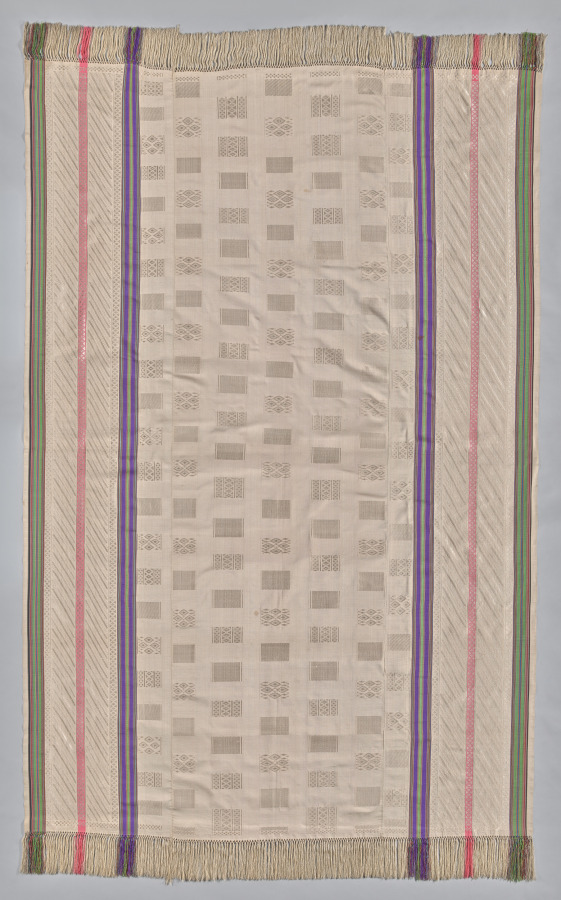
The Wrapper (Lamba Akotifahana): A Study in Imperial Silk and the Art of Restrained Opulence
Provenance and the Language of Luxury
In the rarefied world of textile connoisseurship, where provenance is paramount and narrative is woven as finely as the thread itself, the Lamba Akotifahana stands as a singular artifact. This is not merely a wrapper; it is a document of imperial ambition, a tactile record of trade routes that spanned oceans, and a masterclass in the quiet power of materiality. For the discerning eye, accustomed to the understated elegance of a Savile Row drape, the Akotifahana offers a profound parallel: it is the Malagasy equivalent of a bespoke garment, cut not for the body alone, but for the soul of a kingdom.
The term Akotifahana itself, translating to “woven with skill,” belies the extraordinary technical and artistic complexity of the piece. These wrappers, produced for the Merina aristocracy of 19th-century Madagascar, were not everyday attire. They were ceremonial regalia, diplomatic gifts, and markers of the highest social standing. To wear one was to declare one’s place within a meticulously ordered hierarchy, a hierarchy that looked outward to the world for its materials and inward to its own cultural genius for its design.
Materiality: The Imperial Thread
The very essence of the Akotifahana’s prestige lies in its primary material: silk. Yet, this is not the silk of Lyons or the mulberry groves of China alone. The silk used in these wrappers was often imported, a fact that speaks volumes about Madagascar’s integration into the 19th-century global economy. The Merina court, under the reign of Queen Ranavalona I and her successors, actively sought the finest raw materials, and silk—with its inherent lustre, strength, and association with distant, sophisticated cultures—was the ultimate luxury import.
Consider the parallel with the Savile Row house. Just as a master tailor will source the finest Scottish tweed or Italian cashmere, the Malagasy weaver was a curator of global materials. The silk, often in its raw filament form, was imported from the East, a tangible connection to the ancient Silk Road that now terminated in the highlands of the Indian Ocean. This importation was not a passive act; it was a deliberate assertion of power. To command such materials, to possess the knowledge to transform them into something of transcendent beauty, was to participate in a dialogue of empires. The wrapper, therefore, is not just a textile; it is a geopolitical statement, woven in a language of threads that only the elite could fully comprehend.
Construction and the Art of the Hand
The technical execution of the Akotifahana is where its true genius resides. Unlike the jacquard looms of Europe, which mechanised pattern production, the Akotifahana was woven on a horizontal ground loom, a technology of great antiquity. The weaver, almost exclusively a woman of high status, worked with extraordinary precision, often incorporating supplementary weft threads to create intricate, raised patterns. These patterns—diamonds, zigzags, and stylised floral motifs—are not merely decorative. They are a coded language, a visual heraldry that could denote clan affiliation, marital status, or even specific ceremonial occasions.
The labour involved is almost incomprehensible by modern standards. A single wrapper, measuring approximately 1.5 by 2.5 metres, could take months, even years, to complete. The weaver’s hands, guided by a memory of pattern and a profound understanding of tension, would have worked in a state of focused meditation. This is the antithesis of mass production. It is the slow, deliberate creation of an heirloom, a process that imbues the finished object with an almost spiritual weight. In this, it mirrors the ethos of the bespoke tailor, for whom the process of creation is as important as the final product. The countless hours of hand-stitching, the meticulous pressing, the final fitting—these are rituals that elevate a garment from mere clothing to a work of art. The Akotifahana shares this philosophy entirely.
Legacy and the Modern Gaze
The legacy of the Lamba Akotifahana is complex. With the French colonisation of Madagascar in 1895, the imperial patronage that sustained this art form collapsed. The court was disbanded, and the intricate social structures that demanded such garments were dismantled. The weaving tradition, once a pinnacle of cultural achievement, was relegated to a craft of the past, its secrets passed down in a diminished form or lost entirely.
Today, the Akotifahana is a coveted museum piece, a treasure of collections from the Musée du Quai Branly in Paris to the British Museum in London. For the contemporary observer, it offers a profound lesson in the value of materiality and the enduring power of the handmade. In an age of fast fashion and digital reproduction, the Akotifahana stands as a defiant monument to slowness, skill, and significance. It reminds us that true luxury is not about volume or visibility, but about the quiet, confident assertion of quality and meaning.
For the heritage specialist, the Akotifahana is more than a historical curiosity. It is a benchmark. It challenges us to reconsider our own relationship with cloth, to look beyond the surface and appreciate the layers of history, labour, and intention that constitute a truly great textile. It is, in the most profound sense, a bespoke garment for the ages—cut from the finest imperial silk, tailored by the hands of a master, and finished with a legacy that continues to command respect. To study it is to understand that the language of luxury is universal, and its grammar is written in thread.