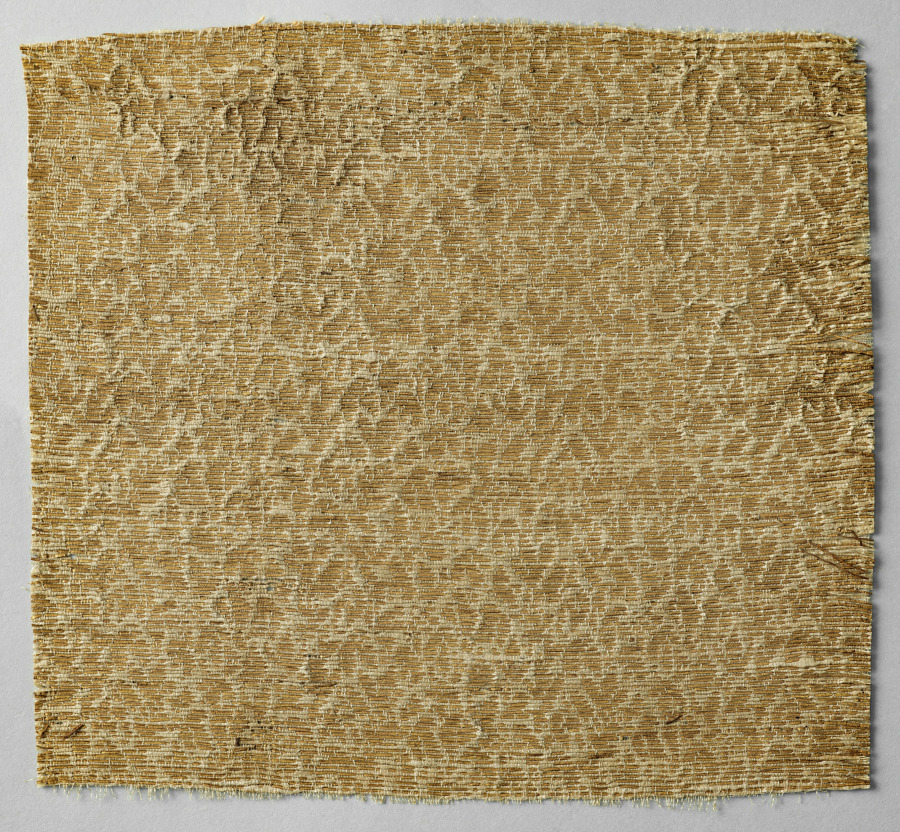
Artifact No. 7: The Leaf-Lattice Silk
Provenance and Materiality
— and not merely silk, but the distilled memory of a mulberry-fed discipline. This textile, a fragment of woven air and light, presents a field of infinitesimal leaves, each no larger than a fingernail’s crescent, repeated in a disciplined, almost obsessive, rhythm. The ground is a pale, undyed ecru, the leaves a deep, mineral verdigris, as if the pattern had been breathed onto the fabric rather than woven into it. The hand is impeccable: a dry, papery crispness that yields with a whisper, then recovers. This is not a printed illusion; it is a structural truth. The leaves are formed by the warp and weft themselves, a twill derivative that creates a subtle, three-dimensional relief. One does not merely see this textile; one reads it through the fingertips.
The materiality is the first and most profound argument. This is not the soft, drapey silk of a bias-cut evening gown. This is a silk of substance, a *taffeta* or a tightly woven *faille*, with a pronounced rib. It possesses a structural integrity that speaks of a different purpose—one of architecture, not of mere adornment. The density of the weave, the precision of the leaf motif, and the refusal of the fabric to compromise its shape all point to a rigorous technical lineage. This is silk as a building material, a textile engineered for permanence, not for fleeting fashion.
The Imperial Weaving Legacy
To understand this fragment, one must abandon the atelier and enter the imperial manufactory. This textile is a direct descendant of the great state silk-weaving centres of the late imperial era—the workshops of Suzhou, Hangzhou, and Nanjing, which operated under the direct patronage of the Qing court. These were not mere factories; they were academies of patience, where a single bolt of ceremonial silk could require months, even years, of labour. The weavers were not artisans in the Western sense; they were hereditary custodians of a sacred craft, their skills passed down through generations, their output dictated by sumptuary laws and ritual calendars.
The tiny leaf motif is the critical clue. In the lexicon of imperial symbolism, the leaf—particularly the bamboo leaf or the mulberry leaf—was not a decorative afterthought. It was a cipher for resilience, for renewal, and for the cyclical nature of imperial power. The bamboo bends but does not break; the mulberry feeds the silkworm that produces the very thread. To weave a field of such leaves was to weave a prayer for the dynasty’s longevity. The scale is deliberate. A large, ostentatious motif would have been considered vulgar, a display of merchant wealth. The tiny leaf, repeated hundreds of times, signals a confidence that does not need to shout. It is the quiet, absolute authority of the court, a power so assured that it can afford to whisper.
Technical Mastery and the Language of Restraint
Consider the technical challenge. To render a leaf of this size with clarity and precision in a woven structure, the designer and weaver had to work in perfect concert. The pattern repeat must be calculated to the fraction of a millimetre. The warp threads—often over 10,000 per bolt—must be tensioned with absolute uniformity. A single broken thread, a single misstep in the drawloom, and the entire pattern would be compromised. This is not a craft of happy accidents; it is a craft of premeditated perfection. The result is a textile that possesses a hypnotic, almost meditative quality. The eye moves across the surface, finding no beginning and no end, only the endless, reassuring repetition of the leaf.
This restraint is the defining characteristic of the imperial aesthetic. Unlike the flamboyant brocades of the later Qing period, which delighted in polychrome excess, this textile belongs to an earlier, more austere tradition. It is a study in monochrome, in texture, in the subtle interplay of light and shadow. The colour—that deep, verdant green—is not a synthetic dye but a natural pigment, likely derived from indigo and a yellow dye from the *huai* flower. The result is a colour that seems to breathe, that changes character in different lights, from a deep forest tone to a bright, almost translucent jade. This is a colour of authority, the colour of the emperor’s hunting robes, the colour of the jade seals that authenticated imperial decrees.
From Court to Cloth: A Modern Translation
For the contemporary house, this textile is not a museum specimen; it is a source code. The challenge is not to replicate it—that would be an exercise in archaeology—but to translate its principles into a modern idiom. The principle of restraint, of structural integrity, of pattern as a quiet, persistent presence—these are the enduring lessons. A modern Savile Row suit, cut from a cloth inspired by this leaf-lattice, would not be a costume. It would be a garment that carries the weight of a thousand years of discipline, but in a silhouette that is entirely of its time.
The tiny leaf, scaled up or down, could become a jacquard for a structured overcoat, or a subtle, tone-on-tone weave for a suit. The key is to preserve the *feeling*—the sense of quiet, unshakeable authority. The modern wearer does not need to know the history of the Qing court to feel the effect. They will simply know that this cloth is different. It has a gravity, a presence, a refusal to be ignored. It is a cloth that speaks of patience, of precision, and of a standard that has not been lowered. This is the legacy of imperial silk weaving: not a set of patterns, but a standard of being. And it is a standard we would do well to uphold.